
This new report from Stanford HAI in collaboration with Hoover Institution assesses America's ability to develop, attract, and retain STEM talent and warns that its advantages over China are narrowing rapidly.
Read paper
Our vision for the future is led by our commitment to studying, guiding, and developing human-centered AI technologies and applications. We believe AI should be collaborative, augmentative, and enhancing human productivity and quality of life.
We empower leaders in education, policy, and civil society with AI fundamentals to amplify their impact for humanity.
More on Education
Focusing on AI technologies across industries and their business implications, Stanford faculty offer courses for leaders and key decision-makers.
Explore our programs


Exploring the unique opportunities and challenges that AI presents in civil society, philanthropy, and nonprofits.
Apply for the Fall 2026 Social Sector Cohort
Policymakers and civil servants are at the front lines of decision-making on emerging technologies such as AI. Recognizing the valuable role they play in the AI governance ecosystem, Stanford HAI has developed specialized training programs to meet their needs.
See how HAI empowers policymakers

Christine Baker

Educating the next generation of AI leaders is core to what HAI is all about. Essential to this mission are leaders and decision makers within the K-12 ecosystem, teachers, and students.
Discover our immersive programs and AI literacy resources
Stanford’s seven leading schools on the same campus enable HAI to offer a multidisciplinary approach to education.
See courses, requirements, and concentration advisors

Through evidence-based research and global convenings, our policy work equips decision-makers with key insights into AI governance’s challenges and opportunities.
We have a historical opportunity and responsibility to establish a human-centered frameworkfor AI research, education, practice and policy.
AI technologies can have unintended side-effects on people beyond the direct user of these tools. As a result, Human-Centered AI requires designing simultaneously for the user, the community, and the broader society.
AI is rapidly growing, with new terms and concepts being introduced at a breakneck speed.
Discover more definitions in Stanford HAI's AI Glossary.
Human-Centered Artificial Intelligence is an approach to AI that prioritizes human needs, values, and well-being throughout the development and deployment of AI systems.
An Open-Source Model is an AI model whose weights, source code, training data—or a detailed, auditable account of that data...

HAI was established to support innovative AI research that bridges disciplines and fields. The Institute aims to appoint and support promising researchers through its fellowship programs who are working at intersections often overlooked by traditional academic departments, in addition to outstanding researchers pursuing core disciplinary topics.

The Stanford Institute for Human-Centered AI strives to foster a culture of interdisciplinary AI research in which technological advancements are inextricably linked to research about their potential societal impacts. HAI builds on the strength of Stanford research by offering many grant programs.

Affinity Groups provide a space for students to share ideas, develop intellectually and strengthen the community of future leaders dedicated to building AI that benefits all of humanity.

Stanford's first large-scale GPU computational instrument, designed to give faculty the infrastructure to train foundation models, run large-scale simulations, and pursue computational work at scales previously available only to industry.
Get the latest news, advances in research, policy work, and education program updates from HAI in your inbox weekly.
Sign Up For Latest News

Dashboards created by Stanford HAI’s Digital Economy Lab measure how AI adoption is altering employment trends and job growth, along with broader economic indicators.

Over three years, we’ve built progressively harder, more realistic benchmarks for medical AI. Here’s what we learned.

It's one of AI policy's hardest unsolved problems. Expert Deb Raji joins Stanford HAI to find answers that move beyond principles and into practice.
Analyzing thousands of human-AI conversations, a new study shows that people are turning to chatbots for increasingly critical tasks – and that productive outcomes depend on how the collaboration unfolds.

How managers introduce and support AI determines whether workers engage with or resist the technology.

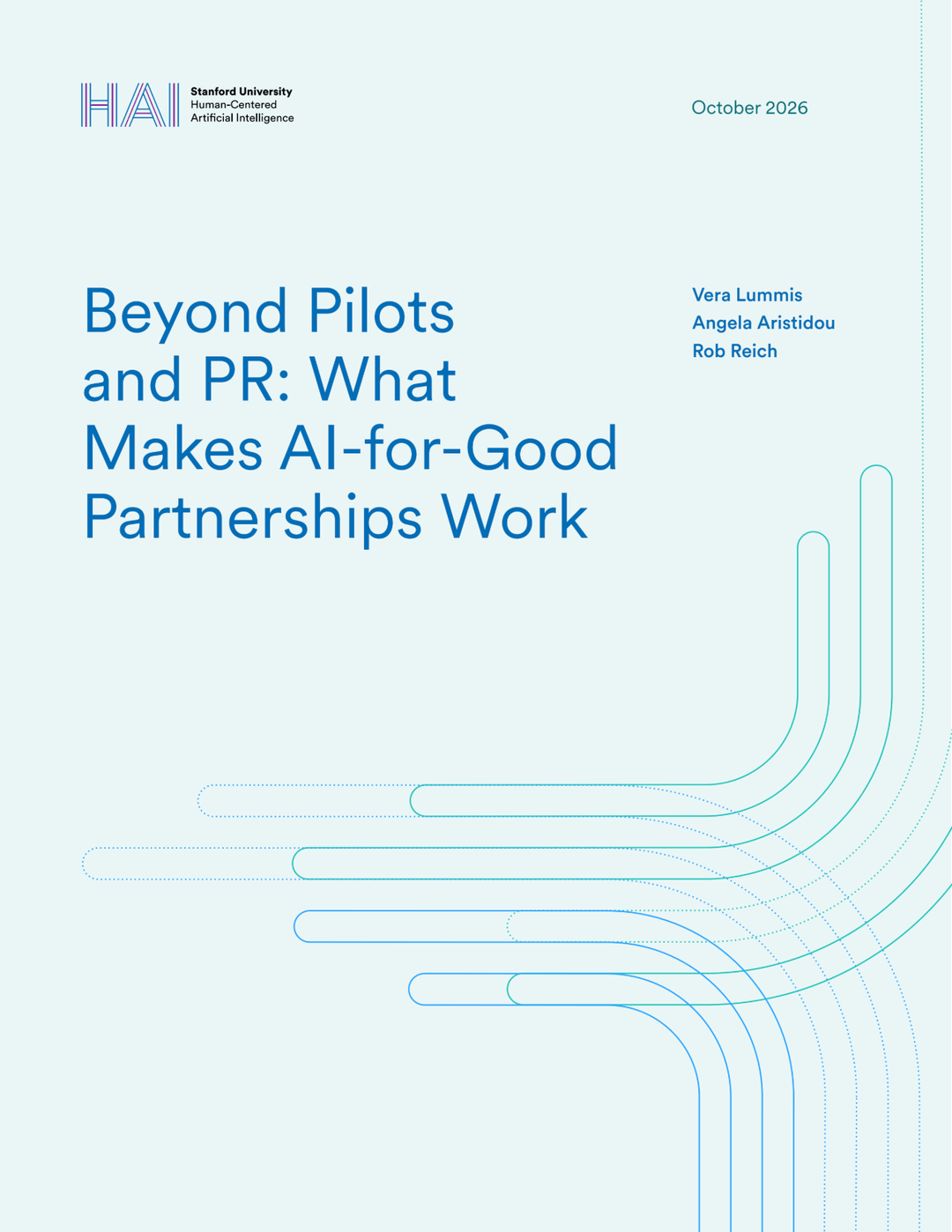
This paper examines how nonprofits and frontier AI labs partner to deploy AI for social good and offers recommendations for structuring these partnerships for greater impact.

Recognizing the valuable role they play in the AI governance ecosystem, Stanford HAI has developed specialized training programs to meet their needs.

AI has the potential to transform healthcare delivery yet there is an urgent need for governance processes to guide the safe, fair, and secure adoption of AI in clinical settings.

What does digital inclusion look like in the age of AI? Over 6,000 of the world’s 7,000-plus living languages remain digitally disadvantaged.

