Jacob Goldin and Daniel E. Ho: Modernizing Tax Administration: AI, Efficiency, and Equity
This HAI seminar with Stanford professors Jacob Goldin and Daniel E. Ho discusses a collaboration on using AI to reshape a core function of government: collecting revenue.
The annual tax gap — the difference between taxes owed and paid — is nearing $500B. According to the National Taxpayer Advocate, IRS information systems are “some of the oldest still in use in the federal government.” Over the past few decades, resources for random audits, which have historically formed the basis for IRS risk estimation approach, have shrunk from supporting 46,000 to only several thousand audits per year. Audit selection methods to estimate taxpayers’ risk of noncompliance have been critiqued as over-auditing the poor. Improperly calibrated models have led to false positive rates as high as 71% for some types of audits that delay refunds to taxpayers by over four months on average, causing severe financial hardship.
Through a unique partnership with the Treasury Department and the Internal Revenue Service (IRS), this HAI seminar will discuss the Stanford RegLab collaboration to modernize the system for tax collection using AI. First, the speakers discuss the design of an active learning system that enables the IRS to learn much more effectively from ongoing audits, and we will discuss new methods that maintain both unbiased population estimation (e.g., of the tax gap) and select audits based on risk of tax evasion. Next, they discuss the implications of algorithmic design on the audit distribution by income and discuss a framework for conducting an equity impact assessment mandated by Biden’s racial justice order (Executive Order 13,985).
Disclaimer: These opinions are those of the presenters and do not necessarily represent the view of the Internal Revenue Service, the Treasury Department, or any other government agency.
Related Events
Serena Wang: From Metric Selection to Metric Discovery in AI Evaluation
Carina Hong | AI That Can Prove It: From Mathematical Discovery to Verified Software
A eureka moment is a two-step process: discovering something new and surprising, and establishing that it is correct. Drawing on her work at Axiom, Carina will discuss the transition from solving mathematical benchmarks to contributing to research, and from proving individual theorems to formalizing mathematical theories in Lean.
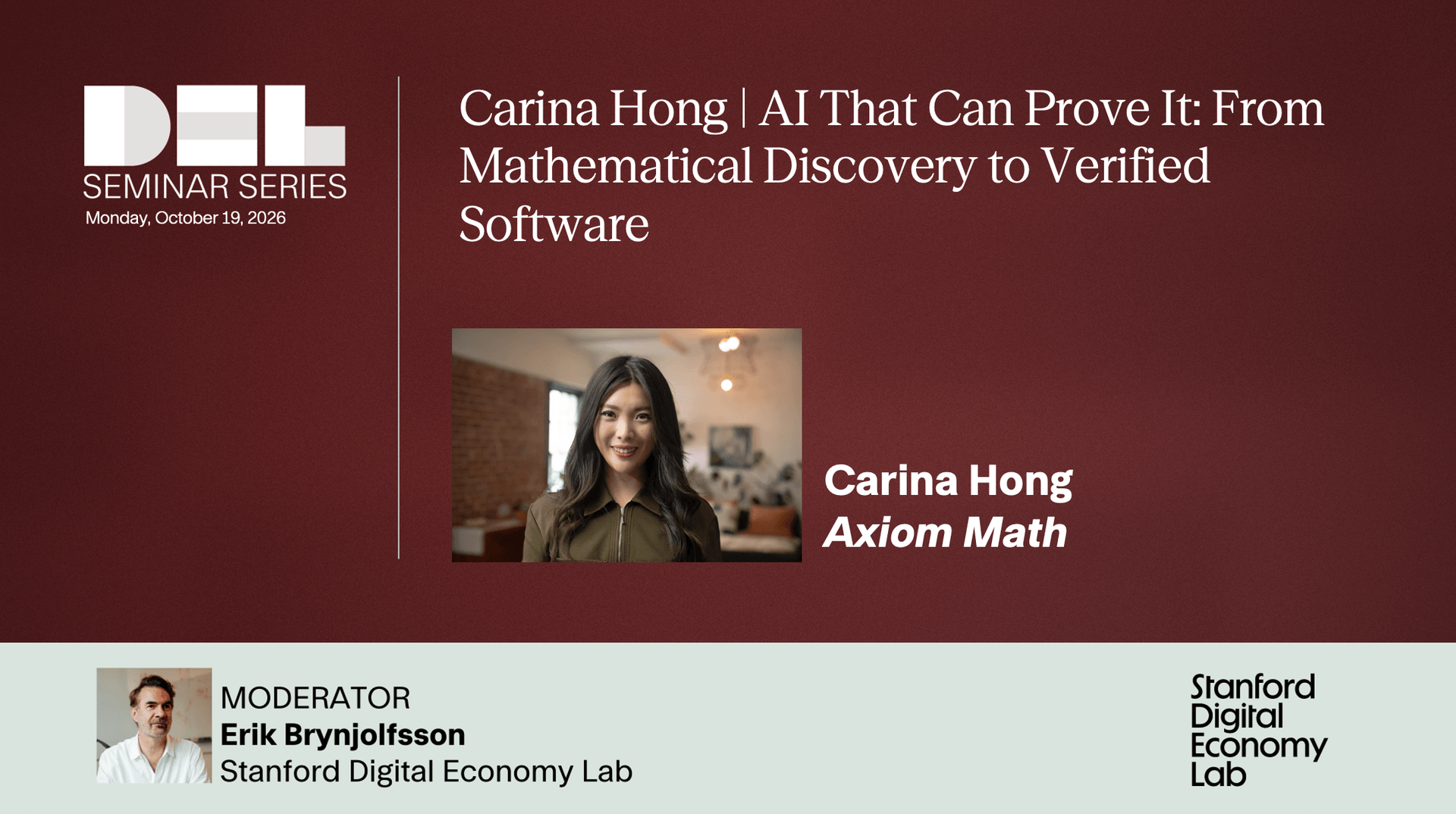
A eureka moment is a two-step process: discovering something new and surprising, and establishing that it is correct. Drawing on her work at Axiom, Carina will discuss the transition from solving mathematical benchmarks to contributing to research, and from proving individual theorems to formalizing mathematical theories in Lean.
Nicholas Branigan | Non-ergodicity and Simpson’s paradox in neural correlates
A Center for Neural Data Science Seminar Series

A Center for Neural Data Science Seminar Series