Stanford HAI’s Most-Watched Videos of the Year
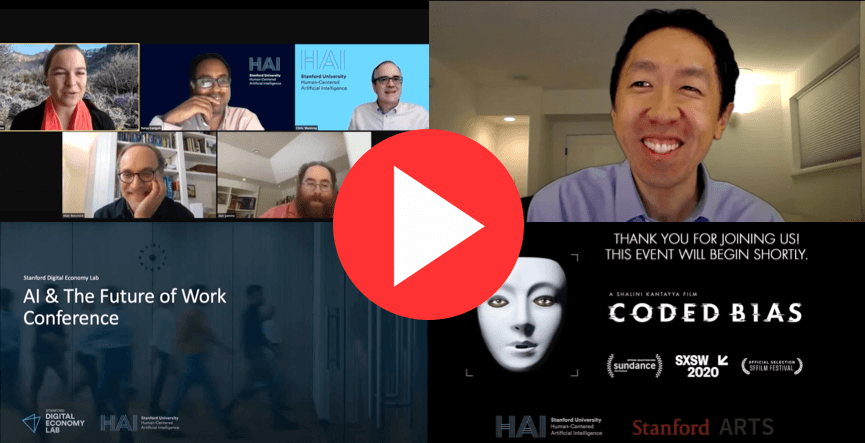
From future of work to facial recognition, here are the most popular videos of the year.
How do we bring AI advances out of the research lab and into real use? What can AI learn from human intelligence? As AI plays a larger role in the workplace, how are industry leaders rethinking their businesses? How do we protect ourselves from inaccurate and biased facial recognition technology? Watch this year’s most popular videos from Stanford HAI, or subscribe to our YouTube channel to watch all our seminars and special events.
Andrew Ng: Bridging AI’s Proof-of-Concept to Production Gap
AI has made headlines for amazing proofs of concept in the business world, from online advertising to medical diagnostic tools to speech recognition. But given all this research progress, why aren’t these systems widely deployed yet? Computer scientist Andrew Ng explores three of the top challenges of getting advances in artificial intelligence into the market.
Triangulating Intelligence: Melding Neuroscience, Psychology, and AI
The HAI fall conference brought leaders in cognitive science, neuroscience, vision, language, and other fields to discuss the latest research at the intersection of how humans learn, how machines learn, and how we can learn from each other. The conversation included everything from robotics to natural language to curiosity-driven play, cognitive science approaches to AI, and deep learning techniques applied for reinforcement learning. (You can also read our fast takeaways from the event.)
Stanford Digital Economy Lab: AI & The Future of Work
The Stanford Digital Economy Lab’s launch event brought together scholars, industry leaders, and policy experts to examine the profound impact AI and digital technologies have had on work and policy. Speakers including SDEL director Erik Brynjolfsson, Greylock Ventures partner Reid Hoffman, Hoover Institution’s Condoleezza Rice, and SEIU’s Mary Kay Henry discussed the transformation of work, policy challenges (and solutions), and robotics frontiers.
Coded Bias: A Conversation with Director Shalini Kantayya
The documentary Coded Bias follows MIT’s Joy Buolamwini and other computer scientists and activists as they discover facial recognition technology’s racial bias and push for legislation to protect people from its misuse. Director Shalini Kantayya joined HAI co-director Fei-Fei Li and HAI associate director Michele Elam to discuss the film’s core lessons and the possible future of facial recognition technology. Also, be sure to read our interview with Kantayya here.
Stanford HAI's mission is to advance AI research, education, policy and practice to improve the human condition. Learn more.
Related News

Dashboards created by Stanford HAI’s Digital Economy Lab measure how AI adoption is altering employment trends and job growth, along with broader economic indicators.

Dashboards created by Stanford HAI’s Digital Economy Lab measure how AI adoption is altering employment trends and job growth, along with broader economic indicators.

Over three years, we’ve built progressively harder, more realistic benchmarks for medical AI. Here’s what we learned.

Over three years, we’ve built progressively harder, more realistic benchmarks for medical AI. Here’s what we learned.

It's one of AI policy's hardest unsolved problems. Expert Deb Raji joins Stanford HAI to find answers that move beyond principles and into practice.

It's one of AI policy's hardest unsolved problems. Expert Deb Raji joins Stanford HAI to find answers that move beyond principles and into practice.