eventWorkshop
Beyond Moderation: How Can We Use Technology to De-Escalate Political Conflict?
Experts from diverse fields convene to discuss what digital technologies can do to enhance civic debate and de-escalate political conflict.
Get the latest news, advances in research, policy work, and education program updates from HAI in your inbox weekly.
Sign Up For Latest News
Experts from diverse fields convene to discuss what digital technologies can do to enhance civic debate and de-escalate political conflict.
Scientific progress is a key driver of economic growth and prosperity. There is great excitement- but also concerns- about the impacts of AI on science, but so far little data. We provide early insights on this from three data sources: a sample of 15 million Gemini interactions, an inventory of over 2,600 specialized AI models across disciplines, and a survey of over 600 scientists.
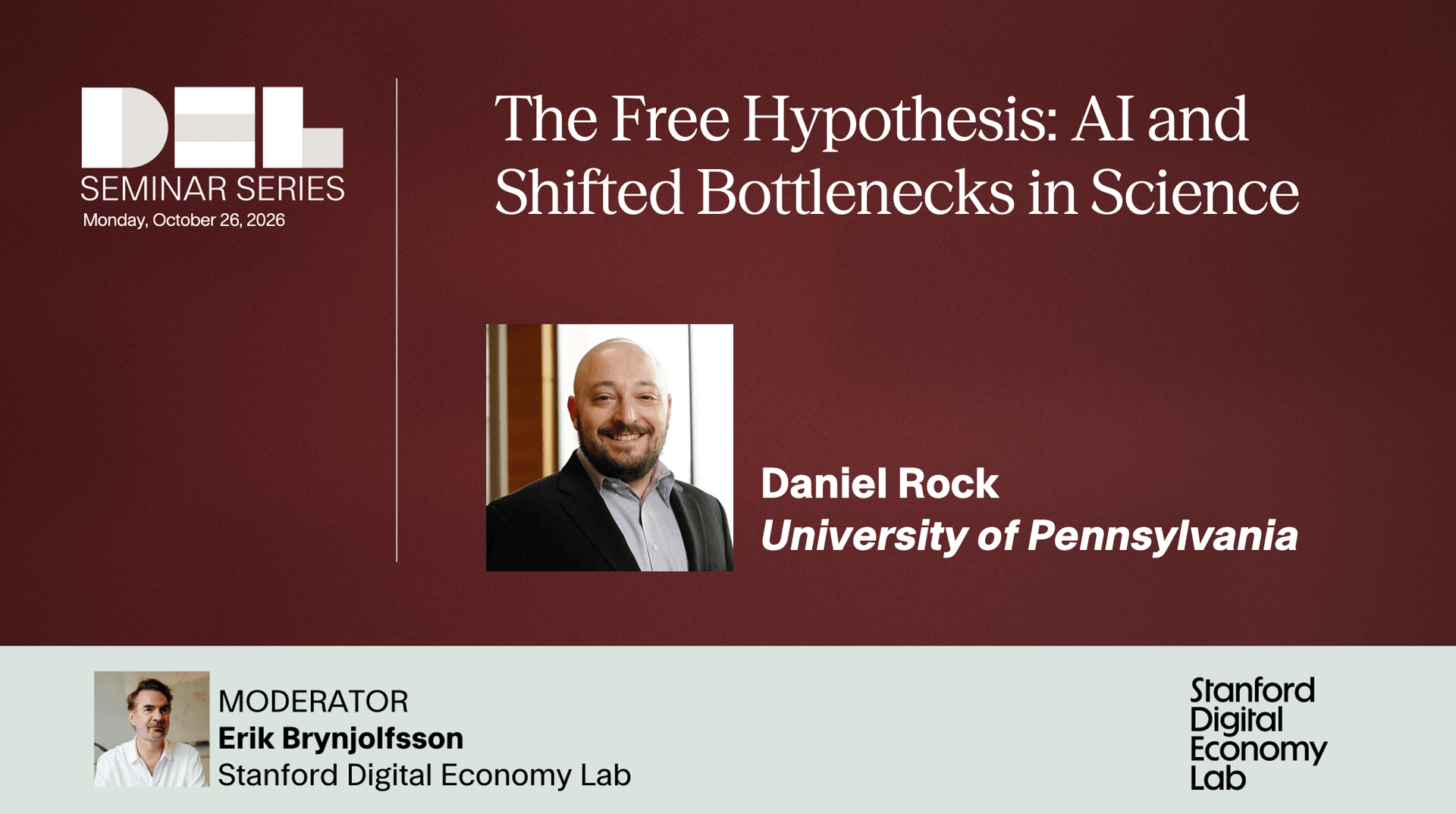
Scientific progress is a key driver of economic growth and prosperity. There is great excitement- but also concerns- about the impacts of AI on science, but so far little data. We provide early insights on this from three data sources: a sample of 15 million Gemini interactions, an inventory of over 2,600 specialized AI models across disciplines, and a survey of over 600 scientists.
The rapid acceleration of AI comes with a profound wave of anxiety. Across every sector of society, people are facing unsettling questions about their worth and their place in a shifting world.
The rapid acceleration of AI comes with a profound wave of anxiety. Across every sector of society, people are facing unsettling questions about their worth and their place in a shifting world.
Sessions run Wednesdays from 4:30–5:30 PM in CoDa E160. Each session features a different Stanford speaker; talk titles are announced by the organizers.
Sessions run Wednesdays from 4:30–5:30 PM in CoDa E160. Each session features a different Stanford speaker; talk titles are announced by the organizers.
Beyond Moderation is a one-day conference hosted by the Ethics Society and Technology Initiatives of the McCoy Family Center for Ethics in Society at Stanford University. It aims to convene a group of experts from diverse fields to discuss the possibilities afforded by digital technologies to enhance civic debate and de-escalate political conflict.
As experiences around the world suggest, social media platforms have created a milieu where the propagation of hate speech and misinformation can lead to the escalation of political and ethnic conflicts. Social media companies have sought to address this issue through automated and semi-automated content moderation, but the net benefits of these measures remain under empirical examination. Beyond Moderation thus intends to explore and analyze alternative technological strategies for addressing the rise of political conflict online.
Confirmed Speakers:
Colin Megill (Co-founder, Pol.is)
Marietje Schaake (International Policy Director, Stanford Cyber Policy Center; International Policy Fellow, Institute for Human-Centered Artificial Intelligence, Stanford)
Michael Bernstein (Associate Professor of Computer Science, Stanford University)
Susan Benesch (Faculty Associate, Berkman Klein Center for Internet and Society, Harvard University; Founder and Executive Director, Dangerous Speech Project)
Amy X. Zhang (Assistant Professor, Allen School of Computer Science & Engineering, University of Washington)
Renée DiResta (Research Manager, Stanford Internet Observatory)
Niousha Roshani (CEO, The Black Entrepeneurs Club; Consultant in Private Tech Sector Engagement with Global Civil Society, Internews)
Oladeji Tiamiyu (Assistant Professor of Law, University of Denver)
Jonathan Stray (Senior Scientist, Center for Human-Compatible AI, University of California, Berkeley)
Thunghong Lin (Research Fellow, Institute of Sociology, Academia Sinica; Fellow, Center for Advanced Study in the Behavioral Sciences, Stanford University)
Deepti Doshi (Co-director, New_Public)
Ravi Iyer (Managing Director, Neely Center for Ethical Leadership and Decision Making, University of Southern California)
This event will take place in the Mackenzie Room (Huang 300), located on the third floor of the Huang Engineering Center, at Stanford University on November 10th, 2023. Breakfast and lunch will be provided and there will be a reception for conference participants at the end of the day.
8:30-9:15 am: Check-in/Breakfast
9:15-9:30 am: Welcome & Introduction
Diana Acosta-Navas (Loyola Chicago/Stanford) and Ting-an Lin (Stanford)
9:30-10:15 am: Keynote Address
Speaker: Colin Megill (pol.is)
10:15-10:30 am: Break
10:30-12:00 pm : Panel 1. Ethical and Societal Perspectives
Panelists: Renée DiResta (Stanford), Thunghong Lin (Stanford; Academia Sinica), and Jonathan Stray (Berkeley). Moderator: Johanna Rodehau-Noack (Stanford)
12:00-1:15 pm: Lunch
1:15-2:45 pm: Panel 2. Technological Opportunities
Panelists: Susan Benesch (Harvard), Amy X. Zhang (UW), Michael Bernstein (Stanford), and Deepti Doshi (New_Public). Moderator: Veronica Rivera (Stanford)
2:45-3:00 pm: Break
3:00-4:30 pm: Panel 3. Political and Global Impact
Panelists: Marietje Schaake (Stanford), Oladeji Tiamiyu (Denver), Niousha Roshani (The Black Entrepreneurs Club), and Ravi Iyer (USC). Moderator: Avshalom Schwartz (Stanford)
4:30-4:45 pm: Closing remarks
Leif Wenar (Stanford)
4:45-5:30 pm: Reception
Parking permits are required to park on Stanford's campus. The Roble Field Garage located at 519 Via Ortega Drive, Stanford, CA 94305 is the recommended guest parking location closest to the venue. See this link for information about Visitor parking if you do not have an 'A' or 'C' parking permit.
For shuttle: See this link for more information about Marguerite, a shuttle free and open to the public – no ID required.