Get the latest news, advances in research, policy work, and education program updates from HAI in your inbox weekly.
Sign Up For Latest News
This seminar pairs a case study of AI diffusion with an organizational approach to technological changes in the workplace.

This seminar pairs a case study of AI diffusion with an organizational approach to technological changes in the workplace.
As AI moves beyond language into systems that can perceive, understand, and act in the physical world, a new frontier is emerging: world models—AI systems that build and maintain working representations of real environments to predict how they change in response to action.

As AI moves beyond language into systems that can perceive, understand, and act in the physical world, a new frontier is emerging: world models—AI systems that build and maintain working representations of real environments to predict how they change in response to action.
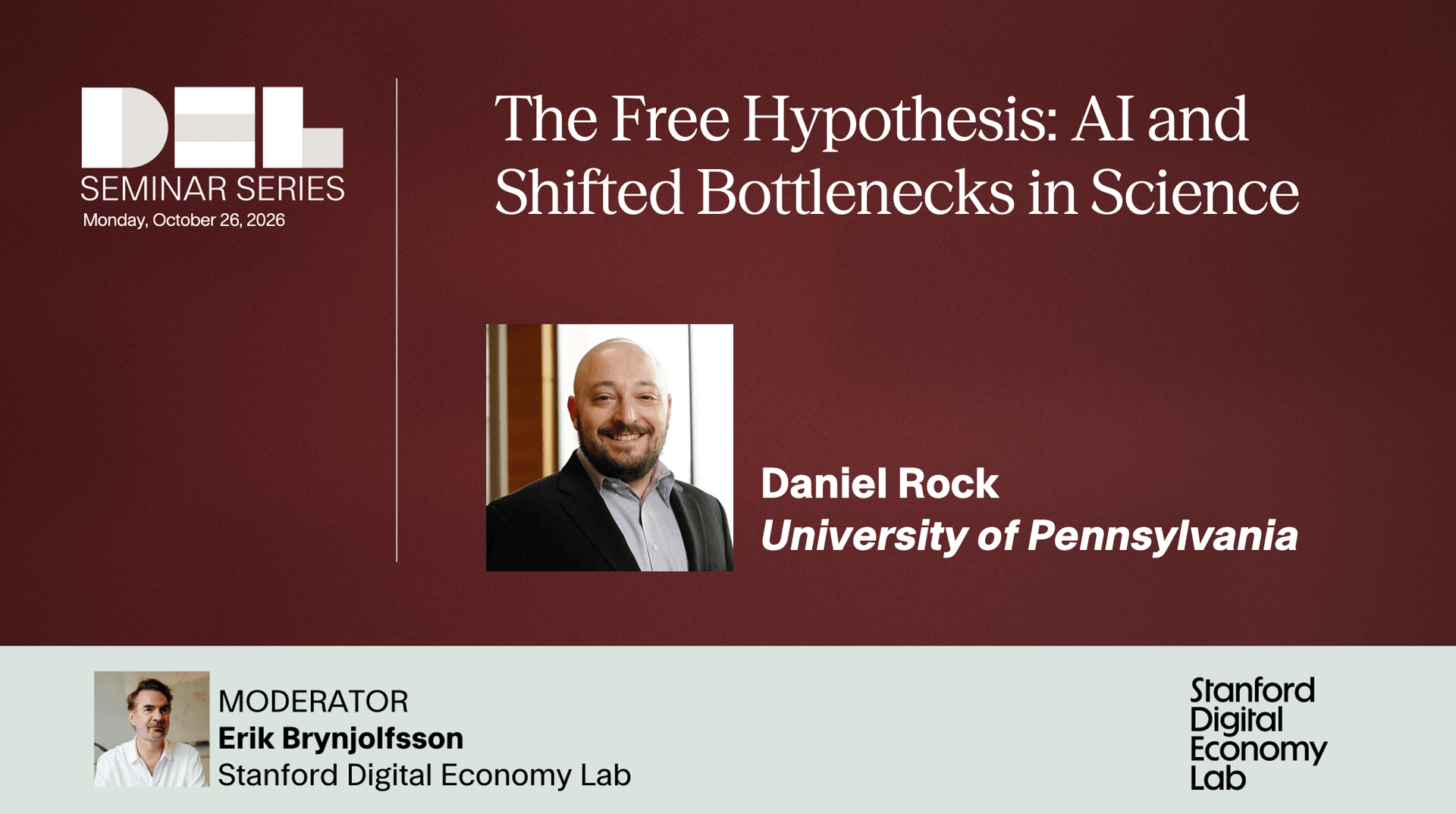
Save the Date. Artificial intelligence is transforming how researchers collect, analyze, and learn from data. As AI systems become increasingly integrated into scientific discovery, business decision-making, and policy analysis, they are reshaping both the questions researchers can ask and the methods they use to answer them.

Save the Date. Artificial intelligence is transforming how researchers collect, analyze, and learn from data. As AI systems become increasingly integrated into scientific discovery, business decision-making, and policy analysis, they are reshaping both the questions researchers can ask and the methods they use to answer them.
Join the Stanford Institute for Human-Centered Artificial Intelligence (HAI) and Stanford Arts on September 30 at 4pm PDT for a panel discussion of Coded Bias, a documentary film focusing on the ground-breaking research by MIT’s Joy Buolamwini into facial recognition technology’s troubling racial bias.
The panel discussion will include Coded Bias director Shalini Kantayya and HAI co-director and computer vision expert Fei-Fei Li, moderated by HAI associate director and Stanford professor of English Michele Elam.