Get the latest news, advances in research, policy work, and education program updates from HAI in your inbox weekly.
Sign Up For Latest News
The Bay Area Tech Economics Seminar is for graduate-trained economists and other quantitative social scientists from academia, policy, or the private sector who are interested in the tech economy and methods for analyzing it, and in making connections with others in this broadly defined space.
Sessions run Wednesdays from 4:30–5:30 PM in CoDa E160. Each session features a different Stanford speaker; talk titles are announced by the organizers.

Sessions run Wednesdays from 4:30–5:30 PM in CoDa E160. Each session features a different Stanford speaker; talk titles are announced by the organizers.
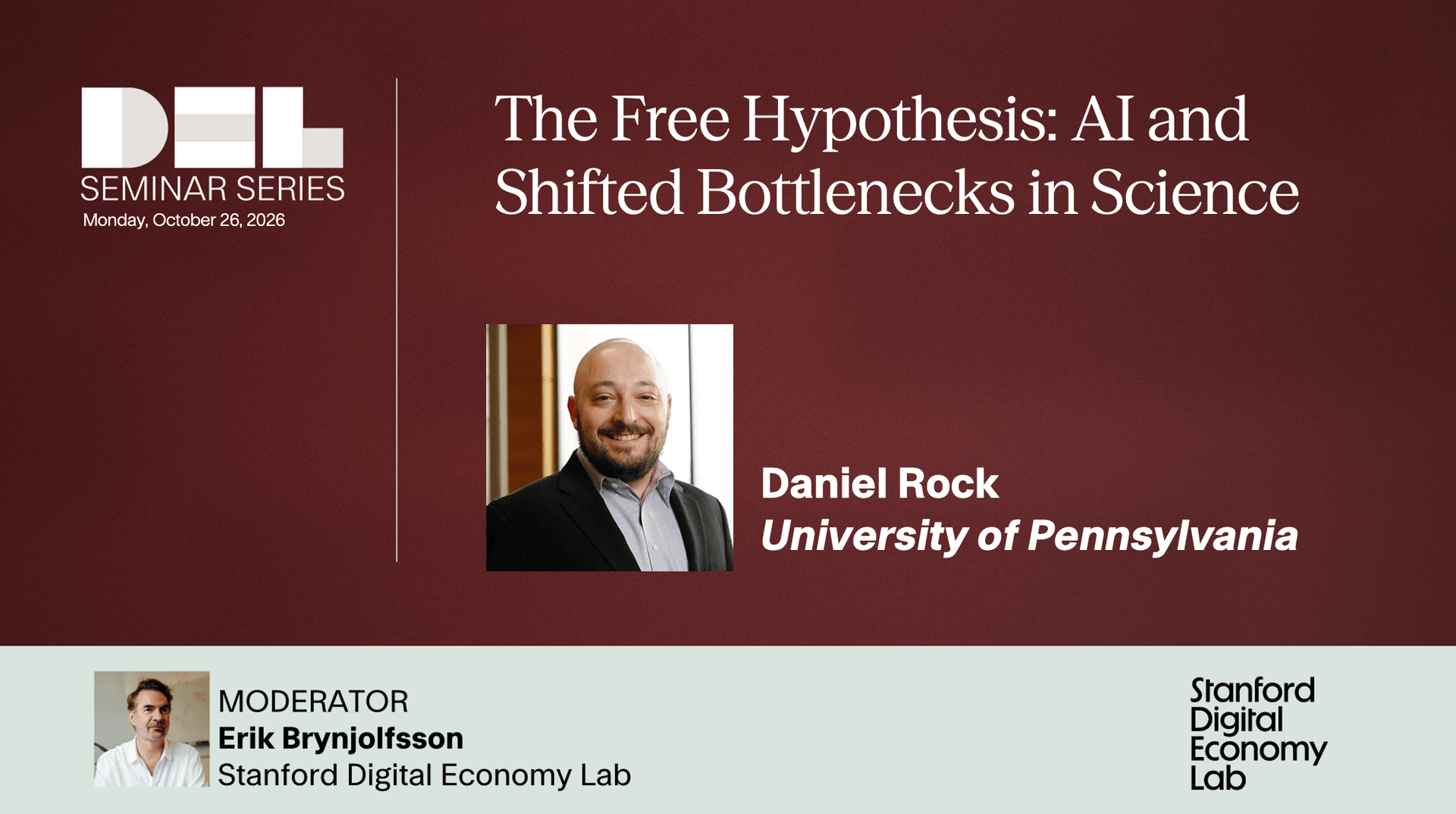
Scientific progress is a key driver of economic growth and prosperity. There is great excitement- but also concerns- about the impacts of AI on science, but so far little data. We provide early insights on this from three data sources: a sample of 15 million Gemini interactions, an inventory of over 2,600 specialized AI models across disciplines, and a survey of over 600 scientists.

Scientific progress is a key driver of economic growth and prosperity. There is great excitement- but also concerns- about the impacts of AI on science, but so far little data. We provide early insights on this from three data sources: a sample of 15 million Gemini interactions, an inventory of over 2,600 specialized AI models across disciplines, and a survey of over 600 scientists.
Innovative leaders understand that a company’s success depends on building strong relationships with a diverse array of stakeholders. Many companies now rely on ESG frameworks to impact stakeholders and communities in positive ways, and synthesize profit and purpose. Yet, often companies struggle to identify, integrate, communicate, and achieve their social impact goals.
In this webinar, Stanford professor Chuck Eesley and Bloomberg Beta partner James Cham explore opportunities to gain competitive advantage by have a positive impact on the world – especially when harnessing powerful new technologies such as AI.
This webinar provides a taste for the three-day live virtual Executive Education program offered by the Stanford Institute for Human-Centered AI (HAI) and Stanford Engineering’s Entrepreneurship Center (STVP): Leading Social Impact Strategy: Harnessing the Power of Purpose and AI. Explore the program today.
This webinar is presented by the Stanford Institute for Human-Centered AI (HAI) and the Stanford Technology Ventures Program (STVP).
Partner, Bloomberg Beta
Associate Professor and W.M. Keck Foundation Faculty Scholar in the Department of Management Science and Engineering