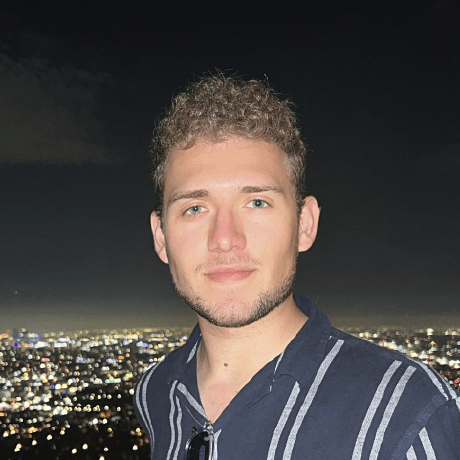
Steven Dillmann is a PhD candidate in Computational Mathematics at Stanford University, advised by Sanmi Koyejo (Computer Science) and Risa Wechsler (Physics), and working closely with Ludwig Schmidt (Computer Science). His research is focused on accelerating scientific discovery across several disciplines via the use-inspired development and rigorous evaluation of agentic research assistants, scientific foundation models, and probabilistic inference methods. He leads Terminal-Bench-Science, a community effort to build the standard for evaluating AI agents on real research workflows, developed in collaboration with domain experts at research institutions worldwide. He has also worked on the safety and ethical evaluation of the genomic foundation model Evo 2, simulation-based inference for strong gravitational lensing, and a unified probabilistic framework for multi-wavelength astronomical imaging.
Steven previously studied Aerospace Engineering at Imperial College London and Data Intensive Science at the University of Cambridge, with research placements at the European Space Agency, NASA JPL, and the Harvard-Smithsonian Center for Astrophysics, where he developed machine learning methods for astronomy and planetary science, including one that led to the discovery of XRT 200515, the first extragalactic fast X-ray transient of its kind found in the Chandra archive.
Outside of research, he plays football (soccer), tennis, poker, and chess, and has a longstanding interest in filmmaking and cinema.