Stanford
University
  • Stanford Home
  • Maps & Directions
  • Search Stanford
  • Emergency Info
  • Terms of Use
  • Privacy
  • Copyright
  • Trademarks
  • Non-Discrimination
  • Accessibility
© Stanford University.  Stanford, California 94305.
What is a Markov Chain? | Stanford HAI
Skip to content
  • About

    • About
    • People
    • Get Involved with HAI
    • Support HAI
    • Subscribe to Email
  • Research

    • Research
    • Fellowship Programs
    • Grants
    • Student Affinity Groups
    • Centers & Labs
    • Research Publications
    • Research Partners
  • Education

    • Education
    • Executive and Professional Education
    • Government and Policymakers
    • K-12
    • Stanford Students
  • Policy

    • Policy
    • Policy Publications
    • Policymaker Education
    • Student Opportunities
  • AI Index

    • AI Index
    • AI Index Report
    • Global Vibrancy Tool
    • People
  • News
  • Events
  • Industry
  • Centers & Labs

What is a Markov Chain?

A Markov Chain is a mathematical model that describes a sequence of events where the probability of each future event depends only on the current state, not on the history of how you got there. This "memoryless" property means that to predict what happens next, you only need to know where you are now, not the entire path you took. Common examples include predicting weather patterns (today's weather influences tomorrow's, but not last week's), autocomplete suggestions, board game movements, and modeling customer behavior in marketing.

Navigate
  • About
  • Events
  • Careers
  • Search
Participate
  • Get Involved
  • Support HAI
  • Contact Us

Stay Up To Date

Get the latest news, advances in research, policy work, and education program updates from HAI in your inbox weekly.

Sign Up For Latest News


Markov Chain mentioned at Stanford HAI

Explore Similar Terms:

Algorithm | Predictive Analytics | Bayesian Networks

See Full List of Terms & Definitions

The Evolution of Safety: Stanford’s Mykel Kochenderfer Explores Responsible AI in High-Stakes Environments
Scott Hadly
May 09
news

As AI technologies rapidly evolve, Professor Kochenderfer leads the charge in developing effective validation mechanisms to ensure safety in autonomous systems like vehicles and drones.
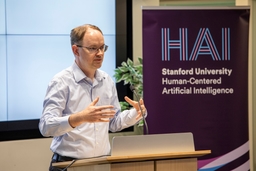
The Evolution of Safety: Stanford’s Mykel Kochenderfer Explores Responsible AI in High-Stakes Environments

Scott Hadly
May 09

As AI technologies rapidly evolve, Professor Kochenderfer leads the charge in developing effective validation mechanisms to ensure safety in autonomous systems like vehicles and drones.

Privacy, Safety, Security
news

Enroll in a Human-Centered AI Course

This AI program covers technical fundamentals, business implications, and societal considerations.