Stanford
University
  • Stanford Home
  • Maps & Directions
  • Search Stanford
  • Emergency Info
  • Terms of Use
  • Privacy
  • Copyright
  • Trademarks
  • Non-Discrimination
  • Accessibility
© Stanford University.  Stanford, California 94305.
AI for Good Seminar Series: AI for Earth and the Environment | Stanford HAI
Skip to content
  • About

    • About
    • People
    • Get Involved with HAI
    • Support HAI
    • Subscribe to Email
  • Research

    • Research
    • Fellowship Programs
    • Grants
    • Student Affinity Groups
    • Centers & Labs
    • Research Publications
    • Research Partners
  • Education

    • Education
    • Executive and Professional Education
    • Government and Policymakers
    • K-12
    • Stanford Students
  • Policy

    • Policy
    • Policy Publications
    • Policymaker Education
    • Student Opportunities
  • AI Index

    • AI Index
    • AI Index Report
    • Global Vibrancy Tool
    • People
  • News
  • Events
  • Industry
  • Centers & Labs
Navigate
  • About
  • Events
  • Careers
  • Search
Participate
  • Get Involved
  • Support HAI
  • Contact Us

Stay Up To Date

Get the latest news, advances in research, policy work, and education program updates from HAI in your inbox weekly.

Sign Up For Latest News

Your browser does not support the video tag.
event

AI for Good Seminar Series: AI for Earth and the Environment

Status
Past
Date
Monday, January 27, 2020 4:30 PM - 5:30 PM PST/PDT
Topics
Energy, Environment

How can AI and machine learning be leveraged to mitigate the impact of human activities on earth’s natural systems?  Learn about data science tools and strategies being used to safeguard our water supply, feed the worldwide human population, and promote greater biodiversity and global sustainability.

Share
Link copied to clipboard!
Event Contact
celia.clark@stanford.edu

Related Events

Dan Iancu & Antonio Skillicorn | Interpretable Machine Learning and Mixed Datasets for Predicting Child Labor in Ghana’s Cocoa Sector
SeminarMar 18, 202612:00 PM - 1:15 PM
March
18
2026

Child labor remains prevalent in Ghana’s cocoa sector and is associated with adverse educational and health outcomes for children.

Seminar

Dan Iancu & Antonio Skillicorn | Interpretable Machine Learning and Mixed Datasets for Predicting Child Labor in Ghana’s Cocoa Sector

Mar 18, 202612:00 PM - 1:15 PM

Child labor remains prevalent in Ghana’s cocoa sector and is associated with adverse educational and health outcomes for children.

Caroline Meinhardt, Thomas Mullaney, Juan N. Pava, and Diyi Yang | How Can AI Support Language Digitization and Digital Inclusion?
SeminarApr 15, 202612:00 PM - 1:15 PM
April
15
2026

What does digital inclusion look like in the age of AI? Over 6,000 of the world’s 7,000-plus living languages remain digitally disadvantaged.

Seminar

Caroline Meinhardt, Thomas Mullaney, Juan N. Pava, and Diyi Yang | How Can AI Support Language Digitization and Digital Inclusion?

Apr 15, 202612:00 PM - 1:15 PM

What does digital inclusion look like in the age of AI? Over 6,000 of the world’s 7,000-plus living languages remain digitally disadvantaged.

Lucas Joppa, Chief Environmental Officer, Microsoft

As Microsoft’s first Chief Environmental Officer, Dr. Lucas Joppa works to advance the company’s core commitment to sustainability through technology innovation, program development, policy advancement, and global operational excellence. With a background in both environmental science and data science, Lucas is committed to using the power of advanced technology to help transform how society monitors, models, and ultimately manages Earth’s natural resources. Dr. Joppa founded Microsoft’s AI for Earth program in 2017—a five-year, $50 million cross-company effort dedicated to delivering technology-enabled solutions to global environmental challenges. Previously, Lucas was Microsoft’s Chief Environmental Scientist and led research programs in Microsoft Research. He remains an active scientist and one of Microsoft’s foremost AI thought leaders, speaking frequently on issues related to Artificial Intelligence, environmental science, and sustainability. With the extensive publication in leading academic journals, such as Science and Nature, Dr. Joppa is a uniquely accredited voice for sustainability in the tech industry. He holds a PhD in Ecology from Duke University, a BS in Wildlife Ecology from the University of Wisconsin, and is a former Peace Corps volunteer to Malawi.


Stefano Ermon, Assistant Professor of Computer Science, Stanford University

Dr. Ermon is an Assistant Professor in the Department of Computer Science at Stanford University, where he is affiliated with the Artificial Intelligence Laboratory and is a fellow of the Woods Institute for the Environment. His research is centered on techniques for scalable and accurate inference in graphical models, statistical modeling of data, large-scale combinatorial optimization, and robust decision making under uncertainty, and is motivated by a range of applications, in particular ones in the emerging field of computational sustainability. Dr. Ermon received his PhD from Cornell University.

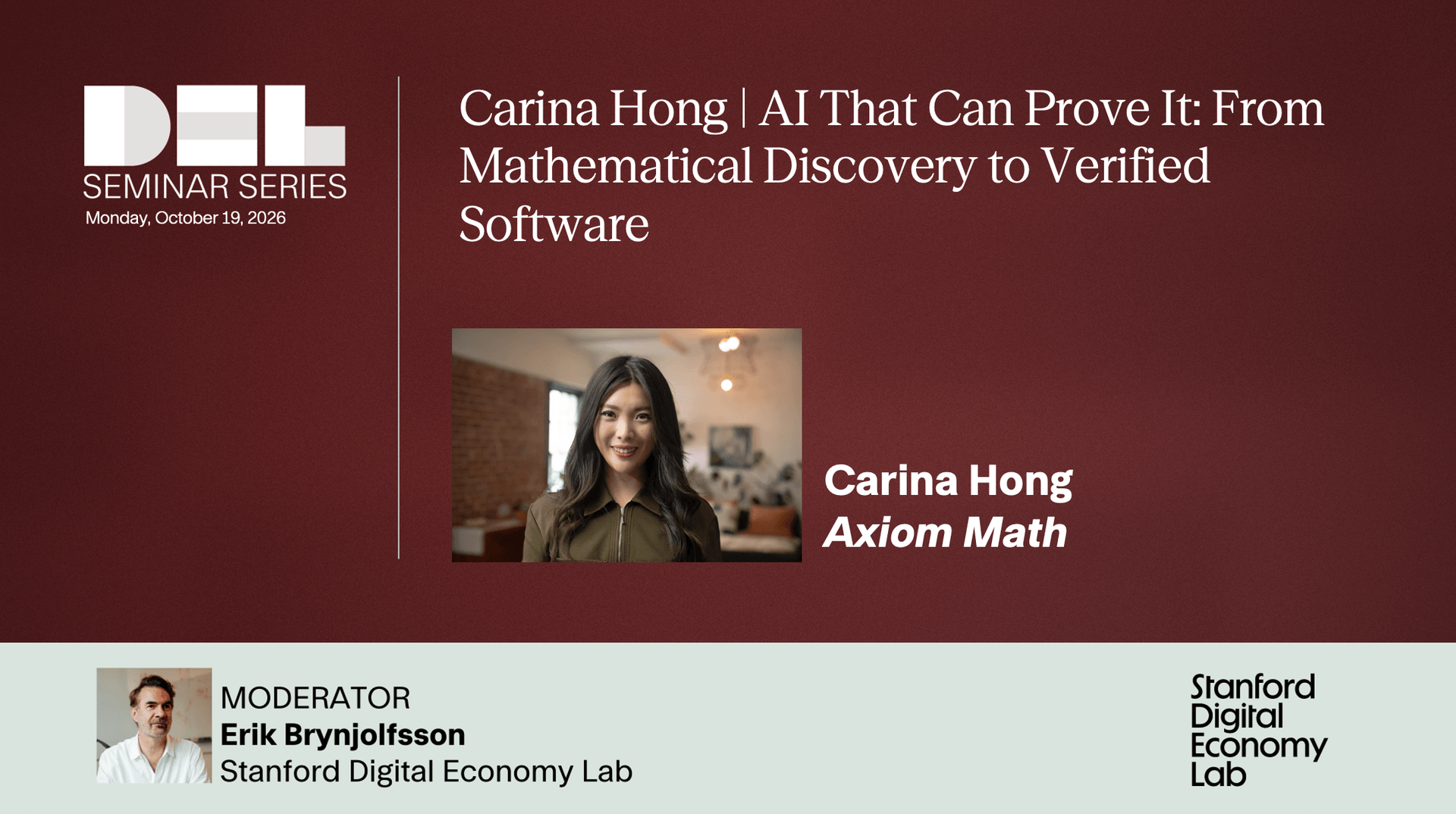
Lucas Joppa
Stefano Ermon
Assistance Professor of Computer Science and Center Fellow, By Courtesy, At the Woods Institute for the Environment