As a part of Stanford's Democracy Day 2024 series of events, Stanford Data Science is proud to host this discussion at the intersection of data science and politics.
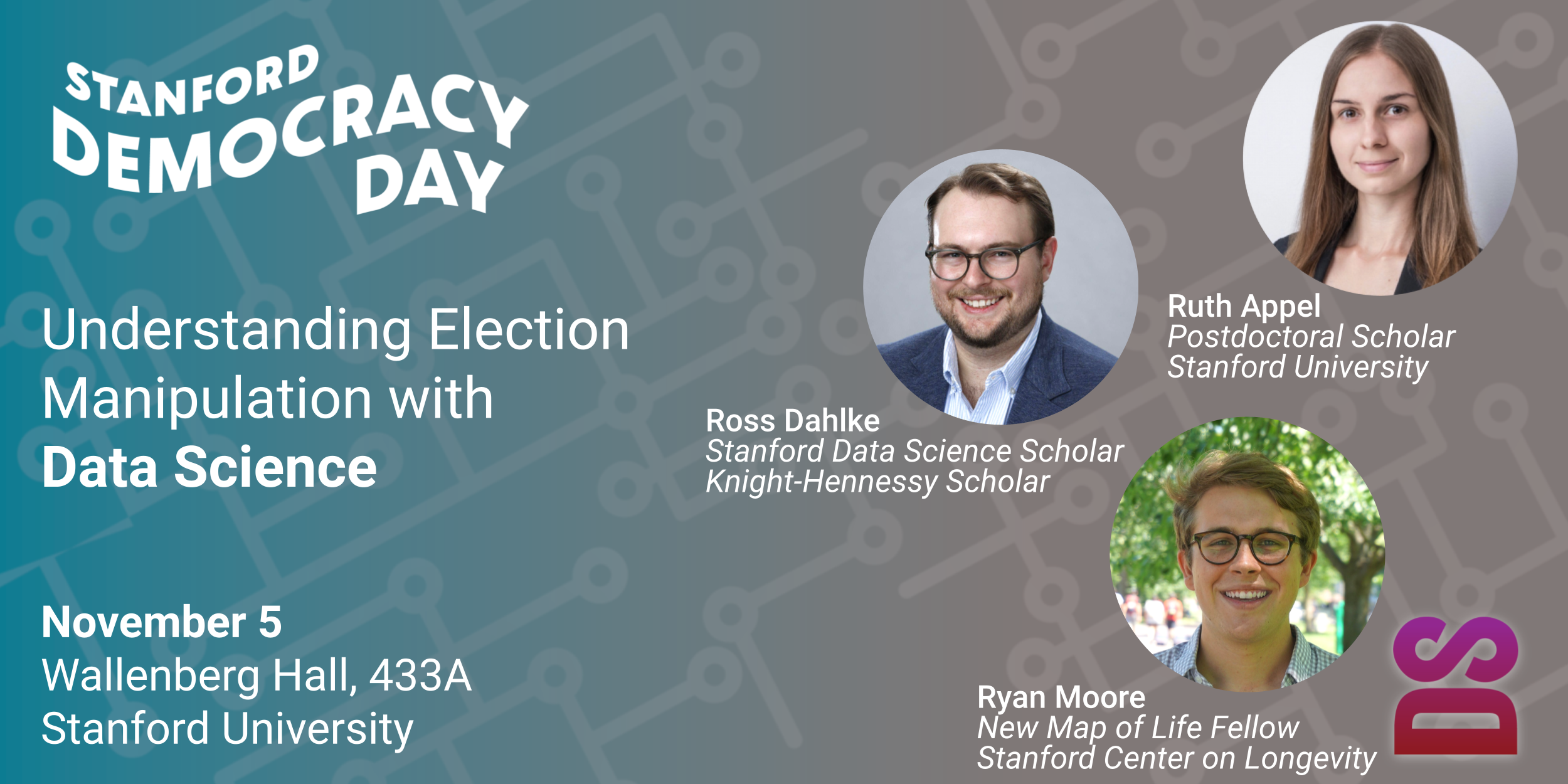
Understanding Election Manipulation with Data Science
This discussion will explore how data science can be used to understand the role of deceptive influence campaigns on social media and misinformation in democracy. We will explore the challenges faced by social media companies in addressing deceptive influence campaigns, how misinformation spreads on the internet, and distinguishing features between misinformation and other types of content, such as high-quality news. Find out more at this discussion, which will offer valuable insights into the multifaceted challenges and opportunities surrounding deceptive influence campaigns on social media and misinformation, their impact on society, and how data science can be used to bolster democracy.
The discussion will be followed by a light lunch.
Speakers:
Ruth Appel, Postdoctoral Scholar at Stanford University, PhD in Political Communication & M.S. in Computer Science (Stanford University).
Ross Dahlke, Stanford Data Science Scholar, Knight-Hennessy Scholar, PhD Candidate in Communication, School of Humanities and Sciences. Ross will be an Assistant Professor at the University of Wisconsin-Madison School of Journalism and Mass Communication in January 2025.
Ryan Moore, PhD Candidate, Department of Communication, Stanford University, and a New Map of Life Fellow at the Stanford Center on Longevity. Next fall, he will be an Assistant Professor in the School of Information at the University of Texas at Austin.