event
Does AI Pose an Existential Threat to Humanity?
DLI's inaugural debate was inspired by thinking through the provocations posed by the impact of ‘intelligent’ technologies on the future of human life.
Get the latest news, advances in research, policy work, and education program updates from HAI in your inbox weekly.
Sign Up For Latest News
DLI's inaugural debate was inspired by thinking through the provocations posed by the impact of ‘intelligent’ technologies on the future of human life.
The rapid acceleration of AI comes with a profound wave of anxiety. Across every sector of society, people are facing unsettling questions about their worth and their place in a shifting world.
The rapid acceleration of AI comes with a profound wave of anxiety. Across every sector of society, people are facing unsettling questions about their worth and their place in a shifting world.
Scientific progress is a key driver of economic growth and prosperity. There is great excitement- but also concerns- about the impacts of AI on science, but so far little data. We provide early insights on this from three data sources: a sample of 15 million Gemini interactions, an inventory of over 2,600 specialized AI models across disciplines, and a survey of over 600 scientists.
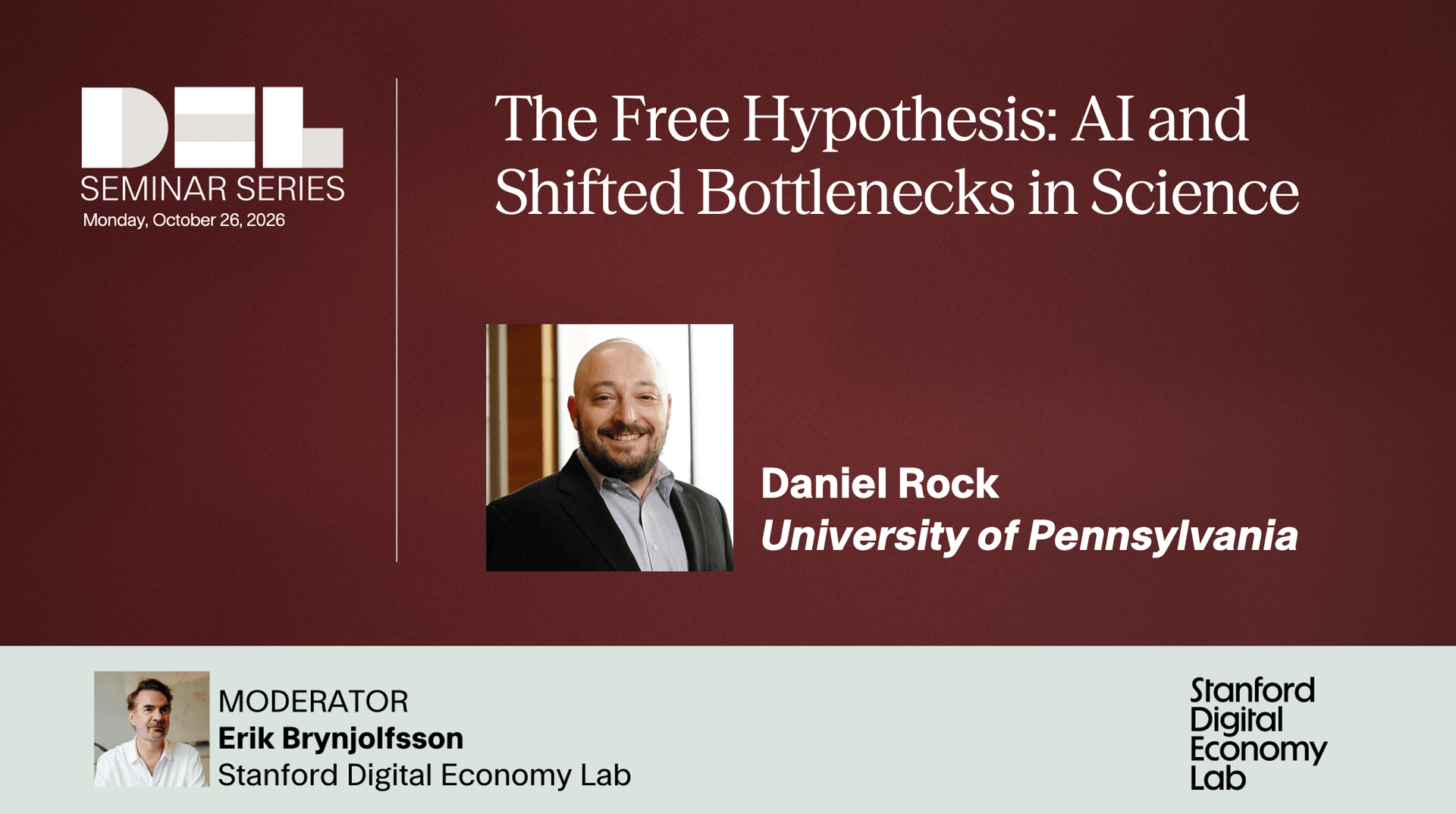
Scientific progress is a key driver of economic growth and prosperity. There is great excitement- but also concerns- about the impacts of AI on science, but so far little data. We provide early insights on this from three data sources: a sample of 15 million Gemini interactions, an inventory of over 2,600 specialized AI models across disciplines, and a survey of over 600 scientists.
Will robots take over the planet? Will they undermine or erode what it means to be human in other more subtle or unanticipated ways? Is the preoccupation with intelligent machines a red herring? Or is the biggest threat posed by intelligent machines the affordances they provide to the humans who wield them? Stanford Provost Emeritus and Co-director of the Institute for Human-Centered AI, John Etchemendy, will moderate as two talented teams of DLI members, captained by Salomé Viljoen and Meg Young, thrash out the pros and cons of AI in the digital age.
