Get the latest news, advances in research, policy work, and education program updates from HAI in your inbox weekly.
Sign Up For Latest News
In the last year, AI models have rapidly improved on public benchmarks measuring their ability to carry out research tasks autonomously. Such performance suggests that models may be capable of automating parts of the AI R&D process itself, thereby accelerating the pace of AI progress.
In the last year, AI models have rapidly improved on public benchmarks measuring their ability to carry out research tasks autonomously. Such performance suggests that models may be capable of automating parts of the AI R&D process itself, thereby accelerating the pace of AI progress.
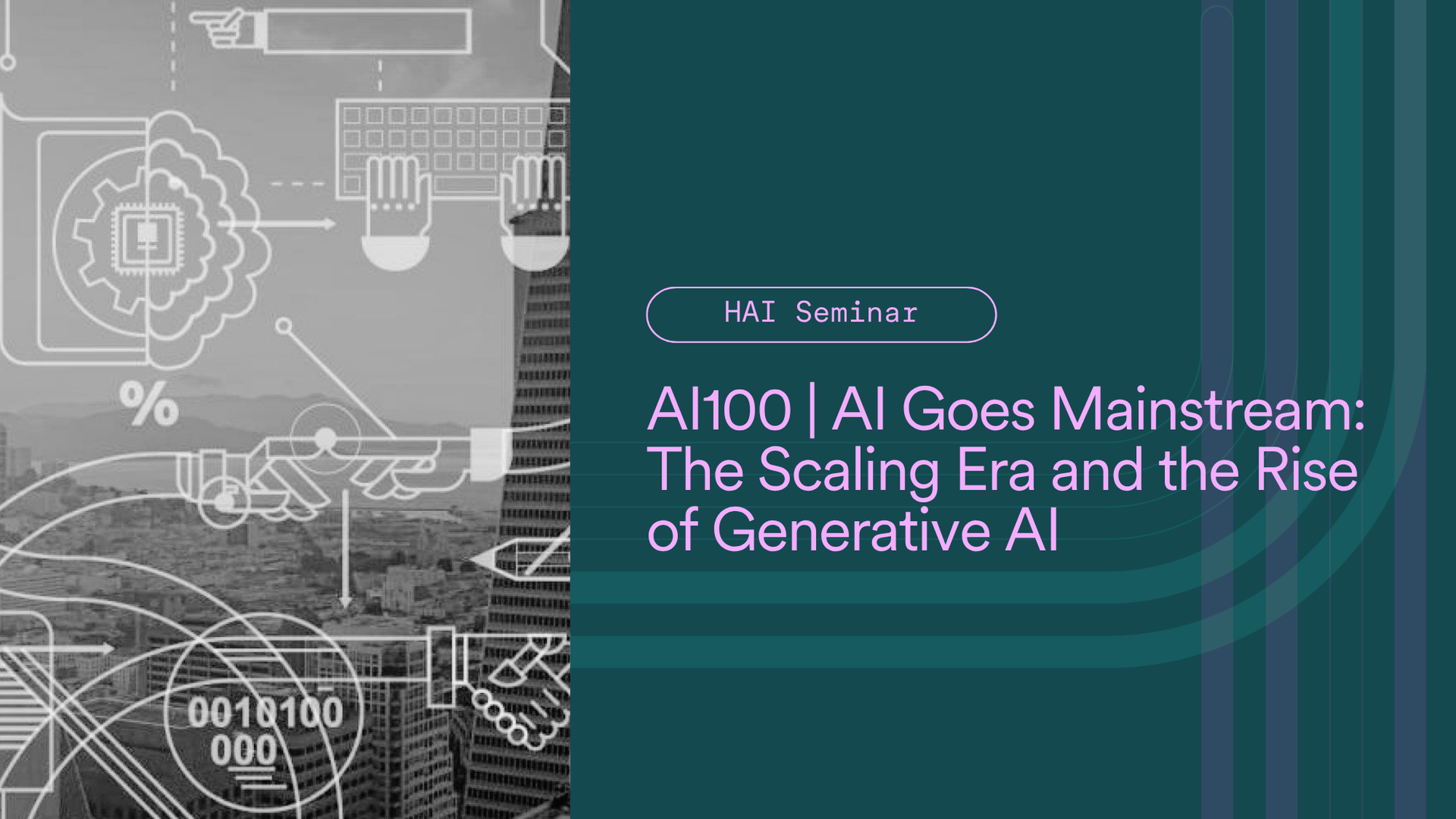
This talk will cover key insights from the third AI100 report, AI Goes Mainstream: The Scaling Era and the Rise of Generative AI, set for release in November 2026. The report was commissioned by the AI100 standing committee and led by study panel chair Michael Wooldridge.

This talk will cover key insights from the third AI100 report, AI Goes Mainstream: The Scaling Era and the Rise of Generative AI, set for release in November 2026. The report was commissioned by the AI100 standing committee and led by study panel chair Michael Wooldridge.
Sessions run Wednesdays from 4:30–5:30 PM in CoDa E160. Each session features a different Stanford speaker; talk titles are announced by the organizers.

Sessions run Wednesdays from 4:30–5:30 PM in CoDa E160. Each session features a different Stanford speaker; talk titles are announced by the organizers.
Abstract: This talk will cover how Graph Neural Networks can be used to enhance LLMs using PyG to improve accuracy for RAG like tasks across any kind of data domain. This will include examples on real world data. We will also cover how LLMs can be used to enhance GNNs for graph machine learning tasks. While not running on Marlowe, the techniques can be applied to any GPU cluster!
Speaker: Rishi Puri graduated from UC Berkeley and is a lead engineer for the Deep Learning FrameWork PyG at NVIDIA. He is also a core contributor to the open source PyG framework and community. His main focus is researching how to combine state of the art graph and language modeling techniques. He enjoys teaching about this work at Stanford, conferences, webinars, and through the PyG Slack and LinkedIn communities.
We are excited to announce a series of Marlowe NVIDIA-led workshops designed to enhance your expertise in GPU computing. Whether you're a beginner or looking to deepen your skills, these sessions offer valuable insights and hands-on learning opportunities. Workshops are expected to be held on a monthly basis.