eventSeminar
HAI Weekly Seminar with Agrim Gupta
Towards Understanding and Building Embodied Intelligence
Get the latest news, advances in research, policy work, and education program updates from HAI in your inbox weekly.
Sign Up For Latest News
Towards Understanding and Building Embodied Intelligence
The rapid acceleration of AI comes with a profound wave of anxiety. Across every sector of society, people are facing unsettling questions about their worth and their place in a shifting world.
The rapid acceleration of AI comes with a profound wave of anxiety. Across every sector of society, people are facing unsettling questions about their worth and their place in a shifting world.
Scientific progress is a key driver of economic growth and prosperity. There is great excitement- but also concerns- about the impacts of AI on science, but so far little data. We provide early insights on this from three data sources: a sample of 15 million Gemini interactions, an inventory of over 2,600 specialized AI models across disciplines, and a survey of over 600 scientists.
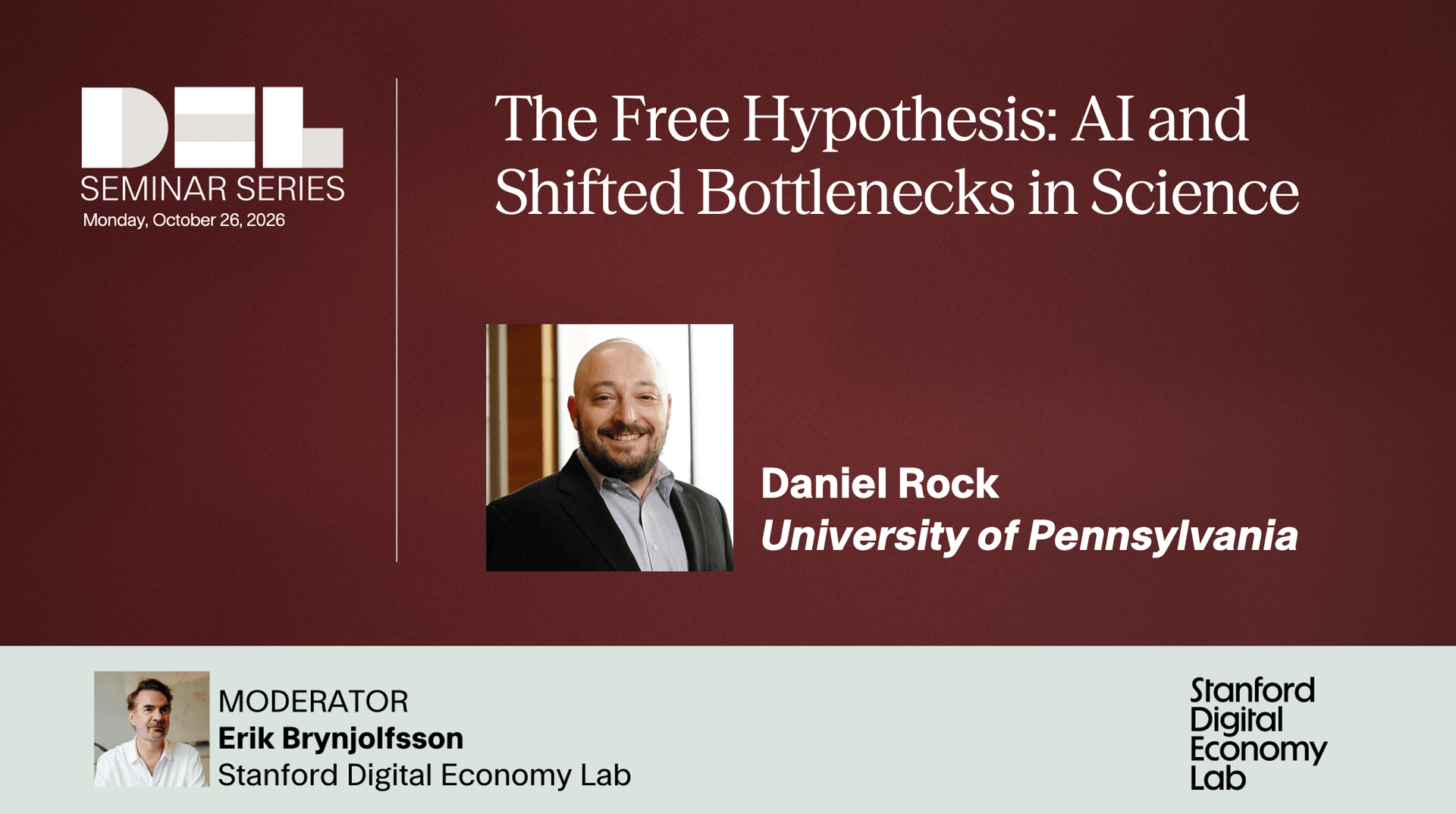
Scientific progress is a key driver of economic growth and prosperity. There is great excitement- but also concerns- about the impacts of AI on science, but so far little data. We provide early insights on this from three data sources: a sample of 15 million Gemini interactions, an inventory of over 2,600 specialized AI models across disciplines, and a survey of over 600 scientists.
In contrast to embodied intelligence, which is common in nature, the recent progress in AI has been disembodied. Animals display remarkable degrees of embodied intelligence by leveraging their evolved morphologies to learn complex tasks. In this talk, I will argue that intelligent behavior is a function of the brain, morphology, and the environment. However, the principles governing relations between environmental complexity, evolved morphology, and the learnability of intelligent control, remain elusive, partially due to the substantial challenge of performing large-scale in silico experiments on evolution and learning. To address this, I will introduce a new framework called DERL which enables us to evolve agents with diverse morphologies to learn hard locomotion and manipulation tasks in complex environments, and reveals insights into relations between environmental physics, embodied intelligence, and the evolution of rapid learning.