eventSeminar
Juan Sebastián Gómez-Cañón | Challenges And Opportunities For Human-Centered Music Emotion Recognition
Music is intertwined with human emotion, memory, and identity, making it a powerful medium for affective experience and regulation.
Get the latest news, advances in research, policy work, and education program updates from HAI in your inbox weekly.
Sign Up For Latest News
Music is intertwined with human emotion, memory, and identity, making it a powerful medium for affective experience and regulation.
AI is advancing rapidly at the cognitive tasks that make up knowledge work, raising fears among firms, policymakers, and, not least, workers of a “China shock” for white-collar jobs. Neil Thompson will present new research on whether those fears are warranted.
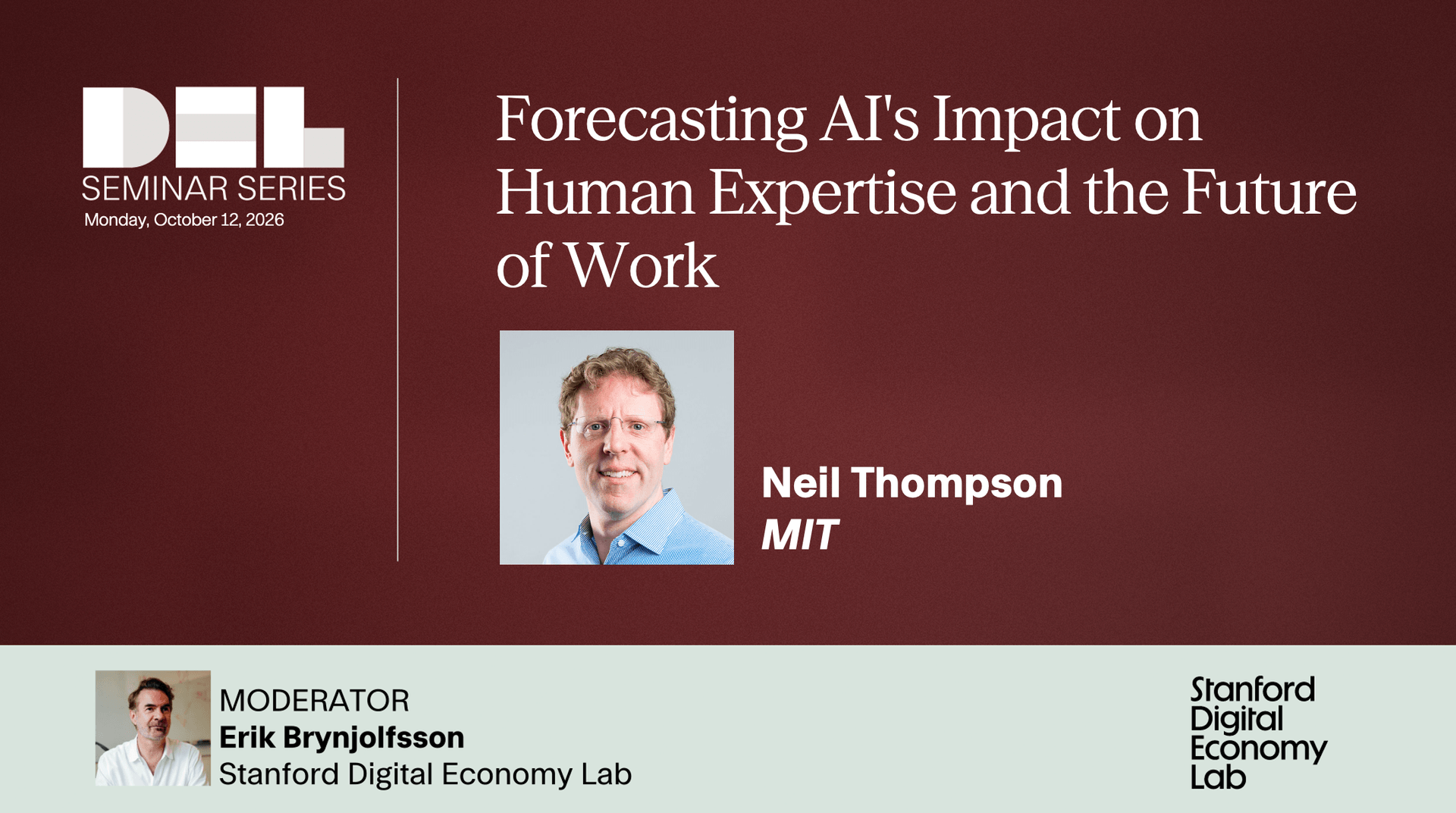
AI is advancing rapidly at the cognitive tasks that make up knowledge work, raising fears among firms, policymakers, and, not least, workers of a “China shock” for white-collar jobs. Neil Thompson will present new research on whether those fears are warranted.
Sessions run Wednesdays from 4:30–5:30 PM in CoDa E160. Each session features a different Stanford speaker; talk titles are announced by the organizers.

Sessions run Wednesdays from 4:30–5:30 PM in CoDa E160. Each session features a different Stanford speaker; talk titles are announced by the organizers.
This has motivated decades of research in music emotion recognition (MER), aiming to model emotional responses to music using computational methods. However, emotional responses to music are not fixed properties of the signal but emerge from interactions between musical structure, listener background, cultural context, and situational factors. As a result, traditional MER approaches that rely on averaged labels or universal ground truth struggle to capture the diversity and subjectivity of emotional experiences.
This talk argues for a human-centered perspective on MER that treats subjectivity not as noise but as a core signal. I discuss methodological challenges in constructing meaningful ground truth, including inter-annotator disagreement, contextual dependence, and personalization, as well as ethical concerns related to the use of emotion in a political context, and potential misuse.