eventLecture
Michael I. Jordan: An Alternative View on AI: Collaborative Learning, Incentives, and Social Welfare
Join Stanford Data Science in this post-conference Distinguished Lecture
Get the latest news, advances in research, policy work, and education program updates from HAI in your inbox weekly.
Sign Up For Latest News
Join Stanford Data Science in this post-conference Distinguished Lecture
The rapid acceleration of AI comes with a profound wave of anxiety. Across every sector of society, people are facing unsettling questions about their worth and their place in a shifting world.

The rapid acceleration of AI comes with a profound wave of anxiety. Across every sector of society, people are facing unsettling questions about their worth and their place in a shifting world.
Sessions run Wednesdays from 4:30–5:30 PM in CoDa E160. Each session features a different Stanford speaker; talk titles are announced by the organizers.

Sessions run Wednesdays from 4:30–5:30 PM in CoDa E160. Each session features a different Stanford speaker; talk titles are announced by the organizers.
An AI Measurement Science (AIMS) Seminar Series

An AI Measurement Science (AIMS) Seminar Series
The lecture will be recorded and available on the
SDS YouTube Channel after the event
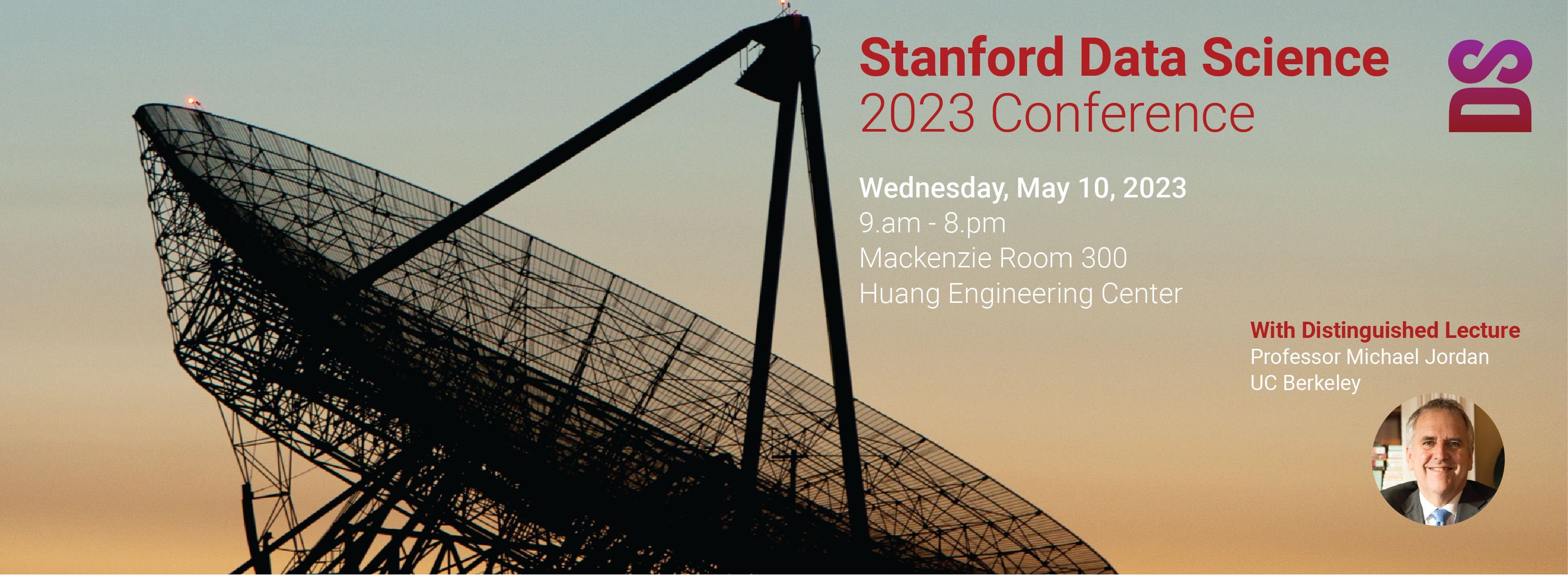
We are pleased to announce the second Stanford Data Science Distinguished Lecture this May 10th, at 6pm. This lecture will follow the day-long Stanford Data Science Conference. We welcome you to join us at 5pm for a dinner reception and an opportunity to engage with others in the Stanford Data Science community and beyond.
Our speaker is Prof. Michael I. Jordan (University of California, Berkeley), who will speak on An Alternative View on AI: Collaborative Learning, Incentives, and Social Welfare
Michael I. Jordan is the Pehong Chen Distinguished Professor in the Department of Electrical Engineering and Computer Science and the Department of Statistics at the University of California, Berkeley. He received his Masters in Mathematics from Arizona State University, and earned his PhD in Cognitive Science in 1985 from the University of California, San Diego. He was a professor at MIT from 1988 to 1998. His research interests bridge the computational, statistical, cognitive, biological and social sciences.
Abstract:
Artificial intelligence (AI) has focused on a paradigm in which intelligence inheres in a single, autonomous agent. Social issues are entirely secondary in this paradigm. Indeed, the overall design of deployed AI systems is often naive---a centralized entity provides services to passive agents and reaps the rewards. Such a framing need not be the dominant paradigm for information technology. In a broader framing, agents are active, they are cooperative, their data is valuable, and they wish to obtain value from their participation in learning-based systems. Intelligence inheres as much in the overall system as it does in individual agents, be they humans or computers. This is a perspective familiar in economics, and a first goal in this line of work is to bring economics into contact with the computing and data sciences. The long-term goal is two-fold---to provide a broader conceptual foundation for emerging real-world AI systems, and to upend received wisdom in the computational, economic, and inferential disciplines.