Get the latest news, advances in research, policy work, and education program updates from HAI in your inbox weekly.
Sign Up For Latest News
In the last year, AI models have rapidly improved on public benchmarks measuring their ability to carry out research tasks autonomously. Such performance suggests that models may be capable of automating parts of the AI R&D process itself, thereby accelerating the pace of AI progress.
In the last year, AI models have rapidly improved on public benchmarks measuring their ability to carry out research tasks autonomously. Such performance suggests that models may be capable of automating parts of the AI R&D process itself, thereby accelerating the pace of AI progress.
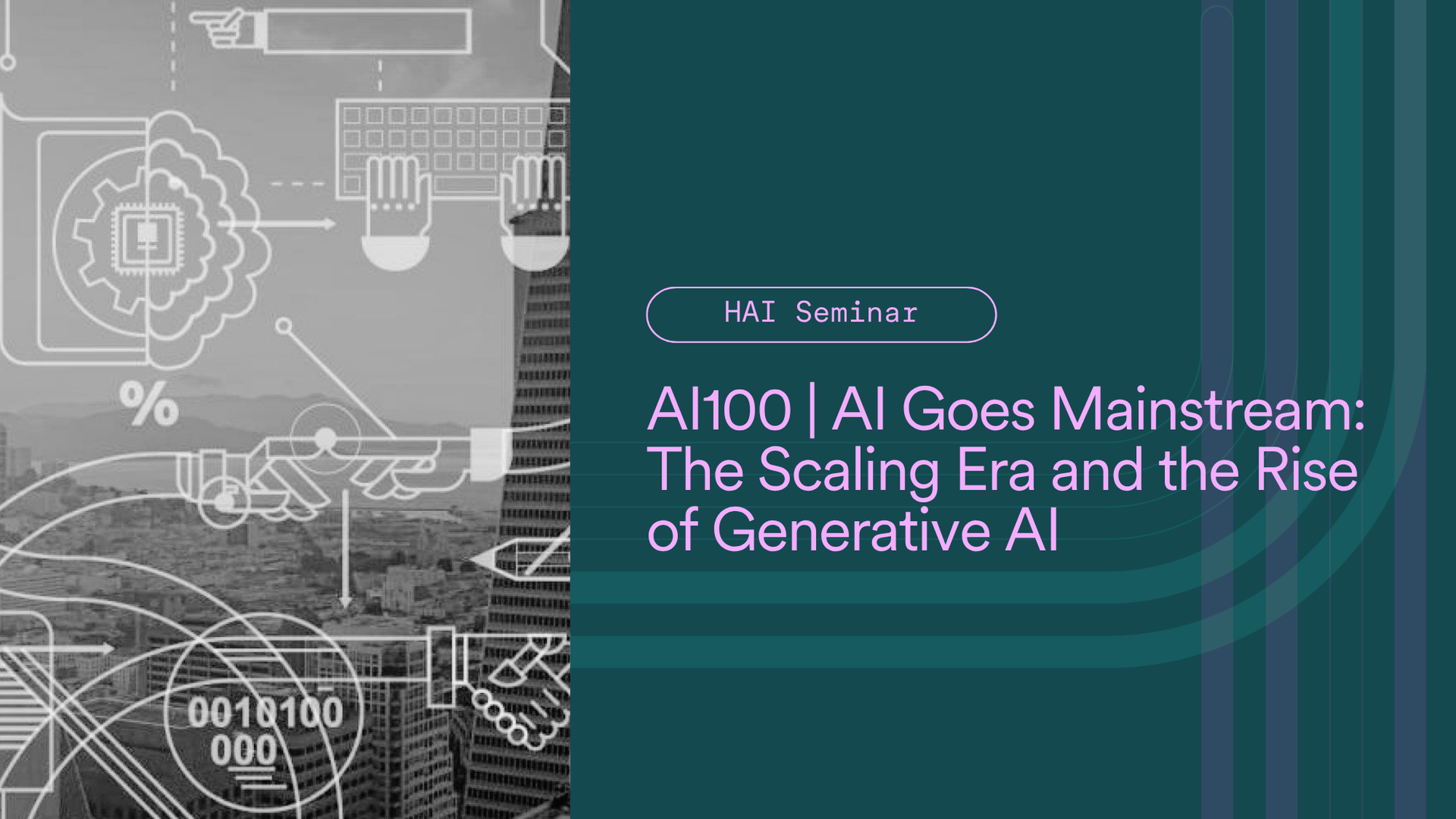
This talk will cover key insights from the third AI100 report, AI Goes Mainstream: The Scaling Era and the Rise of Generative AI, set for release in November 2026. The report was commissioned by the AI100 standing committee and led by study panel chair Michael Wooldridge.

This talk will cover key insights from the third AI100 report, AI Goes Mainstream: The Scaling Era and the Rise of Generative AI, set for release in November 2026. The report was commissioned by the AI100 standing committee and led by study panel chair Michael Wooldridge.
Sessions run Wednesdays from 4:30–5:30 PM in CoDa E160. Each session features a different Stanford speaker; talk titles are announced by the organizers.

Sessions run Wednesdays from 4:30–5:30 PM in CoDa E160. Each session features a different Stanford speaker; talk titles are announced by the organizers.
This talk explores the new wave of robotics driven by world foundation models. We present our family of world models and describe how they are integrated into our ecosystem to scale robot training, simulation, and generalization across diverse tasks and environments.
Akul Santhosh is a Solutions Architect at NVIDIA, working on the Robotics team. He collaborates with researchers and developers working on simulation technogies and world foundation models. Before joining NVIDIA, he earned a master’s degree in computer science from New York University with a focus on Robotics and Simulations.
Aiden Chang is a Solutions Architect at NVIDIA, focusing on enterprise applications of generative AI, robotics, and reasoning systems. He earned his M.S. in Computer Science from the University of Southern California. Outside of work, he enjoys skiing, aviation, and building robots.