Get the latest news, advances in research, policy work, and education program updates from HAI in your inbox weekly.
Sign Up For Latest News
This talk will cover key insights from the third AI100 report, AI Goes Mainstream: The Scaling Era and the Rise of Generative AI, set for release in November 2026. The report was commissioned by the AI100 standing committee and led by study panel chair Michael Wooldridge.

This talk will cover key insights from the third AI100 report, AI Goes Mainstream: The Scaling Era and the Rise of Generative AI, set for release in November 2026. The report was commissioned by the AI100 standing committee and led by study panel chair Michael Wooldridge.
Sessions run Wednesdays from 4:30–5:30 PM in CoDa E160. Each session features a different Stanford speaker; talk titles are announced by the organizers.

Sessions run Wednesdays from 4:30–5:30 PM in CoDa E160. Each session features a different Stanford speaker; talk titles are announced by the organizers.
This talk will explore the latest advances in computational protein design and structure prediction, highlighting NVIDIA technologies such as cuEquivariance and the Proteína family of models, including the latest RFdiffusion4 (RFD4)–Proteína developments. We will discuss how accelerated geometric deep learning and generative AI are enabling scalable, high-performance protein modeling and the design of novel proteins with tailored structures and functions.
Bio:
Youssef Nashed is a Senior Solutions Architect on NVIDIA's Healthcare and Life Sciences team. He joined NVIDIA from Bristol Myers Squibb (BMS), where he was a Senior Principal Scientist focused on machine learning and computational protein design. At BMS, Youssef led a team developing and deploying AI models for antibody discovery and development. He previously served as an Assistant Professor at Northwestern University and conducted research in structural biology at SLAC National Accelerator Laboratory at Stanford. Youssef began his career in high-performance and large-scale GPU computing at Argonne National Laboratory. His background spans computer science, mathematics, structural biology, and AI-driven protein engineering.
Location: CoDa W401
This lecture was recorded and is now live on our YouTube channel
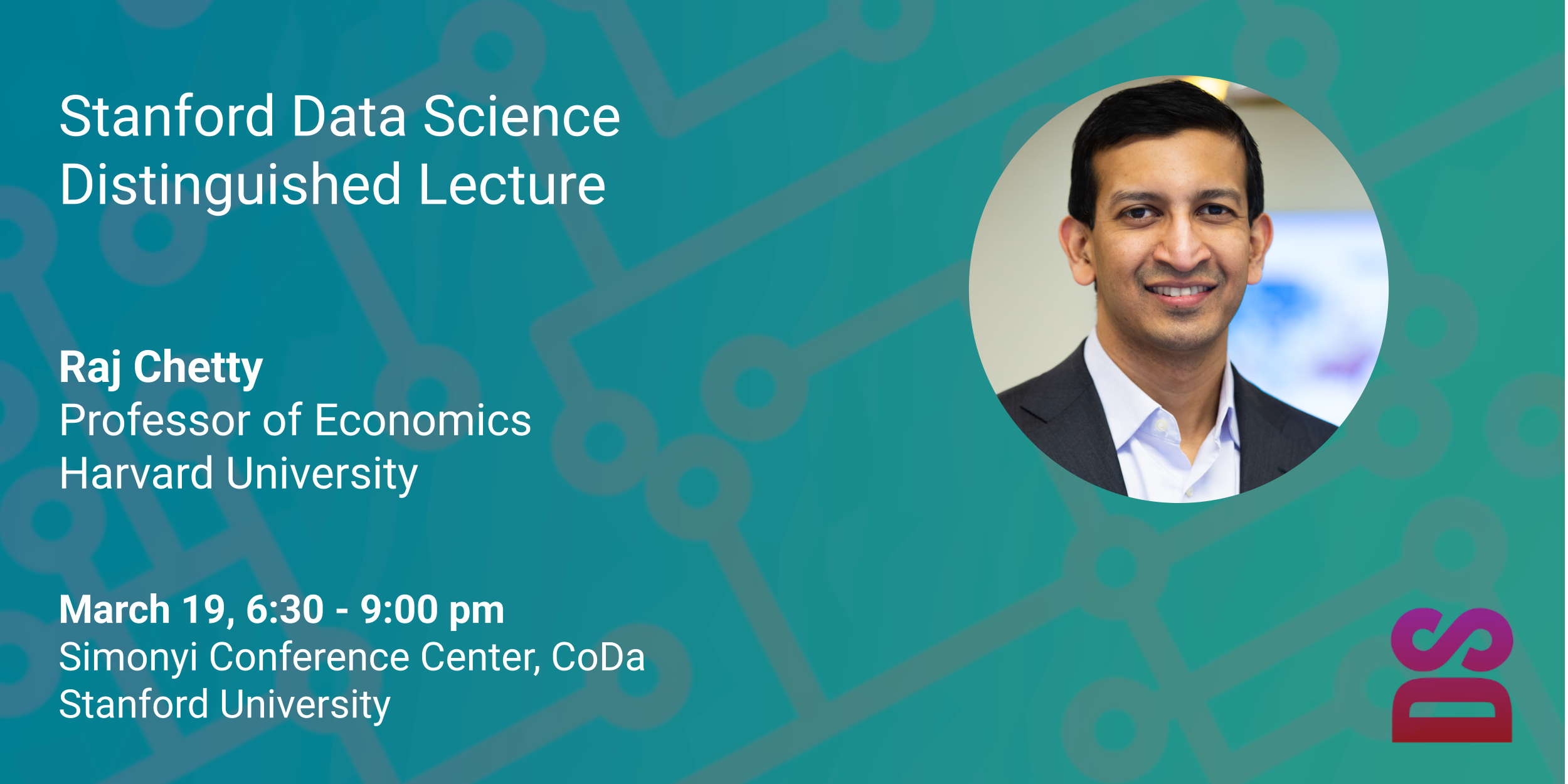
Stanford Data Science is pleased to host our Spring Distinguished Lecture on March 19th, 2025. Our speaker is Raj Chetty, Professor of Economics, Harvard University and Director, Opportunity Insights.
The Lecture will start promptly at 6:30 PM, followed by a 7:30 PM dinner reception and an opportunity to engage with others in the Stanford Data Science community.
Abstract: Children’s chances of earning more than their parents have fallen from 90% to 50% over the past half-century in America. How can we improve opportunities for upward economic mobility? This talk will present findings from a recent set of studies at Opportunity Insights that use various sources of big data—ranging from anonymized tax records to social network data—to understand the science of economic opportunity. Among other topics, the talk will discuss how and why children’s chances of climbing the income ladder vary across neighborhoods, how highly selective colleges may amplify the persistence of privilege, and the role of social capital as a driver of upward mobility. Methodologically, the talk will focus on how novel insights can be obtained by combining experimental and large-scale observational data. The talk will conclude by giving examples of how data science is informing the design of a wide range of policy interventions—from affordable housing to job training programs—to expand opportunities.
Raj Chetty is the William A. Ackman Professor of Economics at Harvard University and the Director of Opportunity Insights, which uses big data to study the science of economic opportunity: how we can give children from all backgrounds better chances of succeeding? Chetty’s work has been widely cited in academia, media outlets, and policy discussions in the United States and beyond.
Chetty received his Ph.D. from Harvard University in 2003 and is one of the youngest-tenured professors in Harvard’s history. He has received numerous awards for his research, including a MacArthur “Genius” Fellowship, the John Bates Clark medal, given to the economist under 40 whose work is judged to have made the most significant contribution to the field, and Harvard’s George Ledlie prize, awarded for research that made the most valuable contribution to science, or in any way for the benefit of mankind.
For further information, please see Prof. Chetty’s full CV
Stanford Data Science brings world-class researchers to campus every quarter in our Distinguished Lecture series. These speakers build and apply modern data science, machine learning, and artificial intelligence techniques and tools to accelerate data-driven discoveries across all fields. Lectures are free for the whole community and include an informal reception beforehand. Spend an evening with creative thought leaders on the Stanford campus. Past lecture recordings are available on our YouTube channel