event
2025 Stanford HAI Orientation
Meet your faculty and peers, and find out more about the ways in which you can get involved. After the event, stay for HAI Seminar at 3pm!
Get the latest news, advances in research, policy work, and education program updates from HAI in your inbox weekly.
Sign Up For Latest News
Meet your faculty and peers, and find out more about the ways in which you can get involved. After the event, stay for HAI Seminar at 3pm!
A eureka moment is a two-step process: discovering something new and surprising, and establishing that it is correct. Drawing on her work at Axiom, Carina will discuss the transition from solving mathematical benchmarks to contributing to research, and from proving individual theorems to formalizing mathematical theories in Lean.
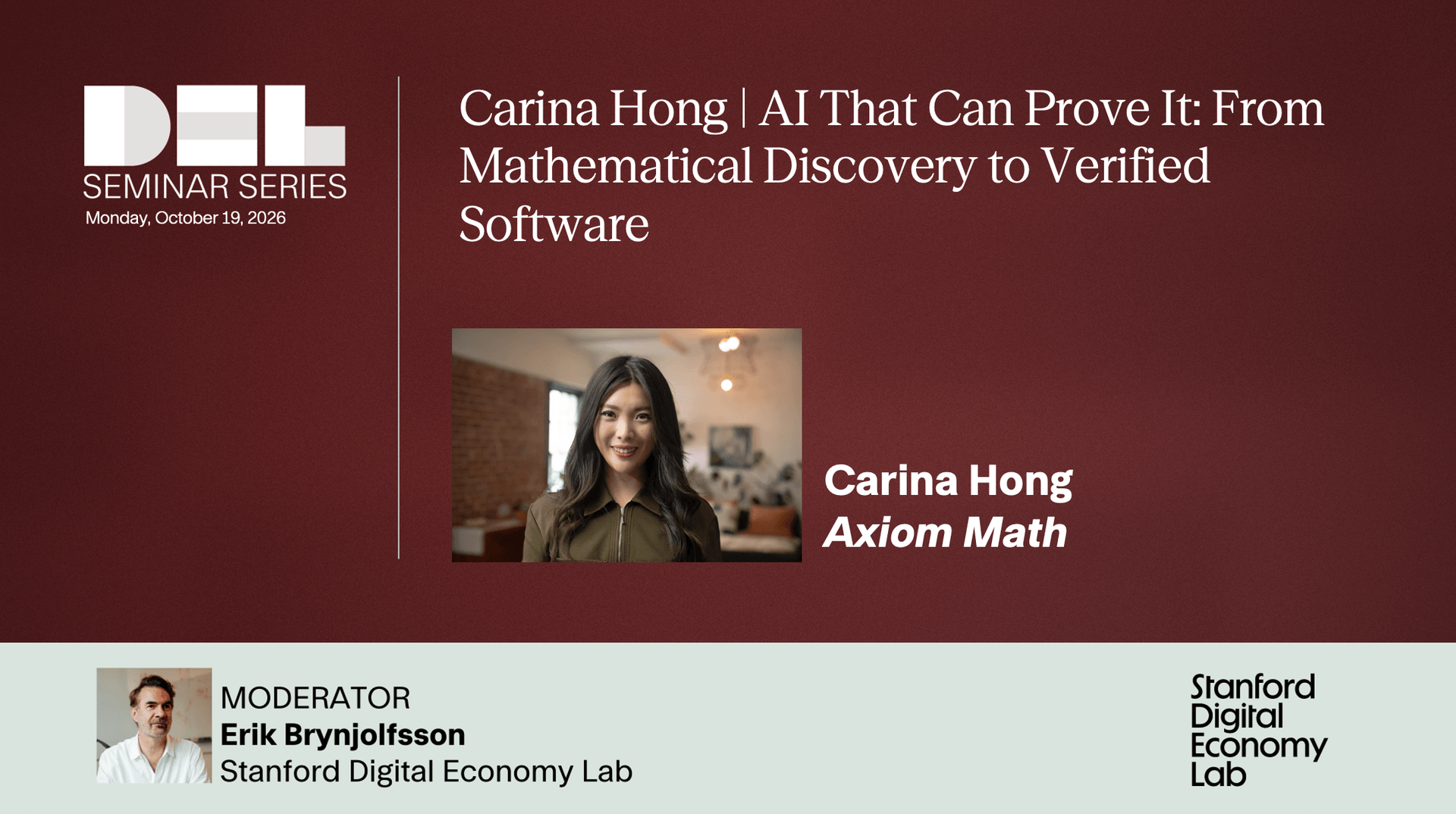
A eureka moment is a two-step process: discovering something new and surprising, and establishing that it is correct. Drawing on her work at Axiom, Carina will discuss the transition from solving mathematical benchmarks to contributing to research, and from proving individual theorems to formalizing mathematical theories in Lean.
A Center for Neural Data Science Seminar Series
A Center for Neural Data Science Seminar Series
The Bay Area Tech Economics Seminar is for graduate-trained economists and other quantitative social scientists from academia, policy, or the private sector who are interested in the tech economy and methods for analyzing it, and in making connections with others in this broadly defined space.
The Bay Area Tech Economics Seminar is for graduate-trained economists and other quantitative social scientists from academia, policy, or the private sector who are interested in the tech economy and methods for analyzing it, and in making connections with others in this broadly defined space.
We are excited to invite you to the Stanford Institute for Human-Centered AI (HAI) Orientation on October 8th from 1:00pm - 2:30pm. This event is a fantastic opportunity to learn more about our work, meet faculty and peers, and discover the various ways you can get involved with our initiatives.
Whether you're a student, faculty member, or staff, we welcome you to join us and become part of our growing community. This orientation is designed to introduce you to the cutting-edge research and educational opportunities available in artificial intelligence and data science at Stanford.
For this year’s orientation, we are pleased to include our partnering organization the Stanford Data Science Initiative. We're thrilled to welcome everyone, from those just beginning to explore these fields to experienced researchers looking to expand their network and knowledge.
Following the orientation, please stick around for a special HAI seminar, book signing, and reception to celebrate the launch of Flash Teams, a new book from HAI Senior Fellows Melissa Valentine and Michael Bernstein!