eventLecture
Advancing AI Audit - Project Showcase and Lessons Learned
How can we effectively design and develop practical tools to assess the presence of bias and potential discrimination in AI systems?
Get the latest news, advances in research, policy work, and education program updates from HAI in your inbox weekly.
Sign Up For Latest News
How can we effectively design and develop practical tools to assess the presence of bias and potential discrimination in AI systems?
Scientific progress is a key driver of economic growth and prosperity. There is great excitement- but also concerns- about the impacts of AI on science, but so far little data. We provide early insights on this from three data sources: a sample of 15 million Gemini interactions, an inventory of over 2,600 specialized AI models across disciplines, and a survey of over 600 scientists.
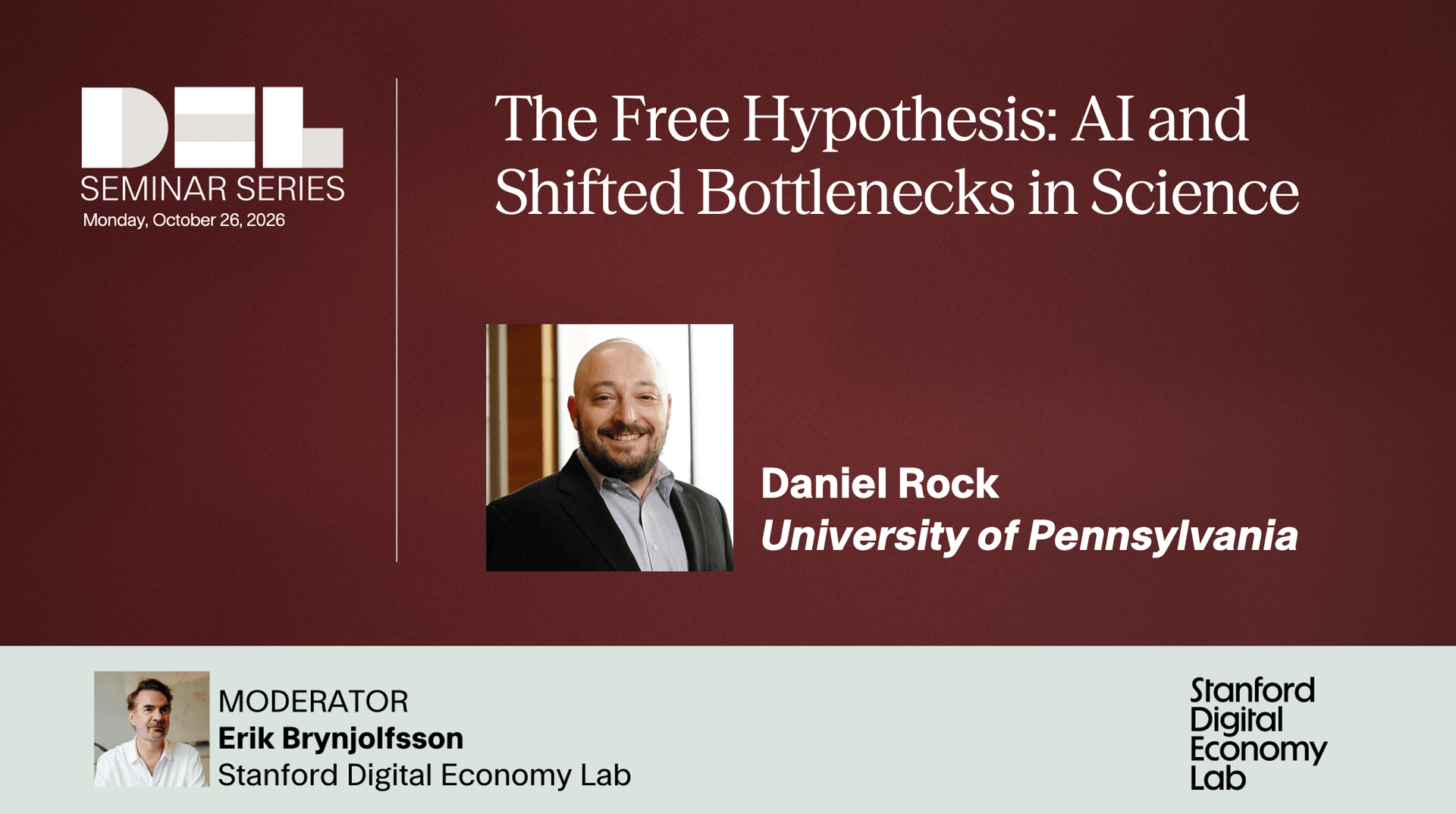
Scientific progress is a key driver of economic growth and prosperity. There is great excitement- but also concerns- about the impacts of AI on science, but so far little data. We provide early insights on this from three data sources: a sample of 15 million Gemini interactions, an inventory of over 2,600 specialized AI models across disciplines, and a survey of over 600 scientists.
The rapid acceleration of AI comes with a profound wave of anxiety. Across every sector of society, people are facing unsettling questions about their worth and their place in a shifting world.
The rapid acceleration of AI comes with a profound wave of anxiety. Across every sector of society, people are facing unsettling questions about their worth and their place in a shifting world.
Sessions run Wednesdays from 4:30–5:30 PM in CoDa E160. Each session features a different Stanford speaker; talk titles are announced by the organizers.

Sessions run Wednesdays from 4:30–5:30 PM in CoDa E160. Each session features a different Stanford speaker; talk titles are announced by the organizers.
Last August, HAI and Cyber Policy Center launched the AI Audit Challenge, an initiative that invited teams from around the world to submit their models, solutions, and tools with the goal of improving our ability to evaluate AI systems. This event spotlights the four award-winning entries, featuring insightful discussions from participants and AI experts on effective practices and valuable lessons learned from the Challenge.
9:00a.m. - 9:05a.m. PDT
HAI International Policy Fellow; International Policy Director, Cyber Policy Center, Stanford University
Responsible AI Fellow, Berkman Klein Center for Internet & Society, Harvard University
9:05a.m. - 9:15a.m. PDT
Auditbot
Neal Lathia
Monzo Bank, UK
9:15a.m. - 9:25a.m. PDT
Ceteris Paribus
Edward Chen
Stanford University
9:25a.m. - 9:35a.m. PDT
End-User Audits
Michelle S. Lam
Stanford University
9:35a.m. - 9:45a.m. PDT
HateCheck
Paul Röttger
University of Oxford
Hannah Rose Kirk
University of Oxford
Bertie Vidgen
University of Oxford
9:45a.m. - 10:15a.m. PDT
Moderated panel discussion
HAI International Policy Fellow; International Policy Director, Cyber Policy Center, Stanford University
10:15a.m. - 11:15a.m. PDT
Moderated panel discussion
Founder and Principal Researcher, Montreal AI Ethics Institute
Schwartz Reisman Chair in Technology and Society, Professor of Law and Professor of Strategic Management. CIFAR AI Chair. Director, Schwartz Reisman Institute for Technology and Society
Staff Research Scientist, DeepMind's Ethics and Society Team
Raj & Neera Singh Assistant Professor, Computer & Information Science, University of Pennsylvania
Responsible AI Fellow, Berkman Klein Center for Internet & Society, Harvard University