Get the latest news, advances in research, policy work, and education program updates from HAI in your inbox weekly.
Sign Up For Latest News
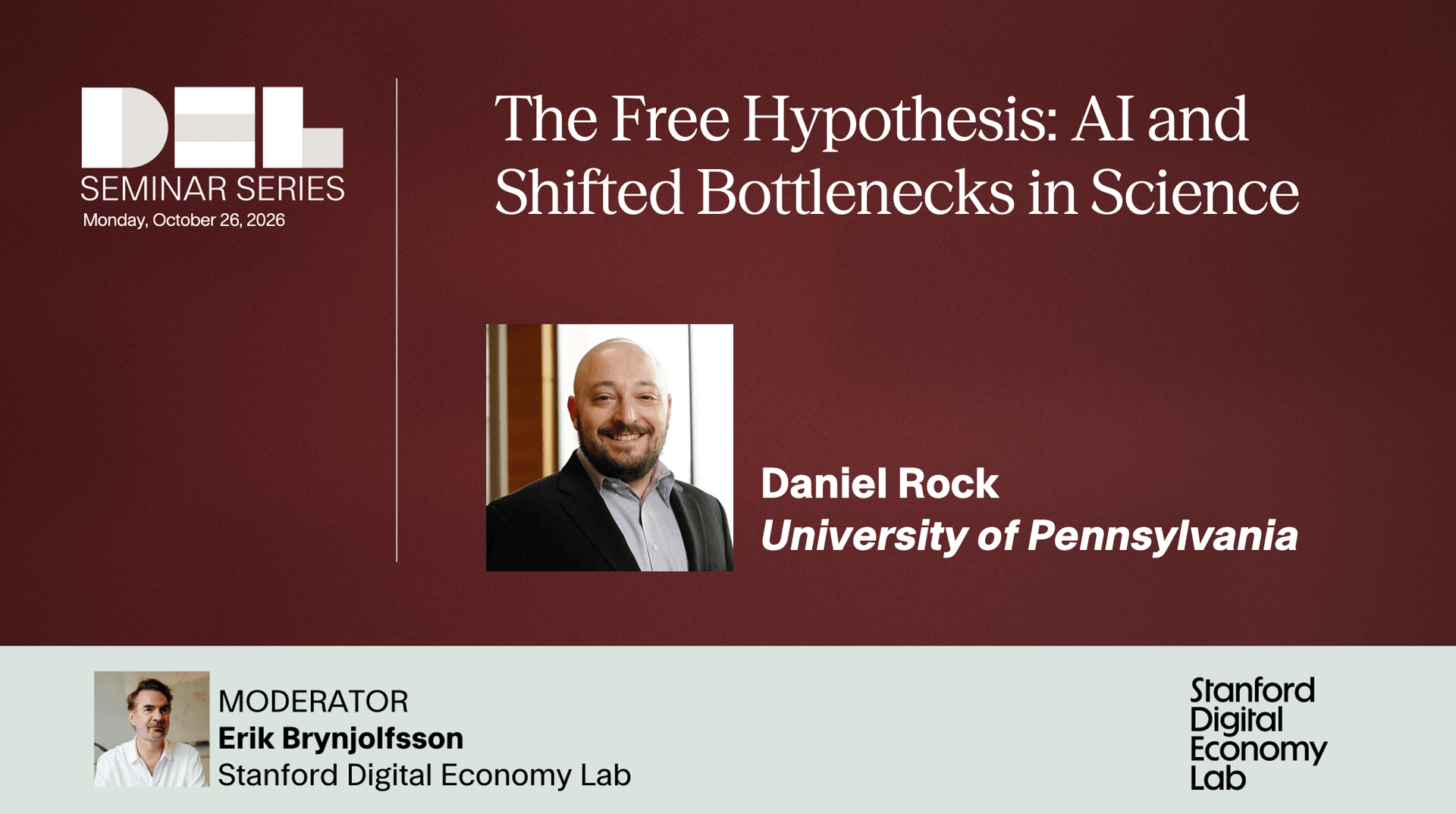
The possibility that AI will automate most cognitive labor is worth taking seriously. How should we adapt to this transformation? I start from the perspective, articulated in the essay “AI as normal technology”, that the true bottlenecks lie downstream of capabilities and that AI’s impacts will unfold gradually over decades. If this is true, there are major gaps in our current evidence infrastructure, because it over-emphasizes the capability layer.
.png&w=1920&q=100)
The possibility that AI will automate most cognitive labor is worth taking seriously. How should we adapt to this transformation? I start from the perspective, articulated in the essay “AI as normal technology”, that the true bottlenecks lie downstream of capabilities and that AI’s impacts will unfold gradually over decades. If this is true, there are major gaps in our current evidence infrastructure, because it over-emphasizes the capability layer.
The AI Index, currently in its ninth year, tracks, collates, distills, and visualizes data relating to artificial intelligence.

The AI Index, currently in its ninth year, tracks, collates, distills, and visualizes data relating to artificial intelligence.
Strategic stability exists when neither side thinks it can improve its strategic outcome by striking first.

Strategic stability exists when neither side thinks it can improve its strategic outcome by striking first.
At this wide-ranging online event, the Stanford Institute for Human-Centered Artificial Intelligence (HAI), Center for Artificial Intelligence in Medicine and Imaging (AIMI), and Center for Continuing Medical Education (CME) are convening experts and leaders from academia, industry, government, and clinical practice to explore critical and emerging issues related to AI's impact across the spectrum of healthcare. Content will be relevant to practitioners, researchers, executives, policymakers, and professionals, with and without technical expertise.
Conference Website
In support of improving patient care, Stanford Medicine is jointly accredited by the Accreditation Council for Continuing Medical Education (ACCME), the Accreditation Council for Pharmacy Education (ACPE), and the American Nurses Credentialing Center (ANCC), to provide continuing education for the healthcare team.
Stanford Medicine designates this Live activity for a maximum of 12.00 AMA PRA Category 1 Credits™. Physicians should claim only the credit commensurate with the extent of their participation in the activity.