Stanford
University
  • Stanford Home
  • Maps & Directions
  • Search Stanford
  • Emergency Info
  • Terms of Use
  • Privacy
  • Copyright
  • Trademarks
  • Non-Discrimination
  • Accessibility
© Stanford University.  Stanford, California 94305.
Bay Area Tech Economics Seminar with Rehan Khan, Snowflake | Stanford HAI
Navigate
  • About
  • Events
  • AI Glossary
  • Careers
  • Search
Participate
  • Get Involved
  • Support HAI
  • Contact Us
Skip to content
  • About

    • About
    • People
    • Get Involved with HAI
    • Support HAI
    • Subscribe to Email
  • Research

    • Research
    • Research Programs
    • Grants
    • Marlowe (opens in new tab)
    • Student Affinity Groups
    • Centers & Labs
    • Research Publications
    • Research Partners
  • Education

    • Education
    • Executive and Professional Education
    • Government and Policymakers
    • K-12
    • Stanford Students
  • Policy

    • Policy
    • Policy Publications
    • Policymaker Education
    • Student Opportunities
  • AI Index

    • AI Index
    • AI Index Report
    • Global Vibrancy Tool
    • People
  • News
  • Events
  • Industry
  • Centers & Labs

Stay Up To Date

Get the latest news, advances in research, policy work, and education program updates from HAI in your inbox weekly.

Sign Up For Latest News

Your browser does not support the video tag.
eventSeminar

Bay Area Tech Economics Seminar with Rehan Khan, Snowflake

Status
Upcoming
Date
Tuesday, October 20, 2026 6:30 PM - 8:30 PM PST/PDT
Location
John A. and Cynthia Fry Gunn Conference Room, Room E241 (Second Floor), ChEM-H / Neurosciences, 290 Jane Stanford Way, Stanford, CA 94305
Topics
Economy, Markets
Data Science

The Bay Area Tech Economics Seminar is for graduate-trained economists and other quantitative social scientists from academia, policy, or the private sector who are interested in the tech economy and methods for analyzing it, and in making connections with others in this broadly defined space.

Share
Link copied to clipboard!
Event Contact
Stanford HAI
datascience@stanford.edu

Related Events

Nicholas Branigan | Non-ergodicity and Simpson’s paradox in neural correlates
SeminarOct 19, 20264:00 PM - 5:00 PM
October
19
2026

A Center for Neural Data Science Seminar Series

Event

Nicholas Branigan | Non-ergodicity and Simpson’s paradox in neural correlates

Oct 19, 20264:00 PM - 5:00 PM

A Center for Neural Data Science Seminar Series

Marlowe | AI + Data for Science with Anshul Kundaje
SeminarOct 21, 2026
October
21
2026

Sessions run Wednesdays from 4:30–5:30 PM in CoDa E160. Each session features a different Stanford speaker; talk titles are announced by the organizers.

Event

Marlowe | AI + Data for Science with Anshul Kundaje

Oct 21, 2026

Sessions run Wednesdays from 4:30–5:30 PM in CoDa E160. Each session features a different Stanford speaker; talk titles are announced by the organizers.

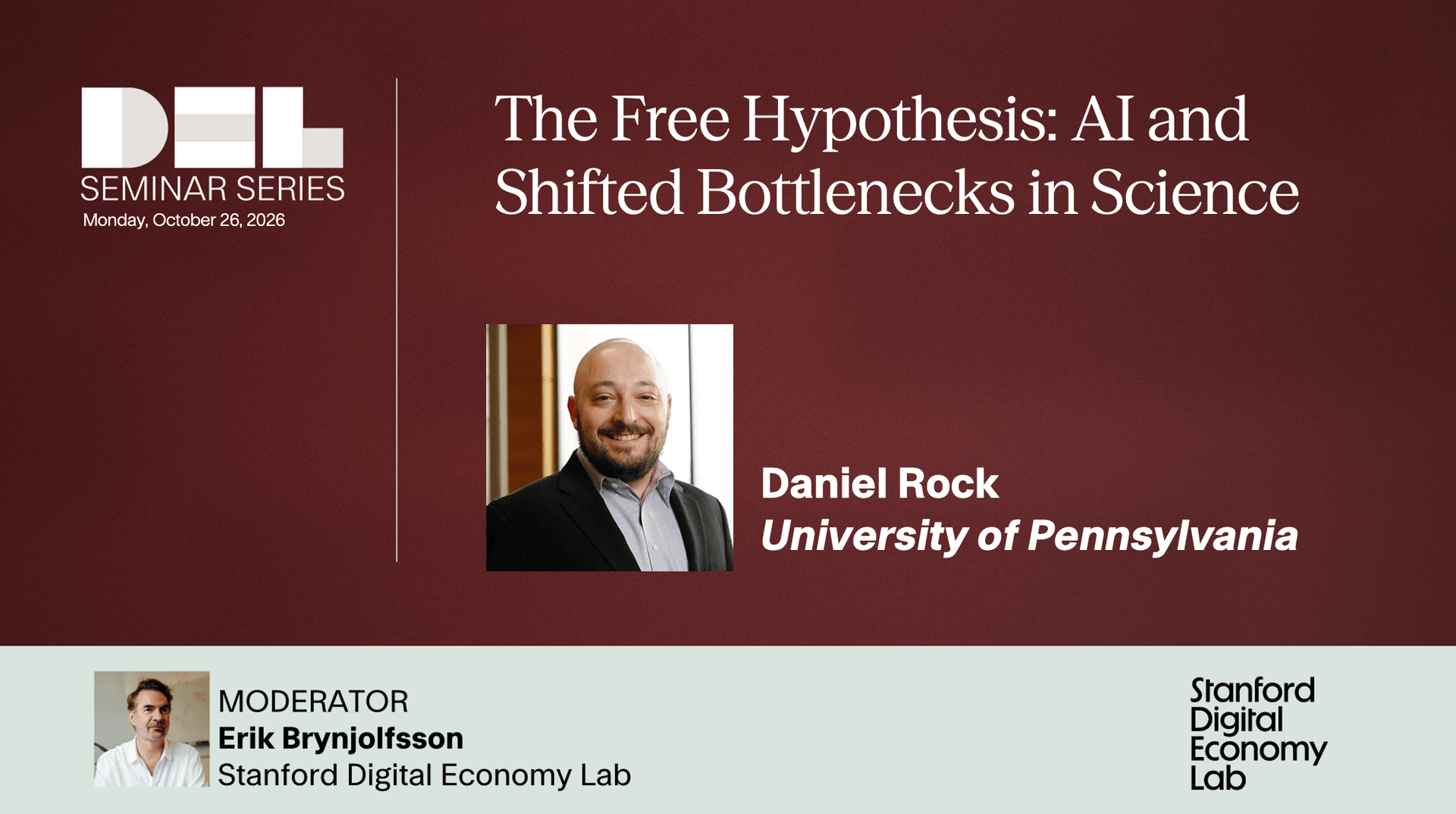
Daniel Rock | The Free Hypothesis: AI and Shifted Bottlenecks in Science
Oct 26, 202612:00 PM - 1:00 PM
October
26
2026

Scientific progress is a key driver of economic growth and prosperity. There is great excitement- but also concerns- about the impacts of AI on science, but so far little data. We provide early insights on this from three data sources: a sample of 15 million Gemini interactions, an inventory of over 2,600 specialized AI models across disciplines, and a survey of over 600 scientists.

Event

Daniel Rock | The Free Hypothesis: AI and Shifted Bottlenecks in Science

Oct 26, 202612:00 PM - 1:00 PM

Scientific progress is a key driver of economic growth and prosperity. There is great excitement- but also concerns- about the impacts of AI on science, but so far little data. We provide early insights on this from three data sources: a sample of 15 million Gemini interactions, an inventory of over 2,600 specialized AI models across disciplines, and a survey of over 600 scientists.

Talk Title: Data Science at Snowflake in the Age of AI

Snowflake is a cloud data platform that thousands of enterprises use to store, analyze, and build AI applications on their data. In this talk, I describe two facets of data science at Snowflake: learning about cause and effect through experimentation and transforming how we work through the rapidly evolving capabilities created by AI. Whereas experimentation has been a staple of data science for years, in the context of relatively small sample sizes and low risk tolerance, we have needed to develop more complex regimes than simple A/B testing to guide product development and improve our systems. Our samples are counted in thousands of accounts rather than millions of users, our outcomes are heavy-tailed, and a bad treatment can disrupt customers' critical workloads. I'll describe how we still learn causally in this setting through careful choice of randomization units, switchback designs, variance reduction, and staged rollouts with guardrails.  In contrast to this traditional work, there is a larger phenomenon of how AI is transforming the way our team works. In a world where teams of agents carry out data science workflows, from monitoring pipelines and investigating metric shifts to producing recurring analyses, the premium for data science work is shifting to designing robust agentic workflows, exercising judgment grounded in deep technical knowledge, and communicating meaning with clarity.

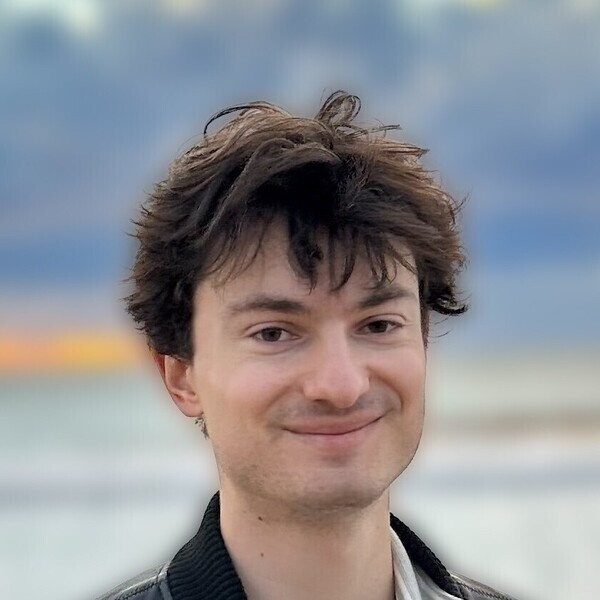
Speaker: Rehan Khan, VP of Data Science, Snowflake

The series is co-sponsored by the University of San Francisco's Master's in Applied Economics and the Stanford Causal Science Center. Join the seminars mailing list!
Speaker
Rehan Khan
Vice President of Data Science, Snowflake