HAI Vodcast with Ge Wang and Vanessa Parli | Episode 1: What Do We (Really) Want from AI?
This quarter, we are piloting a three-part Human-Centered AI Vodcast. A sort of hybrid podcast, live audience and seminar series. Through this series, we hope to better understand what all of you want from AI. So, welcome to Stanford Human-Centered AI Vodcast, where we don't sweep anything under the rug; where we question everything, starting with ourselves.
Preamble
What do we (really) want from artificial intelligence?
We live in a time when advancements in AI technology is shaping our world, while critically outpacing our understanding of this technology in various humanistic contexts (cultural, social, ethical, historical).
Look at us, we are Stanford, one of the most powerful academic institutions, located in the heart of Silicon Valley. And yet it is all too easy to be in a profound bubble. Much of the world knows and cares about AI far less than we might assume. It is all too easy, also, to be sure of ourselves, as the technology creators, while remaining out of touch with the rest of the world. We tell ourselves that more technology is the solution—for technology is what we know, and we are eager to apply our craft. Unfortunately, it is all too easy to do so with a shallow understanding of the social, cultural, historical contexts—while not even considering the possibility that problems in the world are seldom “lack-of-technology” problems, but entrenched human problems (including technology itself). But of course, we keep moving fast because that is good for business. Even when we “design tech for social good”, we too often just end up making something slightly more convenient, because slightly more convenient fits the prevailing economic narrative. This is the bubble, the technology cave we don’t know we are living in.
We need to interrogate ourselves to better understand how we as individuals and as communities would want to live with AI technology—and through our creations how we would want to live with one another. We will seek distinctions between intelligence and wisdom. (working definitions: “Intelligence—having the means to achieve what you desire. Wisdom—having the capacity to assess your desires in the first place, and to assess the means to achieve them.”) So we ask again: what do we (really) want from it all?
And above all, what does it mean to do AI with heart and compassion?
We will be looking forward to discussion with the live audience to address:
What do you (really) want from AI in the real world? —In your world?
How do we want to live with our technologies?
Through our technologies, how do we want to live with one another?
What are the foregone premises in AI that we could re-think?

Watch Event Recording
Related Events
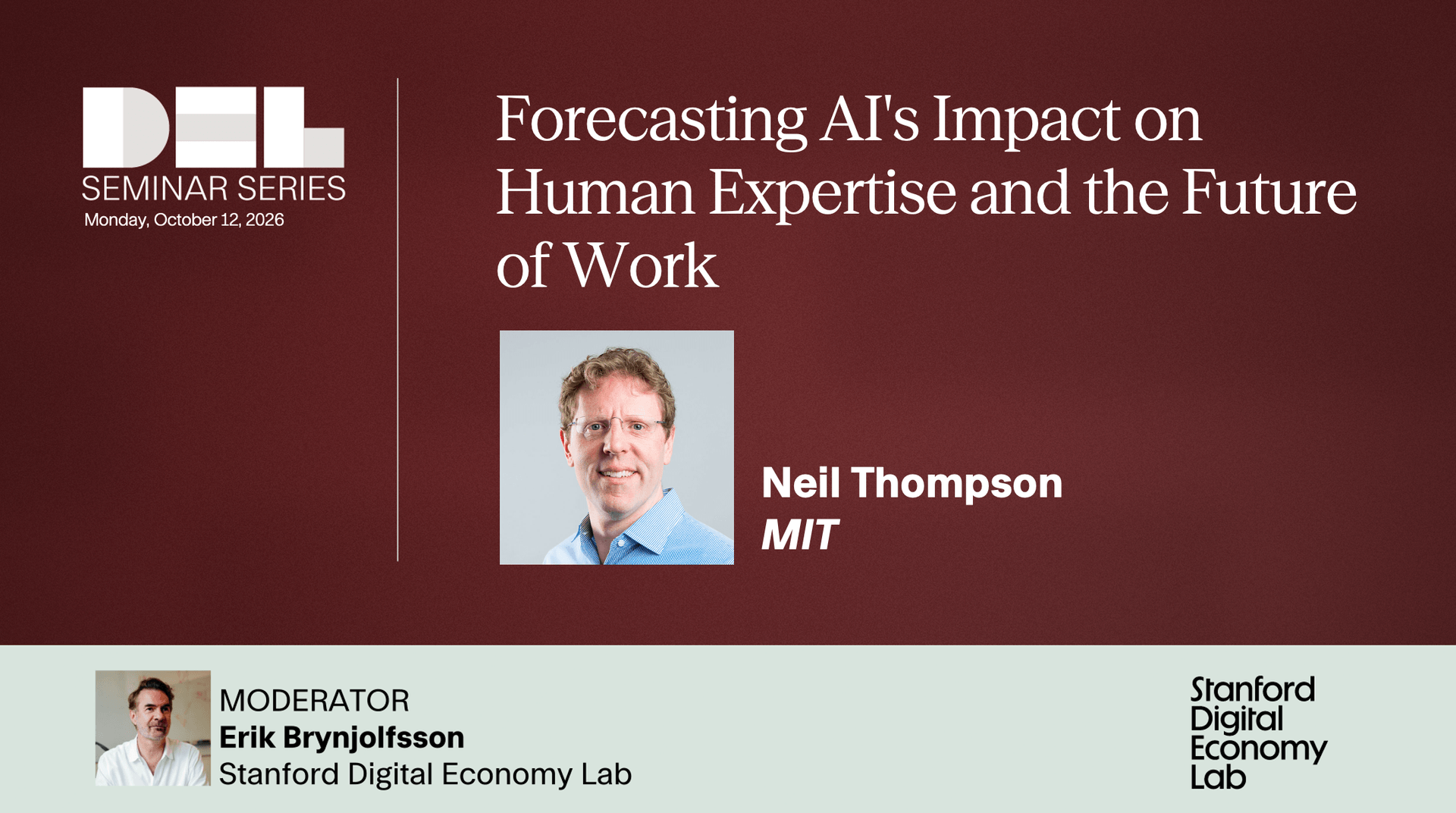
Neil Thompson: Forecasting AI’s Impact on Human Expertise and the Future of Work
AI is advancing rapidly at the cognitive tasks that make up knowledge work, raising fears among firms, policymakers, and, not least, workers of a “China shock” for white-collar jobs. Neil Thompson will present new research on whether those fears are warranted.
AI is advancing rapidly at the cognitive tasks that make up knowledge work, raising fears among firms, policymakers, and, not least, workers of a “China shock” for white-collar jobs. Neil Thompson will present new research on whether those fears are warranted.
Marlowe | AI + Data for Science with Curtis Langlotz
Sessions run Wednesdays from 4:30–5:30 PM in CoDa E160. Each session features a different Stanford speaker; talk titles are announced by the organizers.

Sessions run Wednesdays from 4:30–5:30 PM in CoDa E160. Each session features a different Stanford speaker; talk titles are announced by the organizers.