HAI Weekly Seminar with Amy Zegart
Spies, Lies, and Algorithms: The History and Future of American Intelligence
A contributing writer at the Atlantic, senior fellow at the Hoover Institution, and author of Spying Blind: The CIA, the FBI, and the Origins of 9/11, Zegart reports that the digital age has made intelligence gathering vastly more difficult. Agencies once concentrated on foreign governments and terrorists. “Today,” writes the author, “they also have to understand American tech giants—and how malign actors can use our own inventions against us.” The National Security Agency, the traditional big data behemoth, faces competition from Google, Facebook, Apple, and Amazon, and Twitter and Facebook have become disinformation highways. Zegart warns that Americans get most of their ideas on intelligence agencies from the movies: Torture always works. Heroes break the law, ignore ethics, and act without mercy against America’s enemies. The author recounts triumphs and debacles but mostly delivers a splendid education in psychology and political science as she explains the role, operation, and limitations of intelligence. Intelligence organizations provide information, never policy, which is politicians’ responsibility, and bad things happen when they forget this.
All services gather data, which becomes intelligence only when it is analyzed and used to make predictions. Unfortunately, intelligence predictions are too often wrong, for reasons the author explains in a brilliant section, “The Seven Deadly Biases,” which should be taught in schools along with multiplication tables. According to confirmation bias, humans (not excluding analysts) readily accept facts that confirm what they believe and reject those that contradict it. Readers who assume that catching spies and covert action are straightforward and that Congress keeps an eye on our intelligence services will learn the error of their ways. Zegart’s conclusion offers further unsettling news: In the wireless 21st-century world, espionage, sabotage, and brainwashing are no longer the province of government agencies; nearly anyone with an internet connection can do it.
Speaker
 Amy Zegart
Morris Arnold and Nona Jean Cox Senior Fellow, Hoover Institution; Senior Fellow, Stanford Freeman Spogli Institute of International Studies; Senior Fellow and Associate Director, Stanford HAI
No tweets available.Related Events
Khaoula Chehbouni | Best Practices for the Use of LLMs as Judges
An AI Measurement Science (AIMS) Seminar Series

An AI Measurement Science (AIMS) Seminar Series
Special Seminar and Fireside Chat: Understanding Work Using AI
Phil Lewis from the National Center for O*NET Development will talk about data infrastructure the US Department of Labor provides, and how AI is used to update it. A panel with Diyi Yang from the Stanford Computer Science Department and DEL’s Erik Brynjolfsson will discuss the opportunities of a new partnership between Stanford and the National Center for O*NET Development.
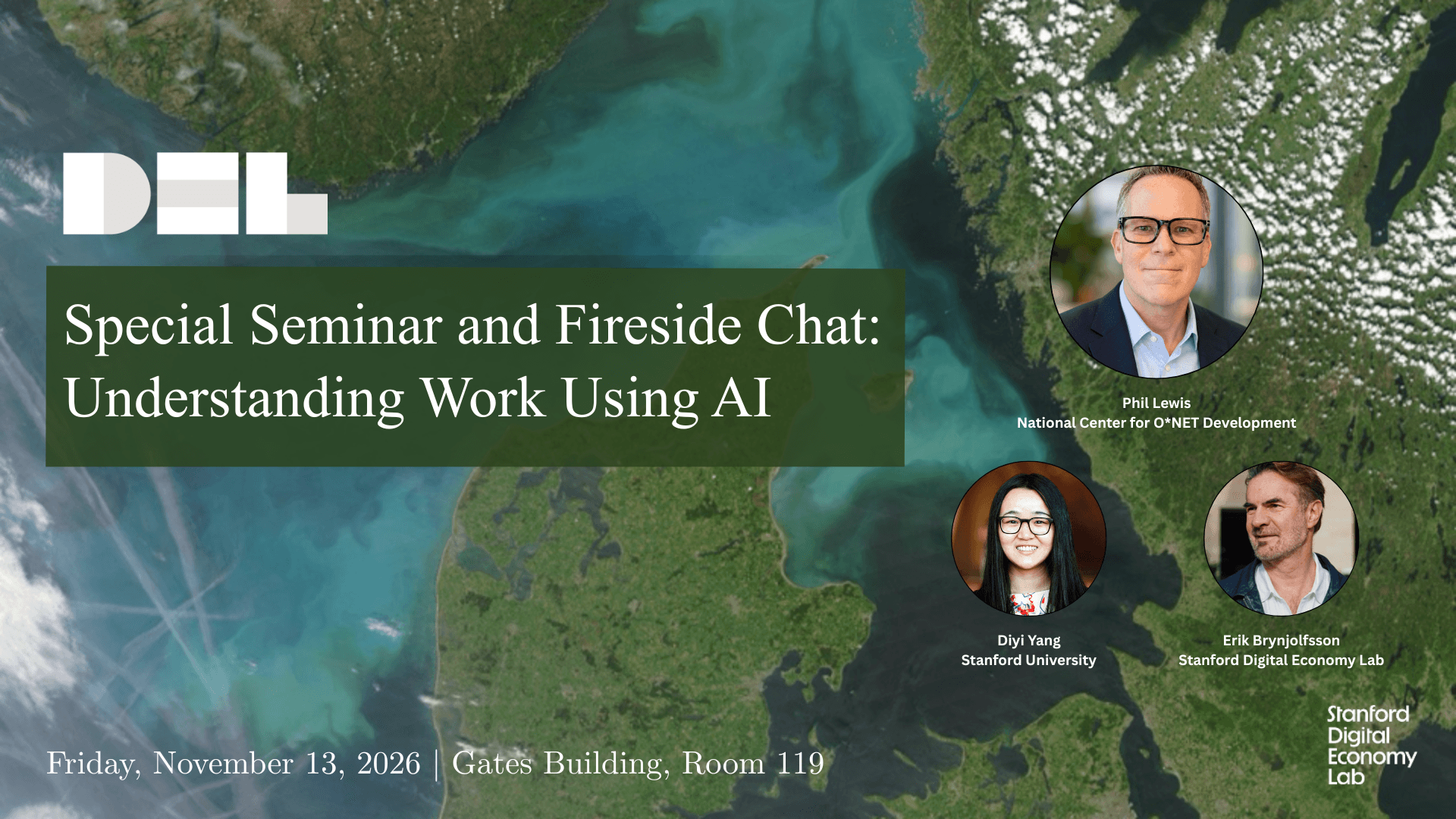
Phil Lewis from the National Center for O*NET Development will talk about data infrastructure the US Department of Labor provides, and how AI is used to update it. A panel with Diyi Yang from the Stanford Computer Science Department and DEL’s Erik Brynjolfsson will discuss the opportunities of a new partnership between Stanford and the National Center for O*NET Development.
Christopher Ong | Research Acceleration: The View Inside OpenAI
In the last year, AI models have rapidly improved on public benchmarks measuring their ability to carry out research tasks autonomously. Such performance suggests that models may be capable of automating parts of the AI R&D process itself, thereby accelerating the pace of AI progress.
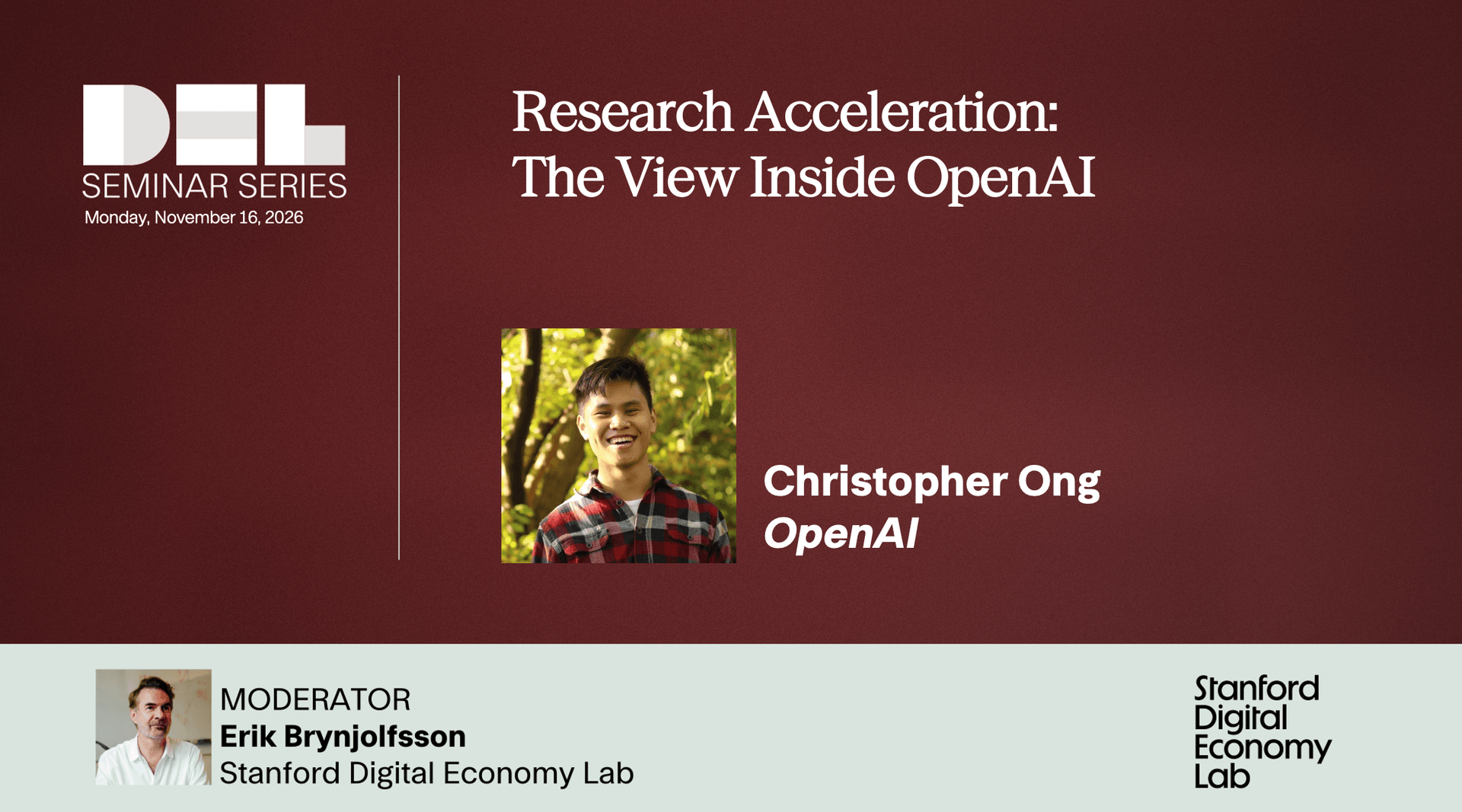
In the last year, AI models have rapidly improved on public benchmarks measuring their ability to carry out research tasks autonomously. Such performance suggests that models may be capable of automating parts of the AI R&D process itself, thereby accelerating the pace of AI progress.