eventSeminar
HAI Weekly Seminar with Lisa Simon
The Future of Work and How the Workforce Adapts to Change
Get the latest news, advances in research, policy work, and education program updates from HAI in your inbox weekly.
Sign Up For Latest News
The Future of Work and How the Workforce Adapts to Change
The rapid acceleration of AI comes with a profound wave of anxiety. Across every sector of society, people are facing unsettling questions about their worth and their place in a shifting world.
The rapid acceleration of AI comes with a profound wave of anxiety. Across every sector of society, people are facing unsettling questions about their worth and their place in a shifting world.
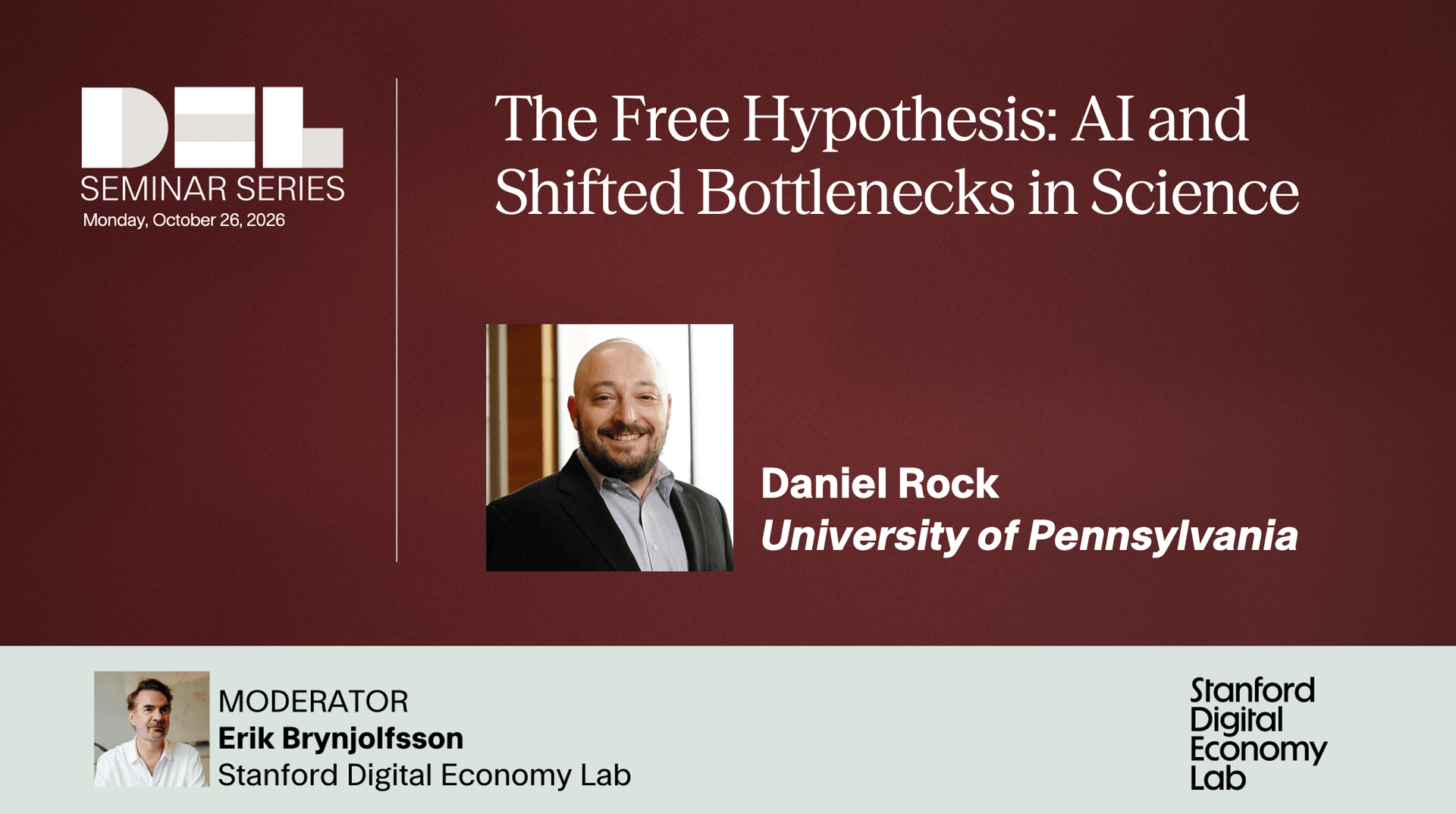
Scientific progress is a key driver of economic growth and prosperity. There is great excitement- but also concerns- about the impacts of AI on science, but so far little data. We provide early insights on this from three data sources: a sample of 15 million Gemini interactions, an inventory of over 2,600 specialized AI models across disciplines, and a survey of over 600 scientists.
Scientific progress is a key driver of economic growth and prosperity. There is great excitement- but also concerns- about the impacts of AI on science, but so far little data. We provide early insights on this from three data sources: a sample of 15 million Gemini interactions, an inventory of over 2,600 specialized AI models across disciplines, and a survey of over 600 scientists.
The labor market is changing ever more rapidly, and with that, the pressure to adapt and evolve has increased on everyone, One of the main drivers of change is technological progress, with technologies such as robots, software or AI fundamentally changing how work gets done and by whom. Automation both replaces certain tasks that humans used to do, and more importantly changes the required skills in occupations that are adapting new technologies. This presentation will draw on my research that sheds light on how individual adapt to change on the labor market. I explore how individuals transition between different career pathways and how they react, when faced with negative shocks. Knowing who can adapt to change and who may need help, provides important policy implications for the future of work. The research presented uses data spanning Europe and the US as well as state-of-the art empirical methods, including machine learning.