eventSeminar
HAI Weekly Seminar with Mitchell Stevens
Massive: How MOOCs Changed the Landscape of Education Research
Get the latest news, advances in research, policy work, and education program updates from HAI in your inbox weekly.
Sign Up For Latest News
Massive: How MOOCs Changed the Landscape of Education Research
Scientific progress is a key driver of economic growth and prosperity. There is great excitement- but also concerns- about the impacts of AI on science, but so far little data. We provide early insights on this from three data sources: a sample of 15 million Gemini interactions, an inventory of over 2,600 specialized AI models across disciplines, and a survey of over 600 scientists.
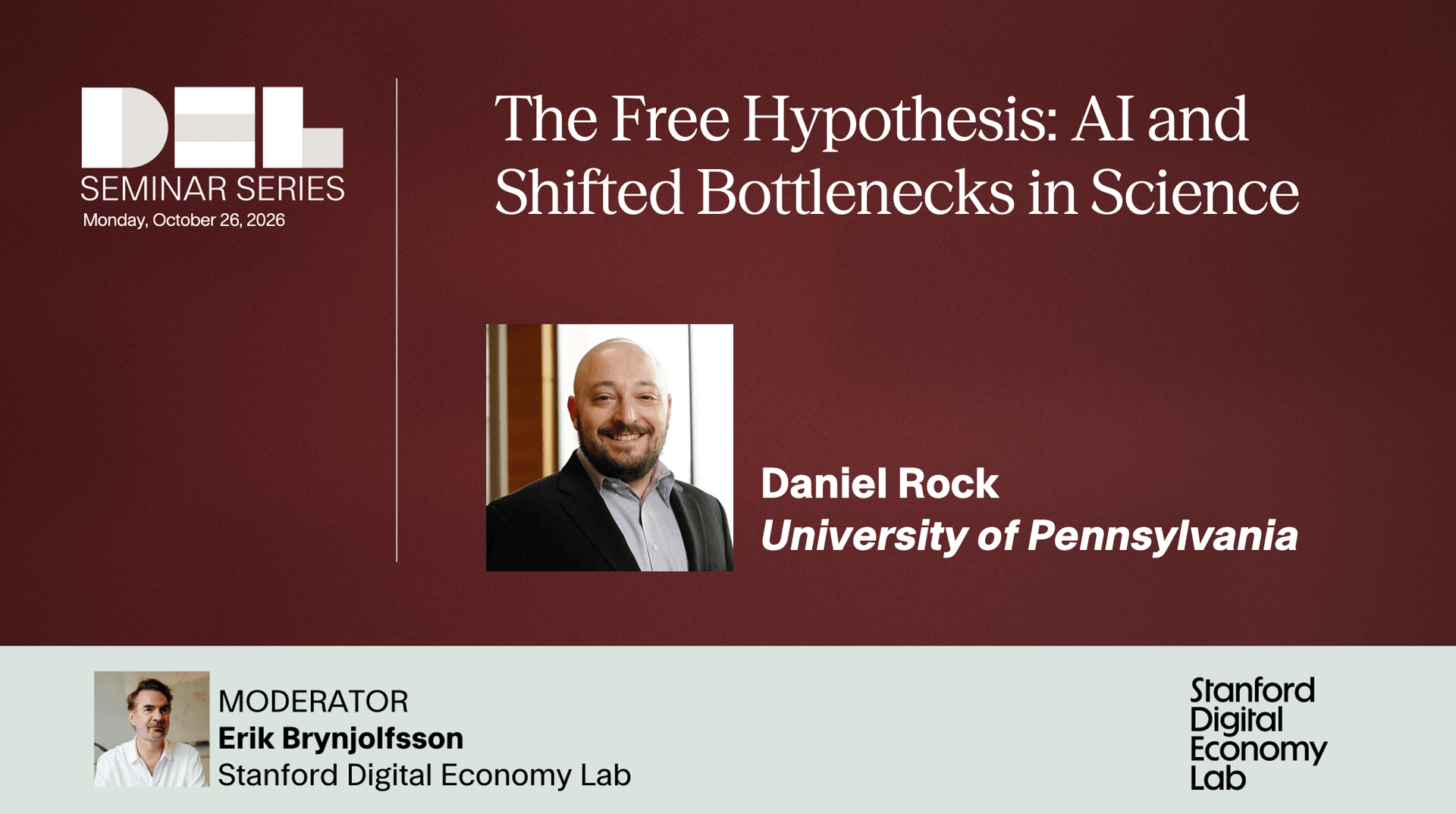
Scientific progress is a key driver of economic growth and prosperity. There is great excitement- but also concerns- about the impacts of AI on science, but so far little data. We provide early insights on this from three data sources: a sample of 15 million Gemini interactions, an inventory of over 2,600 specialized AI models across disciplines, and a survey of over 600 scientists.
The rapid acceleration of AI comes with a profound wave of anxiety. Across every sector of society, people are facing unsettling questions about their worth and their place in a shifting world.
The rapid acceleration of AI comes with a profound wave of anxiety. Across every sector of society, people are facing unsettling questions about their worth and their place in a shifting world.
Sessions run Wednesdays from 4:30–5:30 PM in CoDa E160. Each session features a different Stanford speaker; talk titles are announced by the organizers.

Sessions run Wednesdays from 4:30–5:30 PM in CoDa E160. Each session features a different Stanford speaker; talk titles are announced by the organizers.
The embrace of massively open online courses (MOOCs) by Harvard, MIT and Stanford from 2012-2014 created buzz and anxiety among educators worldwide. While many were quick to thereafter declare the failure of MOOCs as instructional technologies, their legacy continues to transform the landscape of educational research. MOOCs demonstrated that minute instructional interactions could be observed and experimentally instrumented at scale; lured substantial new talent to educational inquiry from the burgeoning fields of data science and machine learning; dramatically expanded what counts as an instructional environment; and abetted the flow of private capital into a burgeoning sector now called “learning.” In this talk I synthesize recent scholarship to frame the promise and risks attendant to pursuit of learning research in digitally mediated environments.