Judith Fan | Cognitive Tools for Uncovering Useful Abstractions
In the 17th century, the Cartesian coordinate system exposed the unity between algebra and geometry, accelerating the development of the math that took humans to the moon.
It was not just another concept, but a cognitive tool that people could wield to express abstract ideas in visual form. Judith Fan’s lab aims to uncover the psychological mechanisms that explain how people have come to deploy these technologies to learn, share knowledge, and innovate. The first part of this talk will focus on the lab’s recent work investigating drawing, which not only sheds light on how humans perceive and understand the visual world, but also accelerates their ability to communicate useful abstractions. The second part will describe emerging research into how humans discover new abstractions when building physical structures, and externalize these abstractions to support planning and collaboration. This talk will close by noting the implications of embracing such behaviors for advancing theories of human cognition and enhancing real-world impact, including in AI and education.
Related Events
Bay Area Tech Economics Seminar with Rehan Khan, Snowflake
The Bay Area Tech Economics Seminar is for graduate-trained economists and other quantitative social scientists from academia, policy, or the private sector who are interested in the tech economy and methods for analyzing it, and in making connections with others in this broadly defined space.
The Bay Area Tech Economics Seminar is for graduate-trained economists and other quantitative social scientists from academia, policy, or the private sector who are interested in the tech economy and methods for analyzing it, and in making connections with others in this broadly defined space.
Marlowe | AI + Data for Science with Anshul Kundaje
Sessions run Wednesdays from 4:30–5:30 PM in CoDa E160. Each session features a different Stanford speaker; talk titles are announced by the organizers.
Sessions run Wednesdays from 4:30–5:30 PM in CoDa E160. Each session features a different Stanford speaker; talk titles are announced by the organizers.
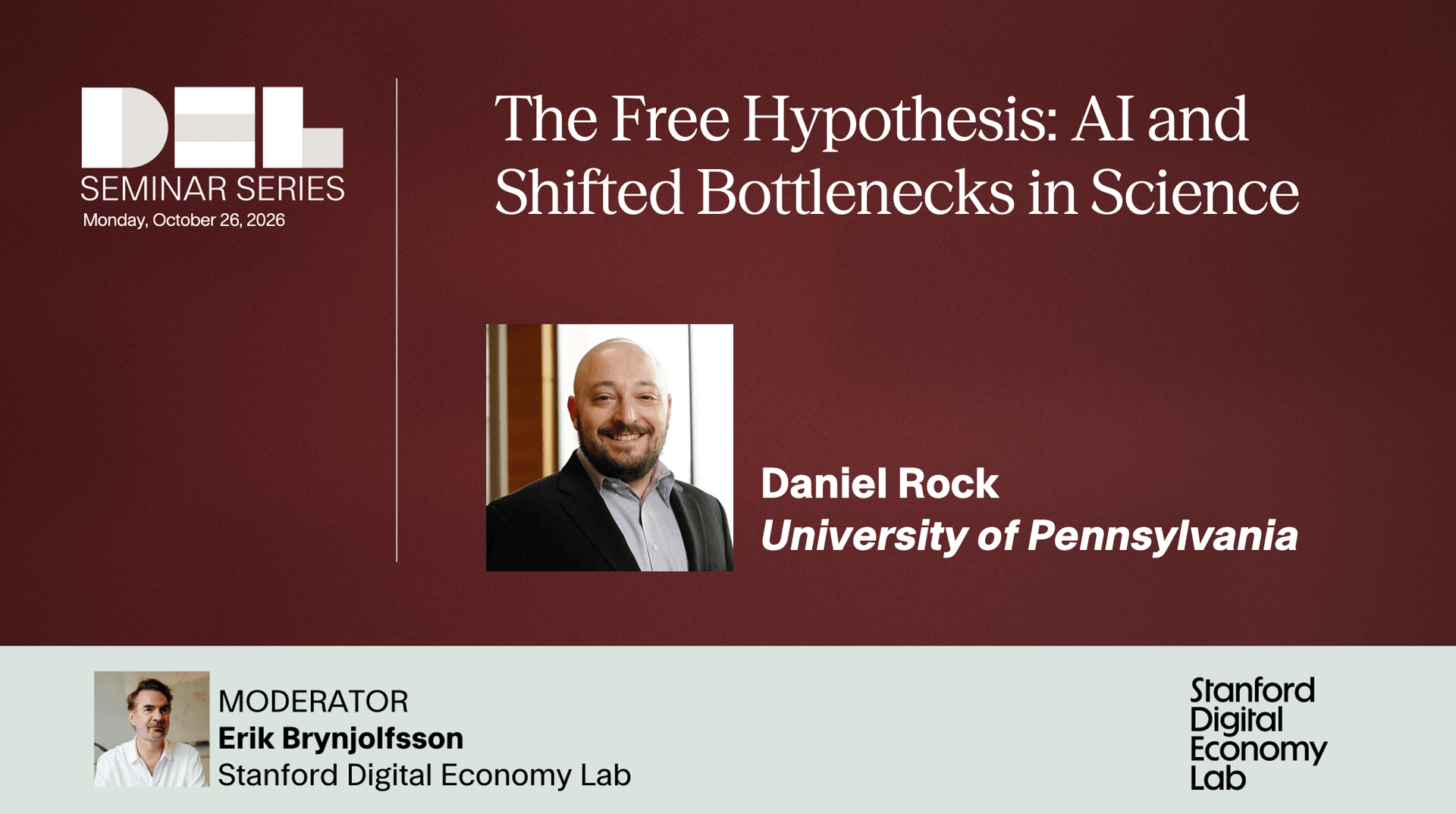
Daniel Rock | The Free Hypothesis: AI and Shifted Bottlenecks in Science
Scientific progress is a key driver of economic growth and prosperity. There is great excitement- but also concerns- about the impacts of AI on science, but so far little data. We provide early insights on this from three data sources: a sample of 15 million Gemini interactions, an inventory of over 2,600 specialized AI models across disciplines, and a survey of over 600 scientists.
Scientific progress is a key driver of economic growth and prosperity. There is great excitement- but also concerns- about the impacts of AI on science, but so far little data. We provide early insights on this from three data sources: a sample of 15 million Gemini interactions, an inventory of over 2,600 specialized AI models across disciplines, and a survey of over 600 scientists.