Get the latest news, advances in research, policy work, and education program updates from HAI in your inbox weekly.
Sign Up For Latest News
This talk will cover key insights from the third AI100 report, AI Goes Mainstream: The Scaling Era and the Rise of Generative AI, set for release in November 2026. The report was commissioned by the AI100 standing committee and led by study panel chair Michael Wooldridge.
This talk will cover key insights from the third AI100 report, AI Goes Mainstream: The Scaling Era and the Rise of Generative AI, set for release in November 2026. The report was commissioned by the AI100 standing committee and led by study panel chair Michael Wooldridge.
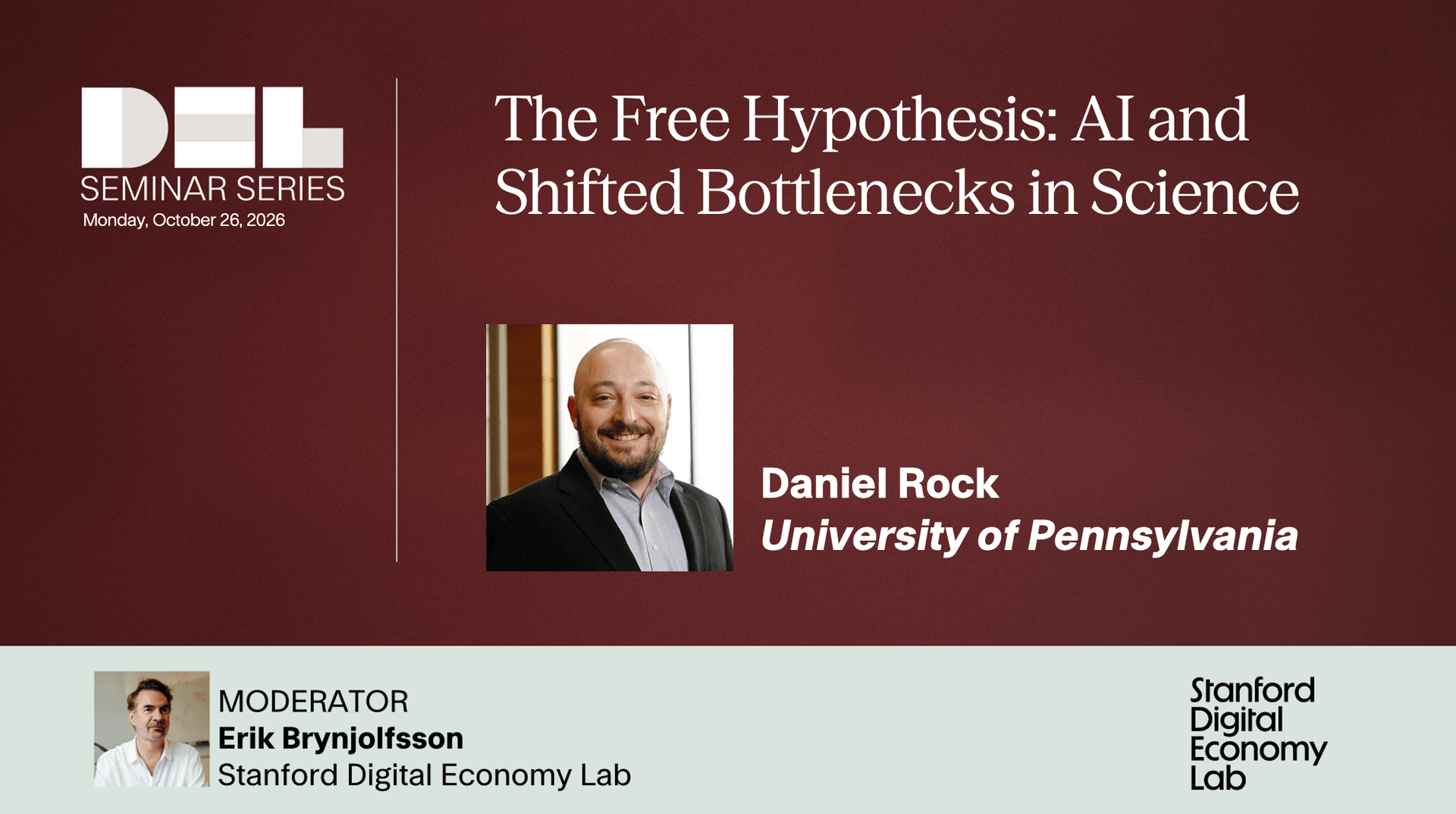
Scientific progress is a key driver of economic growth and prosperity. There is great excitement- but also concerns- about the impacts of AI on science, but so far little data. We provide early insights on this from three data sources: a sample of 15 million Gemini interactions, an inventory of over 2,600 specialized AI models across disciplines, and a survey of over 600 scientists.

Scientific progress is a key driver of economic growth and prosperity. There is great excitement- but also concerns- about the impacts of AI on science, but so far little data. We provide early insights on this from three data sources: a sample of 15 million Gemini interactions, an inventory of over 2,600 specialized AI models across disciplines, and a survey of over 600 scientists.
The rapid acceleration of AI comes with a profound wave of anxiety. Across every sector of society, people are facing unsettling questions about their worth and their place in a shifting world.

The rapid acceleration of AI comes with a profound wave of anxiety. Across every sector of society, people are facing unsettling questions about their worth and their place in a shifting world.
John H. Cochrane (Stanford), “AI, Society, and Democracy: Just Relax”
Sarah Friar (OpenAI) and Laura Bisesto (OpenAI), “The Potential for AI to Restore Local Community Connectedness, the Bedrock of a Healthy Democracy”
Mona Hamdy (Anomaly and Harvard University), Johnnie Moore (JDA Worldwide and The Congress of Christian Leaders), and E. Glen Weyl (Plural Technology Collaboratory), “Techno-ideologies of the Twenty-first Century”
Reid Hoffman (Greylock) and Greg Beato, “Informational GPS”
Lawrence Lessig (Harvard), “Protected Democracy”
James Manyika (Google and Alphabet), “Getting AI Right: A 2050 Thought Experiment”
Jennifer Pahlka (Niskanen Center and the Federation of American Scientists), “AI Meets the Cascade of Rigidity”
Nathaniel Persily (Stanford), “Misunderstanding AI’s Democracy Problem”
Eric Schmidt (Former CEO and Chairman of Google), “Democracy 2.0”
Divya Siddarth (Collective Intelligence Project), Saffron Huang (Collective Intelligence Project), Audrey Tang (Collective Intelligence Project), “A Vision of Democratic AI”
Lily L. Tsai (MIT) and Alex Pentland (Stanford), “Rediscovering the Pleasures of Pluralism: The Potential of Digitally Mediated Civic Engagement”
Eugene Volokh (Stanford and UCLA), “Generative AI and Political Power”