eventSeminar
Wolfgang Lehrach | Code World Models for General Game Playing
While Large Language Models (LLMs) show promise in many domains, relying on them for direct policy generation in games often results in illegal moves and poor strategic play.
Get the latest news, advances in research, policy work, and education program updates from HAI in your inbox weekly.
Sign Up For Latest News
While Large Language Models (LLMs) show promise in many domains, relying on them for direct policy generation in games often results in illegal moves and poor strategic play.
AI is advancing rapidly at the cognitive tasks that make up knowledge work, raising fears among firms, policymakers, and, not least, workers of a “China shock” for white-collar jobs. Neil Thompson will present new research on whether those fears are warranted.
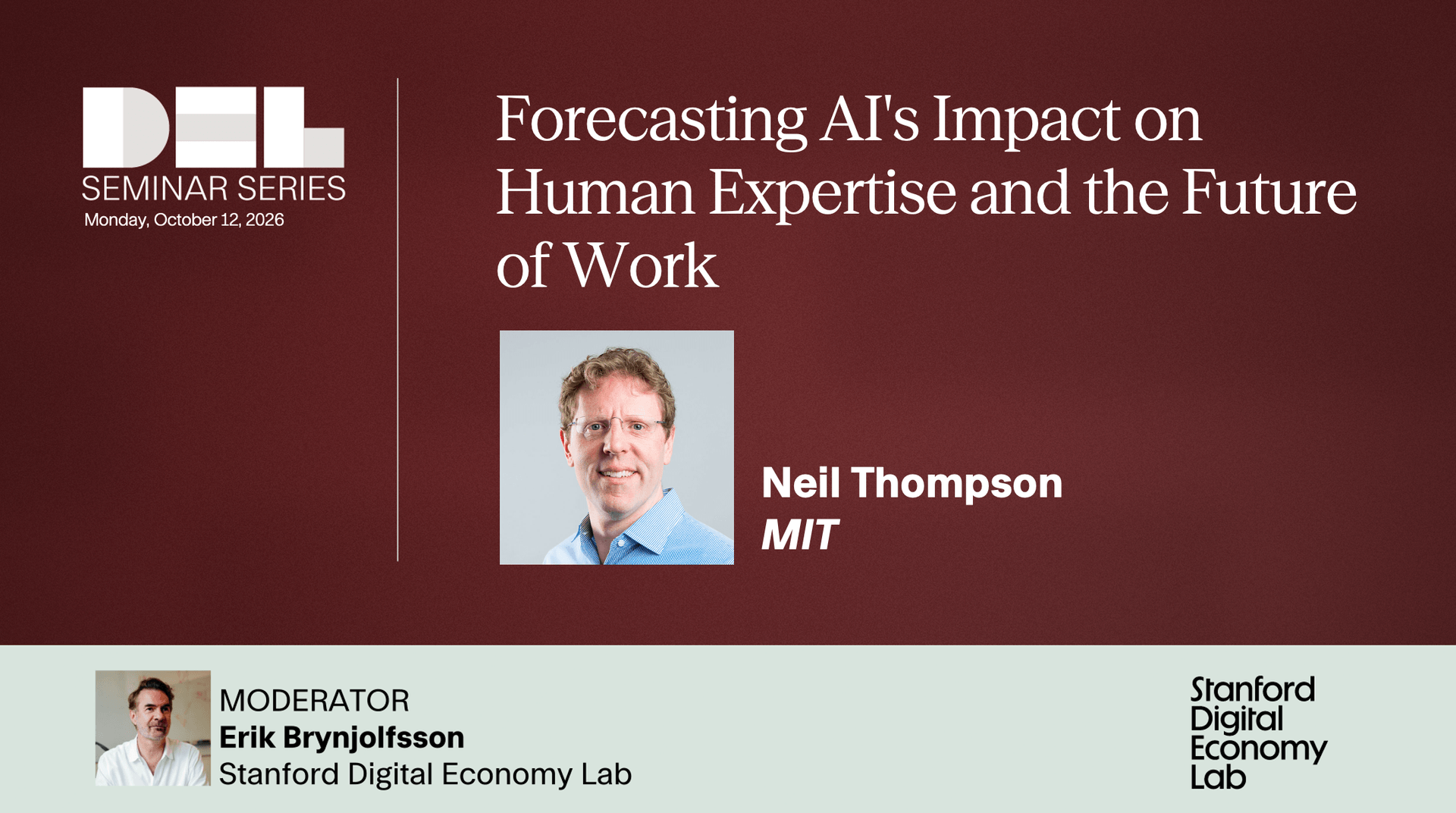
AI is advancing rapidly at the cognitive tasks that make up knowledge work, raising fears among firms, policymakers, and, not least, workers of a “China shock” for white-collar jobs. Neil Thompson will present new research on whether those fears are warranted.
Scientific progress is a key driver of economic growth and prosperity. There is great excitement- but also concerns- about the impacts of AI on science, but so far little data. We provide early insights on this from three data sources: a sample of 15 million Gemini interactions, an inventory of over 2,600 specialized AI models across disciplines, and a survey of over 600 scientists.
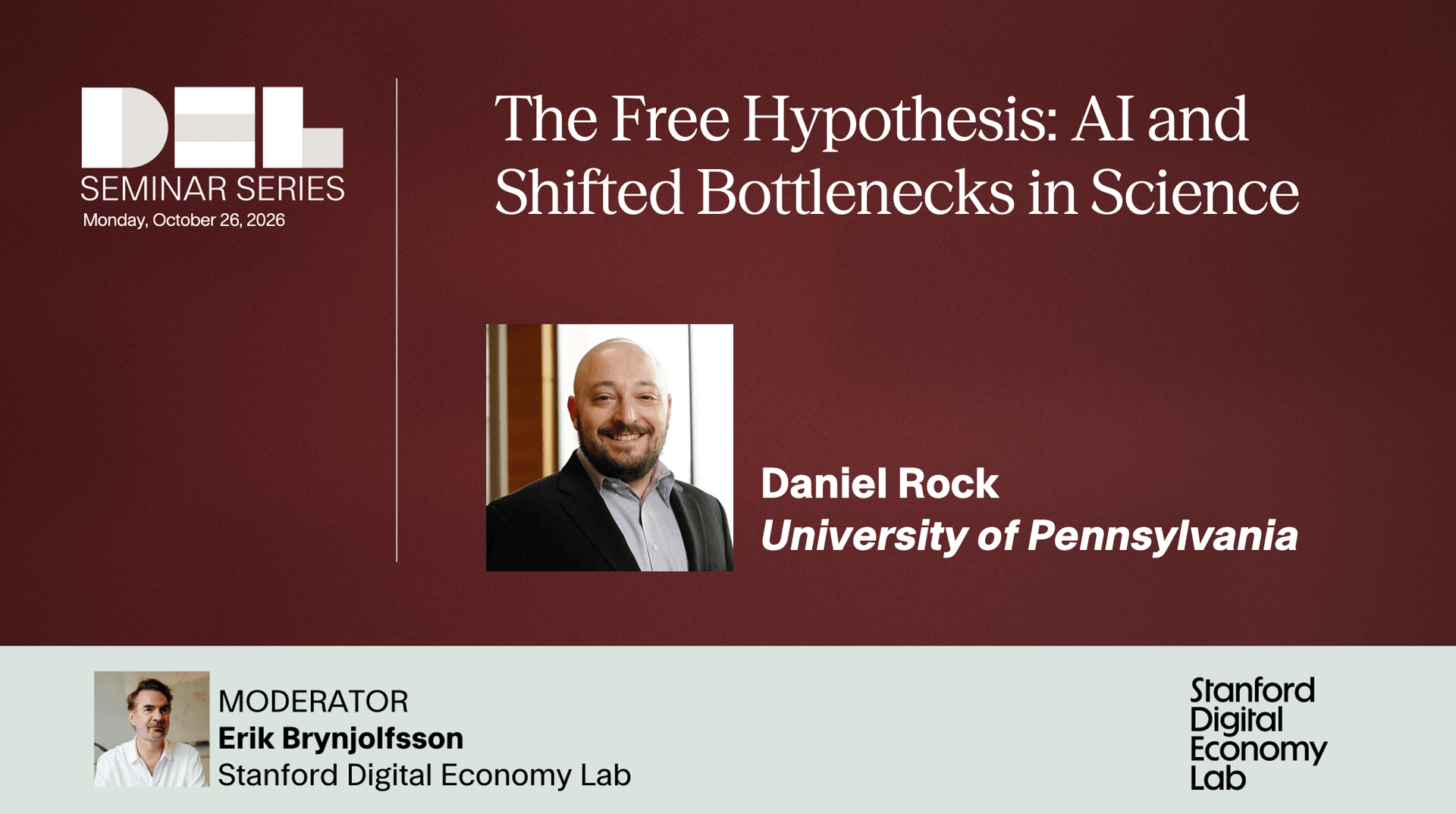
Scientific progress is a key driver of economic growth and prosperity. There is great excitement- but also concerns- about the impacts of AI on science, but so far little data. We provide early insights on this from three data sources: a sample of 15 million Gemini interactions, an inventory of over 2,600 specialized AI models across disciplines, and a survey of over 600 scientists.
In this talk, I present an approach that moves away from direct prompting, instead using LLMs as program synthesizers to bridge the gap between natural language rules and symbolic world models. The LLM receives a game description and example trajectories, and outputs an executable, symbolic world model (CWM) represented in Python. The trajectories also ensure the rules are correctly captured and aid in refining the CWM if they are not. Note that even trajectories containing only a single player's observations and actions can be used to help validate and refine CWMs. Furthermore, partially observed trajectories also allow comparisons between CWMs via a bound on the likelihood.
Given a CWM, Monte Carlo Tree Search (MCTS) or Reinforcement Learning (RL) methods can play the game, and gameplay can be further enhanced by adding in LLM-derived synthesized value functions. Imperfect information games are handled by having the LLM synthesize inference functions to impute information sets, or by directly training reinforcement learning policies on top of the CWM.