Building a Wearable That Can Catch You When You Stumble
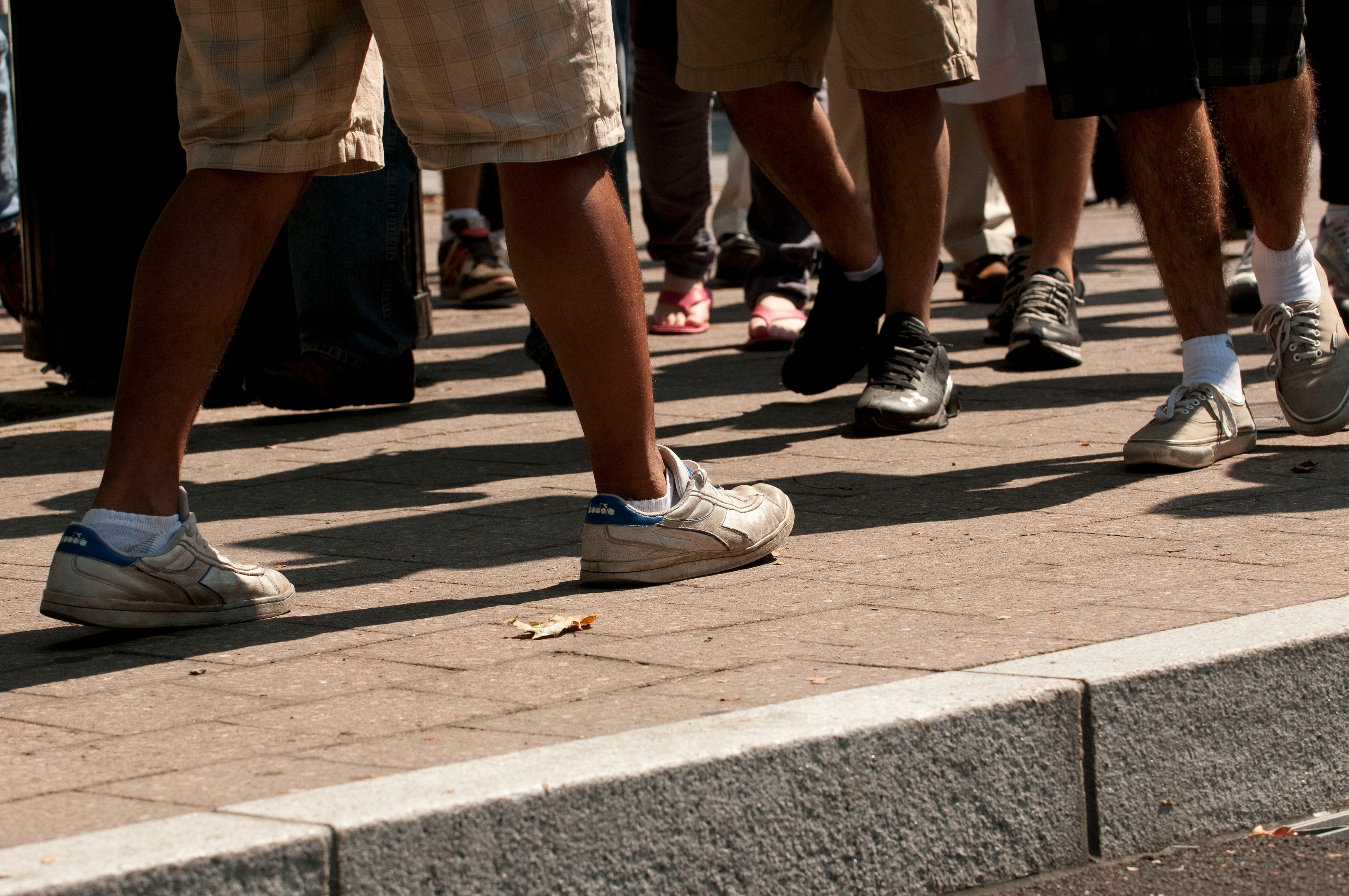
An AI-based robotics system can predict and prevent falls in high-risk populations.
Tripping over clutter or missing a stair-step can be much more than an annoyance.
For older adults, especially, the consequences of stumbling and falling can be costly on every dimension. Indeed, the direct medical costs of falls have been estimated as high as $50 billion per year.
One promising solution is an AI-based robotics system to predict and prevent falls.
“We research problems where robots need to apply physical force to humans to assist them — such as activities of daily life like dressing, feeding, walking, and bathing,” says C. Karen Liu, a Stanford associate professor of computer science. Specifically, Liu and her team seek to break new ground in robotic assistance by developing wearable robotic devices to aid in human locomotion.
They propose creation of an AI-based system to predict and prevent falls. The research group, which includes Stanford colleagues Steve Collins, Scott Delp, Leo Guibas, and VJ Periyakoil, along with multiple graduate students and other associates, received one of Stanford Institute for Human-Centered Artificial Intelligence's inaugural Hoffman-Yee grants to fund their work.
The Problem
Falls have major impact on individual and collective well-being. Beyond the large annual cost injuries incur, when an older person falls, their risk of falling again in the future doubles. But falling can be mostly predictable if we have the right sensing capability, Liu explains. Actuators, or motors that convert energy into torque to stimulate or stop movement, can be used to prevent falls as part of a wearable device.
Still, preventing a fall with AI technology is far from easy. “It’s one of the most complex situations you can imagine, with persistent physical contact between human and robot,” Liu says. “We have to understand how to do this in an effective but safe manner.”
Preventing falls with wearable robotics requires two steps: detecting fall-related conditions and using predictions yielded to activate a wearable device. The team has proposed exactly such a detection-and-activation system.
The Solution
To start, “You need to create an AI system to teach another AI system,” Liu says of the team’s challenge.
Specifically, they aim to develop an AI-based “intelligent agent” to simulate human motion and what happens to mobility as a result of perturbation such as tripping over an unseen item or bumping into furniture. “The system will need to figure the most effective way to recover,” Liu says.
The agent is a software-based simulation trained to mimic human locomotion and balance recovery. Simulating motion with AI is faster, much less expensive, and safer than running trials with actual humans or building locomotive robots. Liu says, “There are so many different dimensions we need to consider when studying falling. Physics-based simulation allows us to easily create not just one human model but a distribution of human models to train the intelligent robotic device. That’s the centerpiece of our approach.”
The proposed wearable, at least to start, would be placed around a user’s hip area, in the form of an exoskeletal device — a semi-rigid apparatus that provides extra control and power to muscles in the region. “Eventually, we could move to an exoskeleton covering more of the lower limbs,” Liu says.
Once fully trained, the system would use an onboard computer to detect or predict falls by monitoring the user’s acceleration and velocity of center of mass, among other factors. “If the possibility of falling is predicted to be higher than a certain threshold,” Liu says, “the recovery policy will be activated.”
The recovery protocol would apply torque to specific leg areas such as the hip, to change the timing or placement of the next footstep, to prevent falling. “It might help the user take the next step a little faster or make it longer or shorter,” Liu says. The team also aims to augment wearable devices with vision perception to detect fall hazards such as uneven pavement and steer the user away. “In many cases, we would like to have the user preemptively avoid the fall hazards rather than passively recover from a fall,” Liu says.
Moreover, the “system must avoid false-positives [incorrect prediction of a fall] at all costs,” Liu says. “Faulty assistance is worse than no assistance at all. The system that applies torque has to stay off unless the detection system is certain a fall will happen. If it activates at the wrong time, it could actually cause a fall.”
Once refined, the system would be tested with older adults and other populations before larger-scale rollout.
The Impact
Liu’s team will target the system to multiple user populations, starting with those over age 65, who are most at risk for harmful falls.
“But we’re looking to help anyone able to walk on their own who still has difficulty navigating certain situations, such as moving in a cluttered, narrow space or getting out of a car,” Liu says. That might include people with a neurological or movement disorder, for example.
Beyond addressing falls, the proposed AI system represents a broader type of solution that provides much more intelligent awareness and understanding of humans interacting with a complex environment. “Being able to understand users and predict their intentions and offer help at the right time is important in many situations,” Liu says. “We’d like to have a wearable device that provides intelligent assistance to complement a user's motion plan, instead of overpowering their movements.”
That means similar prediction-to-activation systems that could eventually help people with activities ranging from opening doors to lifting heavy objects. But for now, the system Liu and her team are building will focus on helping people specifically with navigation of their daily living environments — one prevented fall at a time.
Stanford HAI's mission is to advance AI research, education, policy and practice to improve the human condition. Learn more.
Related News

A new Stanford-led study finds that X’s “For You” algorithm mistakes outrage for interest – and fills your feed accordingly.

A new Stanford-led study finds that X’s “For You” algorithm mistakes outrage for interest – and fills your feed accordingly.
AI Companions May Worsen Loneliness for Vulnerable Users, Stanford Study Finds

Stanford research finds that users with limited social networks who seek emotional support from AI companions experience lower well-being.

Stanford research finds that users with limited social networks who seek emotional support from AI companions experience lower well-being.
The Complexities of Governing Mental Health AI

Policymakers, academics, healthcare providers, AI developers, and patient advocates convened by Stanford HAI identify critical gaps in how we regulate AI tools used for therapy and emotional support.

Policymakers, academics, healthcare providers, AI developers, and patient advocates convened by Stanford HAI identify critical gaps in how we regulate AI tools used for therapy and emotional support.