How Natural Disasters Exacerbate Inequity
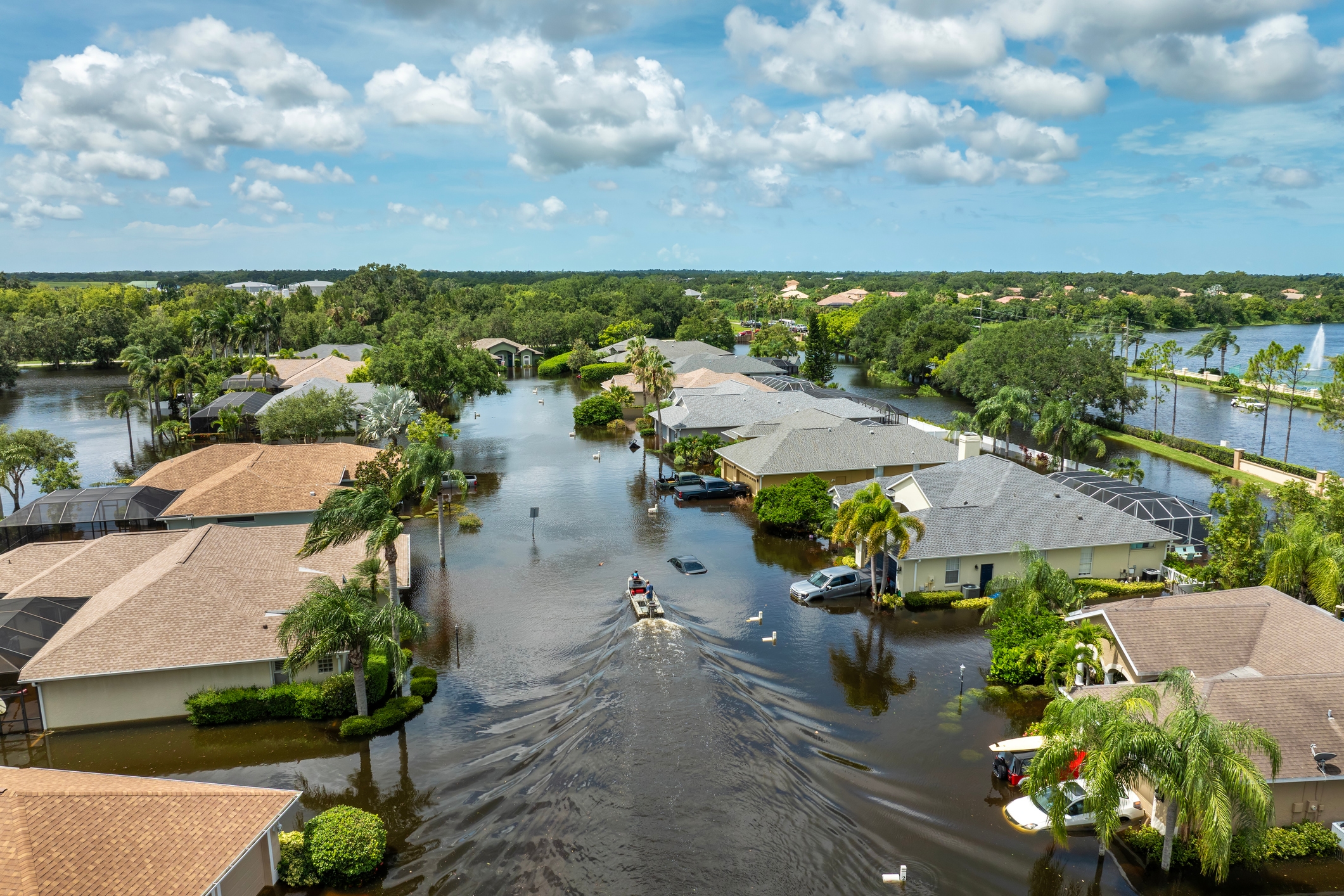
Using AI to analyze Google Street View images of damaged buildings across 16 states, Stanford researchers found that destroyed buildings in poor areas often remained empty lots for years, while those in wealthy areas were rebuilt bigger and better than before.
After a massive natural disaster, some people whose homes are destroyed will stay and rebuild while others will move and establish new lives elsewhere.
Entire communities are changed in ways that have not been fully understood. Are they rebuilt in ways that are equitable or do the forces favoring growth become a kind of “recovery machine” that reinvests and rebuilds to the benefit of the wealthy?
In the past, researchers have often evaluated natural disasters’ impacts one storm at a time and for short time periods, with a focus on population changes rather than the built environment, says Tianyuan Huang, who completed his PhD in civil and environmental engineering and computer science at Stanford last year and now works for Waymo.
To address those limitations, Huang and his colleagues turned to historical Google Street View data, which includes photos taken of nearly every address across the United States every one to three years. “This dataset offers an opportunity for much larger scale and longer-term study of how the built environment changes over time after extreme events,” Huang says.
The researchers asked GPT-4, the first publicly available multi-modal model capable of combining vision and language together, to look at the Google Street View data and assess the extent of recovery of buildings that were damaged by extreme weather events in 16 states from 2011 to 2018.
The team’s findings, supported by a Stanford Institute for Human-Centered AI cloud credit and now published in Nature, show that buildings in lower income areas that were visibly damaged after a disaster were much more likely to become empty lots for years, while damaged buildings in wealthy areas were much more likely to be rebuilt as larger and more robust structures. “After a disaster, the income disparities are amplified,” Huang says.
The results support the “recovery machine” hypothesis, which posits that, after a disaster, developers, realtors, and bankers follow their pro-growth inclinations to build back better than ever. It’s an urge that tends to benefit people with access to or control over financial resources while neglecting lower income people.
According to co-author Jackelyn Hwang, associate professor of sociology at the Stanford School of Humanities and Sciences and director of the Changing Cities Research Lab, this research shows that our nation’s disaster relief system helps wealthier neighborhoods become wealthier and maintain their housing values despite being located in climate-risky areas. “Current policies are not working as well for poor communities,” she says.
Studying Disasters Using Google Street View
Huang had previously used Google Street View’s historical images dataset to study urban gentrification over a 16-year time period. For that work, he trained a model to recognize changes in the built environment. But when he and his colleagues launched their climate-disaster-related project in 2023, they had a new tool at their disposal: OpenAI’s GPT-4. “We used it the second day after it was released.” Huang says.
The team first asked GPT-4 to identify all the buildings that were visibly damaged after extreme events in the historical Google Street View data for more than 106,000 properties with FEMA damage reports across 16 states from 2007 to 2023. A manual check found that GPT-4 was 98% accurate at that task and identified more than 17,000 visibly damaged buildings.
The team then asked GPT-4 to evaluate how many of the damaged buildings became or remained empty lots, were rebuilt to the same level as before the disaster, or were built back bigger or nicer than they had been before. Compared with human labellers, GPT-4 was 80% accurate at this task. The team also validated these findings with satellite data.
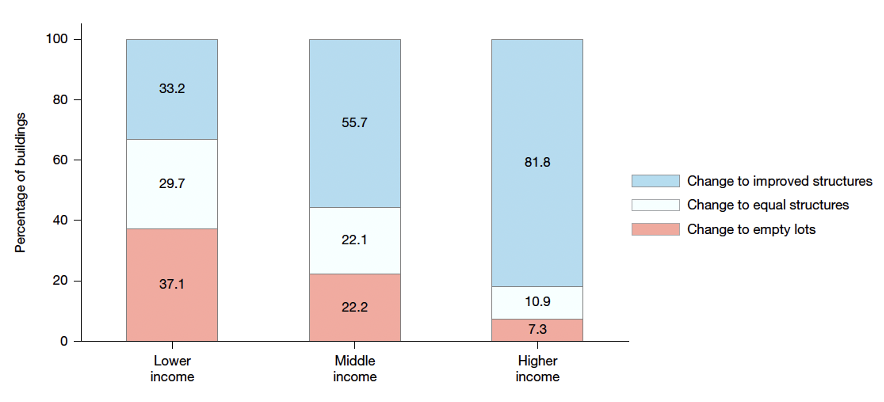
The researchers found distinct differences in rebuild rates for census tracts with different median income levels (low, medium, high). In lower-income areas, more than 37% of buildings that were damaged and then became empty lots after a disaster remained empty lots for years afterward, while only 22% and 7% did so in medium and high-income areas. Conversely, nearly 82% of damaged buildings changed to improved structures in high income census tracts, compared with 56% and 33% in medium and low-income tracts.
Additional analyses of FEMA assistance recipients by zip code showed that more rebuilding occurred in areas where more people had homeowners and flood insurance. “Property owners in poor neighborhoods often don’t have insurance, which means they are much less likely to rebuild,” Hwang says.
As disasters become more common, the cost of insurance has become prohibitive for lower income homeowners, Huang notes. These findings, he says, point to the importance of providing insurance subsidies. “That would greatly help the recovery process.”
Resilience and Vulnerability
Some prior research has suggested that lower-income or otherwise vulnerable populations are trapped in place after natural disasters because they lack the resources to move. This theory, called segmented withdrawal, was especially popular after Hurricane Katrina when black, lower income people in New Orleans were seemingly stuck in low-lying areas that flood, says Huang.
But Huang and his colleagues’ work with Google Street View supports the opposite theory––that real estate developers and other forces that favor growth are more likely to support wealthier elites rebuilding and even improving their homes following a disaster than they are to provide fewer such support to lower income neighborhoods. As a result, more low income people abandon their properties.
As Hwang sees it, there’s plenty of community engagement work to be done to figure out the right solution for lower income communities in climate disaster prone areas. “Current approaches for assisting with climate recovery in poor neighborhoods are not equitable.”
Related News

Dashboards created by Stanford HAI’s Digital Economy Lab measure how AI adoption is altering employment trends and job growth, along with broader economic indicators.

Dashboards created by Stanford HAI’s Digital Economy Lab measure how AI adoption is altering employment trends and job growth, along with broader economic indicators.
This conversation spans the evolution of AI, exploring the opportunities for AI to augment human capabilities, particularly in healthcare, education, and scientific discovery. Fei-Fei discusses the limits of today’s AI, the importance of preserving human agency, and why society, not just the technology industry, needs to play a role in shaping its future.
This conversation spans the evolution of AI, exploring the opportunities for AI to augment human capabilities, particularly in healthcare, education, and scientific discovery. Fei-Fei discusses the limits of today’s AI, the importance of preserving human agency, and why society, not just the technology industry, needs to play a role in shaping its future.
Stanford students across disciplines are teaming up to tackle society’s pressing questions in the age of AI.
Stanford students across disciplines are teaming up to tackle society’s pressing questions in the age of AI.