Computer Vision
Computer vision is enhancing machines’ ability to interpret and act on visual data, transforming sectors like healthcare, security, and manufacturing.
This conversation spans the evolution of AI, exploring the opportunities for AI to augment human capabilities, particularly in healthcare, education, and scientific discovery. Fei-Fei discusses the limits of today’s AI, the importance of preserving human agency, and why society, not just the technology industry, needs to play a role in shaping its future.
This conversation spans the evolution of AI, exploring the opportunities for AI to augment human capabilities, particularly in healthcare, education, and scientific discovery. Fei-Fei discusses the limits of today’s AI, the importance of preserving human agency, and why society, not just the technology industry, needs to play a role in shaping its future.
We present a new method of deconstructing class activation tokens of vision transformers into a new, overcomplete basis, where each basis vector is “monosemantic” and affiliated with a single, human-compatible conceptual description. We achieve this through the use of a highly optimized and customized version of the K-SVD algorithm, which we call Double-Batch K-SVD (DBK-SVD). We demonstrate the efficacy of our approach on the sbucaptions dataset, using CLIP embeddings and comparing our results to a Sparse Autoencoder (SAE) baseline. Our method significantly outperforms SAE in terms of reconstruction loss, recovering approximately 2/3 of the original signal compared to 1/6 for SAE. We introduce novel metrics for evaluating explanation faithfulness and specificity, showing that DBK-SVD produces more diverse and specific concept descriptions. We therefore show empirically for the first time that disentangling of concepts arising in Vision Transformers is possible, a statement that has previously been questioned when applying an additional sparsity constraint. Our research opens new avenues for model interpretability, failure mitigation, and downstream task domain transfer in vision transformer models. An interactive demo showcasing our results can be found at https://disentangling-sbucaptions.xyz, and we make our DBK-SVD implementation openly available at https://github.com/RomeoV/KSVD.jl.
We present a new method of deconstructing class activation tokens of vision transformers into a new, overcomplete basis, where each basis vector is “monosemantic” and affiliated with a single, human-compatible conceptual description. We achieve this through the use of a highly optimized and customized version of the K-SVD algorithm, which we call Double-Batch K-SVD (DBK-SVD). We demonstrate the efficacy of our approach on the sbucaptions dataset, using CLIP embeddings and comparing our results to a Sparse Autoencoder (SAE) baseline. Our method significantly outperforms SAE in terms of reconstruction loss, recovering approximately 2/3 of the original signal compared to 1/6 for SAE. We introduce novel metrics for evaluating explanation faithfulness and specificity, showing that DBK-SVD produces more diverse and specific concept descriptions. We therefore show empirically for the first time that disentangling of concepts arising in Vision Transformers is possible, a statement that has previously been questioned when applying an additional sparsity constraint. Our research opens new avenues for model interpretability, failure mitigation, and downstream task domain transfer in vision transformer models. An interactive demo showcasing our results can be found at https://disentangling-sbucaptions.xyz, and we make our DBK-SVD implementation openly available at https://github.com/RomeoV/KSVD.jl.
Using AI to Understand Residential Solar Power

This brief introduces a computer-vision approach to analyzing solar panel adoption in U.S. households that can help policymakers tailor incentive mechanisms.

This brief introduces a computer-vision approach to analyzing solar panel adoption in U.S. households that can help policymakers tailor incentive mechanisms.
HAI Executive Director Russell Wald talks about the AI competition between the U.S. and China, and the advent of “world models” that predict what might happen in real-world environments.
HAI Executive Director Russell Wald talks about the AI competition between the U.S. and China, and the advent of “world models” that predict what might happen in real-world environments.
Increasingly large robotics datasets are being collected to train larger foundation models in robotics. However, despite the fact that data selection has been of utmost importance to scaling in vision and natural language processing (NLP), little work in robotics has questioned what data such models should actually be trained on. In this work we investigate how to weigh different subsets or "domains'' of robotics datasets during pre-training to maximize worst-case performance across all possible downstream domains using distributionally robust optimization (DRO). Unlike in NLP, we find that these methods are hard to apply out of the box due to varying action spaces and dynamics across robots. Our method, ReMix, employs early stopping and action normalization and discretization to counteract these issues. Through extensive experimentation on both the Bridge and OpenX datasets, we demonstrate that data curation can have an outsized impact on downstream performance. Specifically, domain weights learned by ReMix outperform uniform weights by over 40% on average and human-selected weights by over 20% on datasets used to train the RT-X models.
Increasingly large robotics datasets are being collected to train larger foundation models in robotics. However, despite the fact that data selection has been of utmost importance to scaling in vision and natural language processing (NLP), little work in robotics has questioned what data such models should actually be trained on. In this work we investigate how to weigh different subsets or "domains'' of robotics datasets during pre-training to maximize worst-case performance across all possible downstream domains using distributionally robust optimization (DRO). Unlike in NLP, we find that these methods are hard to apply out of the box due to varying action spaces and dynamics across robots. Our method, ReMix, employs early stopping and action normalization and discretization to counteract these issues. Through extensive experimentation on both the Bridge and OpenX datasets, we demonstrate that data curation can have an outsized impact on downstream performance. Specifically, domain weights learned by ReMix outperform uniform weights by over 40% on average and human-selected weights by over 20% on datasets used to train the RT-X models.
Evaluating Facial Recognition Technology: A Protocol for Performance Assessment in New Domains

This white paper provides research- and scientifically-grounded recommendations for how to give context to calls for testing the operational accuracy of facial recognition technology.

This white paper provides research- and scientifically-grounded recommendations for how to give context to calls for testing the operational accuracy of facial recognition technology.
All Work Published on Computer Vision

Stanford scientists in Senegal hunting for schistosomiasis—a parasitic disease infecting 200+ million people worldwide—used AI to transform local field work into satellite-powered disease mapping.
Stanford scientists in Senegal hunting for schistosomiasis—a parasitic disease infecting 200+ million people worldwide—used AI to transform local field work into satellite-powered disease mapping.

Fei-Fei Li, Co-Founder of Stanford HAI, speaks about the importance of learning about new technologies.
Fei-Fei Li, Co-Founder of Stanford HAI, speaks about the importance of learning about new technologies.
HAI Co-Founder Fei-Fei Li is nominated as one of the USA Today's 2026 Women of the Year.
HAI Co-Founder Fei-Fei Li is nominated as one of the USA Today's 2026 Women of the Year.
From Privacy to ‘Glass Box’ AI, Stanford Students Are Targeting Real-World Problems

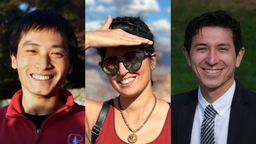
An Amazon-backed fellowship will support 10 Stanford PhD students whose work explores everything from how we communicate to understanding disease and protecting our data.
An Amazon-backed fellowship will support 10 Stanford PhD students whose work explores everything from how we communicate to understanding disease and protecting our data.
HAI Co-Director Fei-Fei Li named one of America's top 250 greatest innovators, alongside fellow Stanford affiliates Rodney Brooks, Carolyn Bertozzi, Daphne Koller, and Andrew Ng.
HAI Co-Director Fei-Fei Li named one of America's top 250 greatest innovators, alongside fellow Stanford affiliates Rodney Brooks, Carolyn Bertozzi, Daphne Koller, and Andrew Ng.

QuantiPhy is a new benchmark and training framework that evaluates whether AI can numerically reason about physical properties in video images. QuantiPhy reveals that today’s models struggle with basic estimates of size, speed, and distance but offers a way forward.
QuantiPhy is a new benchmark and training framework that evaluates whether AI can numerically reason about physical properties in video images. QuantiPhy reveals that today’s models struggle with basic estimates of size, speed, and distance but offers a way forward.