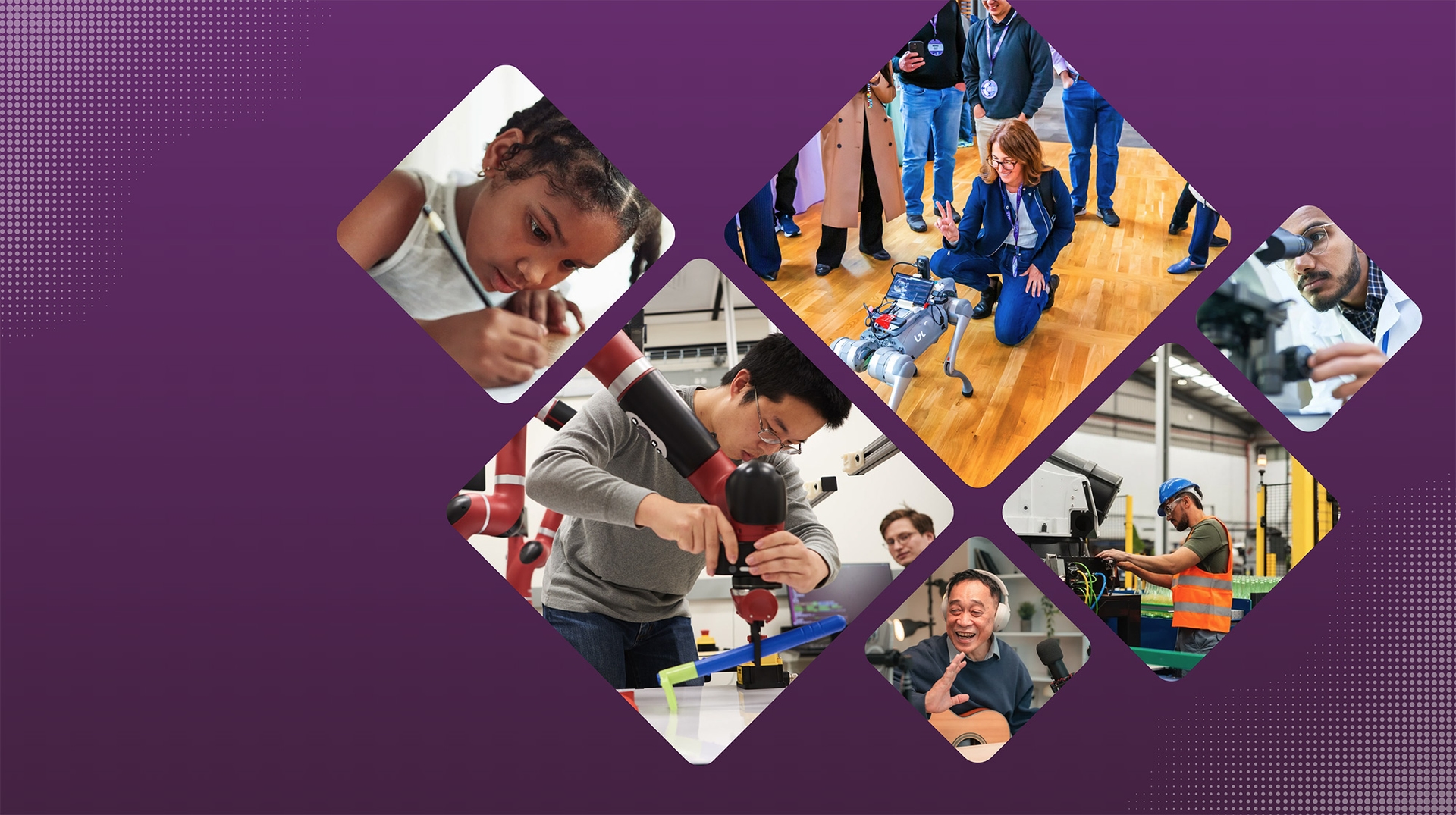
Advanced statistical and computational insights are transforming all aspects of physics. The goal of Physics and AI (PAI) 2026 is to bring together physics/statistics/data science/computer science researchers, practitioners, and educators who are developing and using AI. Physics here is broadly defined and includes related fields within the physical sciences. The conference will include both work that views physics through the lens of AI and research that views AI through the lens of physics.
Why Physics?
Many areas of physics have been in a big-data, precision era for decades. As such, they were early adopters of AI tools. The deep learning revolution of the last decade has transformative potential in physics, especially given the field’s culture of developing and using advanced statistical and computational techniques. Physics also has unique challenges that necessitate dedicated research and pedagogy. For example, the biggest scientific datasets in existence are from physics experiments, and the data are not always images or text. Additionally, ab initio simulations often play a key role in physics research, leading to the rise of simulation-based inference. These and other aspects of physics have led to a growing research area at the intersection of physics and AI—with data physicists and phystatistians emerging as researchers at the forefront of novel methodology.
Conference Structure
This Conference is modeled after the Machine Learning and Physical Sciences Workshop (MLPS) at NeurIPS. We welcome short research papers that will be peer reviewed and then ranked for impact by area chairs. Accepted papers will be published, and authors will be invited to present a poster. A small number of accepted papers will be selected for spotlight talks. The rest of the program will include invited talks and panels. Paper submission is open to all.
Call for Papers (closed)
Tracks
Research: Complete or high-quality work in progress work developing new AI methods for physics, developing new physics methods for AI, or innovative applications of AI in physics.
Datasets and Benchmarks: Well-documented, public physics (real and/or synthetic) datasets that will facilitate developments in AI research. There should be clear baseline methods presented alongside the dataset.
Perspectives: Compelling and grounded viewpoints on past, present, and/or future status/challenges of topics at the intersection of AI and physics.
Education and Training: Highly effective training materials for AI and physics literacy and/or expertise. Could include descriptions of university courses and/or summer school programs.
Submissions must be four pages or fewer (excluding references) and follow the NeurIPS format. Appendices are not allowed. We primarily encourage the submission of original content; however, work that has been published in archival venues elsewhere is also welcome, provided it is modified to fit the venue and includes proper citations. The review is double blind—all paper content must be anonymized (for code, see e.g., this tool). The exception is the datasets track, which is only single blind (okay to link to the actual dataset). Paper submission is through the conference OpenReview page. We encourage authors to follow the NeurIPS guidelines and best practices; submissions that do not adhere to the formatting rules (including template manipulation) will be desk-rejected. All authors must be included at the time of submission—authors cannot be added after the review begins (only the submitting author needs an OpenReview account). One author must be physically present to present a poster if the paper is accepted. Submissions are confidential until authors confirm that they (including all non-accepted content) are not made public.
Please ensure that your paper is approachable by someone who is not an expert in your specific area—e.g., please avoid, or at least define, jargon. AI can be used for any part of the process, but human authors must take full responsibility for the content.
Each paper not rejected will be reviewed by multiple people matched via OpenReview using bidding. Reviewers will use an easy-to-follow template to highlight the pros and cons of the submissions, and they will state their confidence in the review. Criteria for successful submissions include: correctness, novelty, relevance, and (potential for) impact. There will be no rebuttal period. Minor flaws will not be the sole reason to reject a paper.
Organizing Committees
Local Organizers and Advisors
Tom Abel
Susan Clark
Surya Ganguli
Sanmi Koyejo
Phil Marshall
Benjamin Nachman
Chris Re
Risa Wechsler
Non-local Organizers and Advisors (from GDS and MLPS)
Nina Andrejevic, Argonne National Lab
Casey Berger, Bates College
Jerome Delhommelle, U. Mass Lowell
Ivo Dinov, U. Michigan
Cristiano Fanelli, William & Mary
Eun-Ah Kim, Cornell University
Garrett Merz, U. Wisconsin
Vinicius Mikuni, U. Nagoya
Siddharth Mishra-Sharma, BU/Anthropic
Mark Neubauer, UIUC
Ryotaro Okabe, MIT
Entao Yang, Air Liquide