Get the latest news, advances in research, policy work, and education program updates from HAI in your inbox weekly.
Sign Up For Latest News
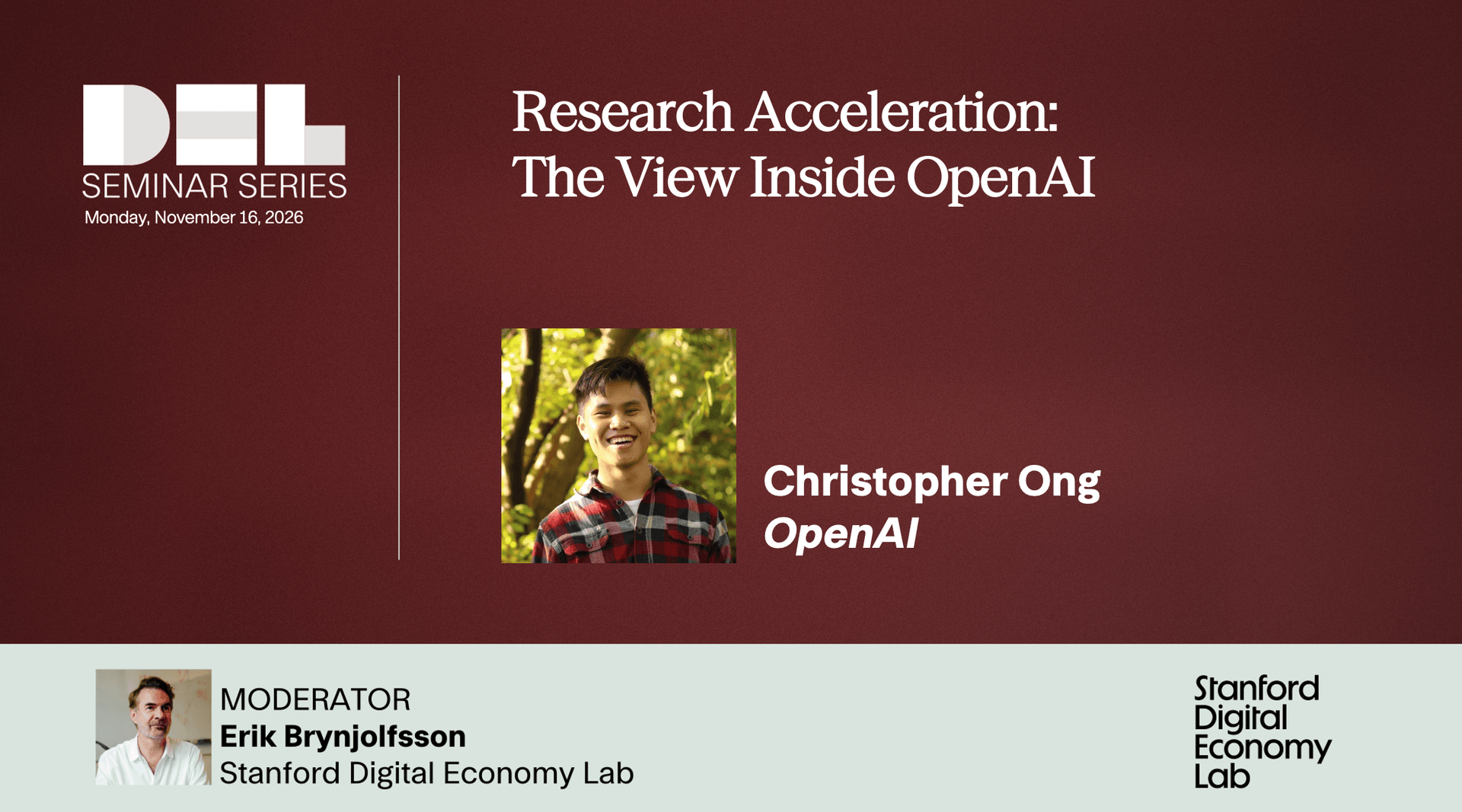
In the last year, AI models have rapidly improved on public benchmarks measuring their ability to carry out research tasks autonomously. Such performance suggests that models may be capable of automating parts of the AI R&D process itself, thereby accelerating the pace of AI progress.
In the last year, AI models have rapidly improved on public benchmarks measuring their ability to carry out research tasks autonomously. Such performance suggests that models may be capable of automating parts of the AI R&D process itself, thereby accelerating the pace of AI progress.
This talk will cover key insights from the third AI100 report, AI Goes Mainstream: The Scaling Era and the Rise of Generative AI, set for release in November 2026. The report was commissioned by the AI100 standing committee and led by study panel chair Michael Wooldridge.

This talk will cover key insights from the third AI100 report, AI Goes Mainstream: The Scaling Era and the Rise of Generative AI, set for release in November 2026. The report was commissioned by the AI100 standing committee and led by study panel chair Michael Wooldridge.
Sessions run Wednesdays from 4:30–5:30 PM in CoDa E160. Each session features a different Stanford speaker; talk titles are announced by the organizers.

Sessions run Wednesdays from 4:30–5:30 PM in CoDa E160. Each session features a different Stanford speaker; talk titles are announced by the organizers.
June 10 | June 11 | June 12 |
What Is Unique about Physics and AI? | Foundation Models and Agents for Physics | AI Through the Lens of Physics |
8:00-9:00: Coffee and Registration | 8:00-9:00: Coffee | 8:00-9:00: Coffee |
9-9:30: Opening Remarks: | 9:00-9:45: A data scientist’s take on foundation models and agents for discovery science; James Zou (Stanford) | 9:00-9:45: Advice for a (young) investigator in the first and last days of the Anthropocene; Jascha Sohl-Dickstein (Anthropic) |
9:30-10:15: A physicist’s take on what is unique about AI and physics; Mike Williams (MIT) | 9:45-10:30: Foundation models for physics; Vinicius Mikuni (Nagoya) | 9:45-10:30: The physics of AI; Yasaman Bahri (DeepMind) |
10:15-10:45: Break | 10:30-10:50: Break | 10:30-10:50: Break |
10:45-11:30: A computer scientist’s take on what is unique about AI and physics; Rose Yu (UCSD) | 10:50-11:20: Paper Spotlight - The Galaxy's Guide to the Tokenizer: A Benchmark for Scientific Foundation(Sogol Sanjaripour) | 10:50-11:20: Paper Spotlight - Dynamical Regimes of Multimodal Diffusion Models (Emil Albrychiewicz) |
11:30-12:00: Paper Spotlight - SEAL—A Symmetry Encouraging Loss for High Energy Physics (Inbar Savoray) | 11:20-11:50: Paper Spotlight - MadEvolve: Evolutionary Optimization of Cosmological Algorithms with Large Language Models (Shihui Zang) | 11:20-11:50: Paper Spotlight - Capturing non-Markovian dynamics in non-equilibrium stochastic systems using flow matching (Bhargav Siddani) |
12:00-12:30: Paper Spotlight - Emulating Cosmic Structure Formation with a Lagrangian Neural Cellular Automaton (Cooper Jacobus) | 11:50-1:15: Lunch | 11:50-1:15: Lunch |
12:30-1:45: Lunch | 1:15-1:45: Paper Spotlight - Chain-of-Thought Physics Benchmark for Reasoning Models (Filomela Gerou) | 1:15-1:45: 1:15-1:45: Paper Spotlight - Explicit or Implicit? Encoding Physics at the Precision Frontier (Tanvi Wamorkar) |
1:45-2:45: What makes AI and physics special |
| 1:45-3:00: Poster Session 3 & Refreshments |
2:45-4:00: Poster Session 1& Refreshments | 2:45-4:00: Poster Session 2 & Refreshments | 3:00-3:45: A science of AI for Science: From data to AI models to conceptual understanding; Surya Ganguli (Stanford) |
|
| 3:45-4:00: Closing remarks: Benjamin Nachman (Stanford/SLAC) |
|
| 4:00-5:00pm: Reception |