Beneath the Ice: The Rising Ridges that Guide a Melting Glacier
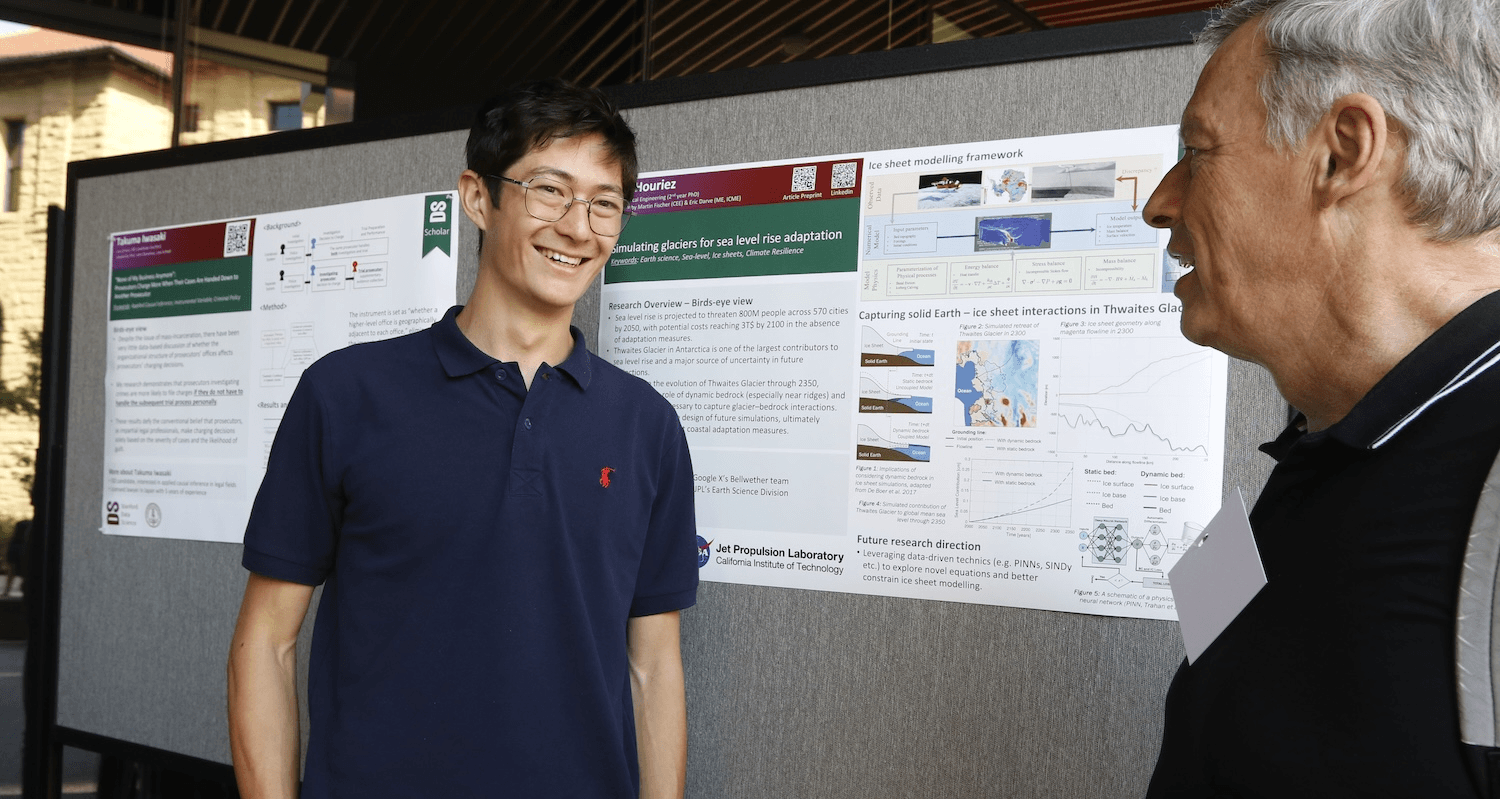
By Luc Houriez
Sea level projections are crucial to inform adaptation plans for our coastal communities. With nearly 600 cities at risk of sea level rise, and over 100 billion dollars in costs in the Bay Area alone by 2050, accurately predicting the evolution of ice caps has become a priority for many scientists around the world.
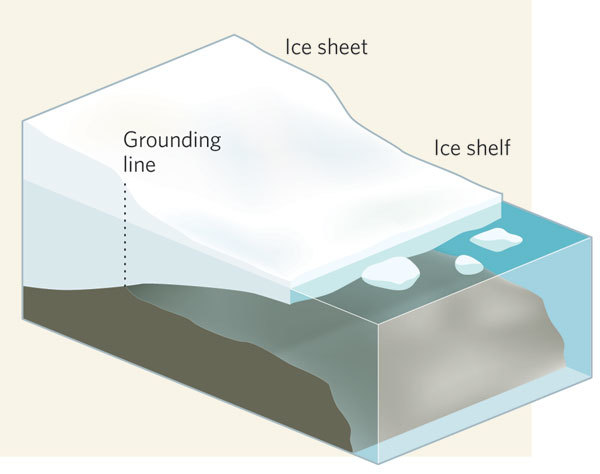 Figure 1: Simplified schematic of Thwaites Glacier. The ice sheet sits atop the bedrock, and the ice shelf floats over the ocean. The grounding line marks the transition between the ice sheet (grounded ice) and the ice shelf (floating ice). Source: Huybrechts et al., 2009. Nature 458, 295-296.
Over the past three years, I’ve been fortunate to work with inspiring Earth scientists at NASA’s Jet Propulsion Laboratory. Our project involved modeling the evolution of Thwaites Glacier in Antarctica, one of the fastest melting glaciers across the globe. We ran advanced simulations, taking into account interactions between the ice, the ocean, and the underlying bedrock to predict how the glacier would evolve in the coming decades and centuries.
In our study, a particular focus is given to the response of the bedrock to changes in the ice cap. As the ice cap melts and loses mass, a heavy weight is taken off of the underlying bedrock, causing it to rebound upwards. This has a significant impact on the evolution of Thwaites Glacier as it is highly dependent on the topography of the bedrock the Glacier is sliding upon. Put simply, Thwaites Glacier can be thought of as a giant block of ice sliding towards the ocean on a downward-sloping terrain (the bedrock). Ridges and peaks in this terrain (akin to those which can be seen in the mountains we hike in) can ‘pin’ the Glacier for extended periods of time, slowing its rapid descent towards the sea. Our research explores the reinforcement of these ridges and peaks due to the bedrock’s rebound.
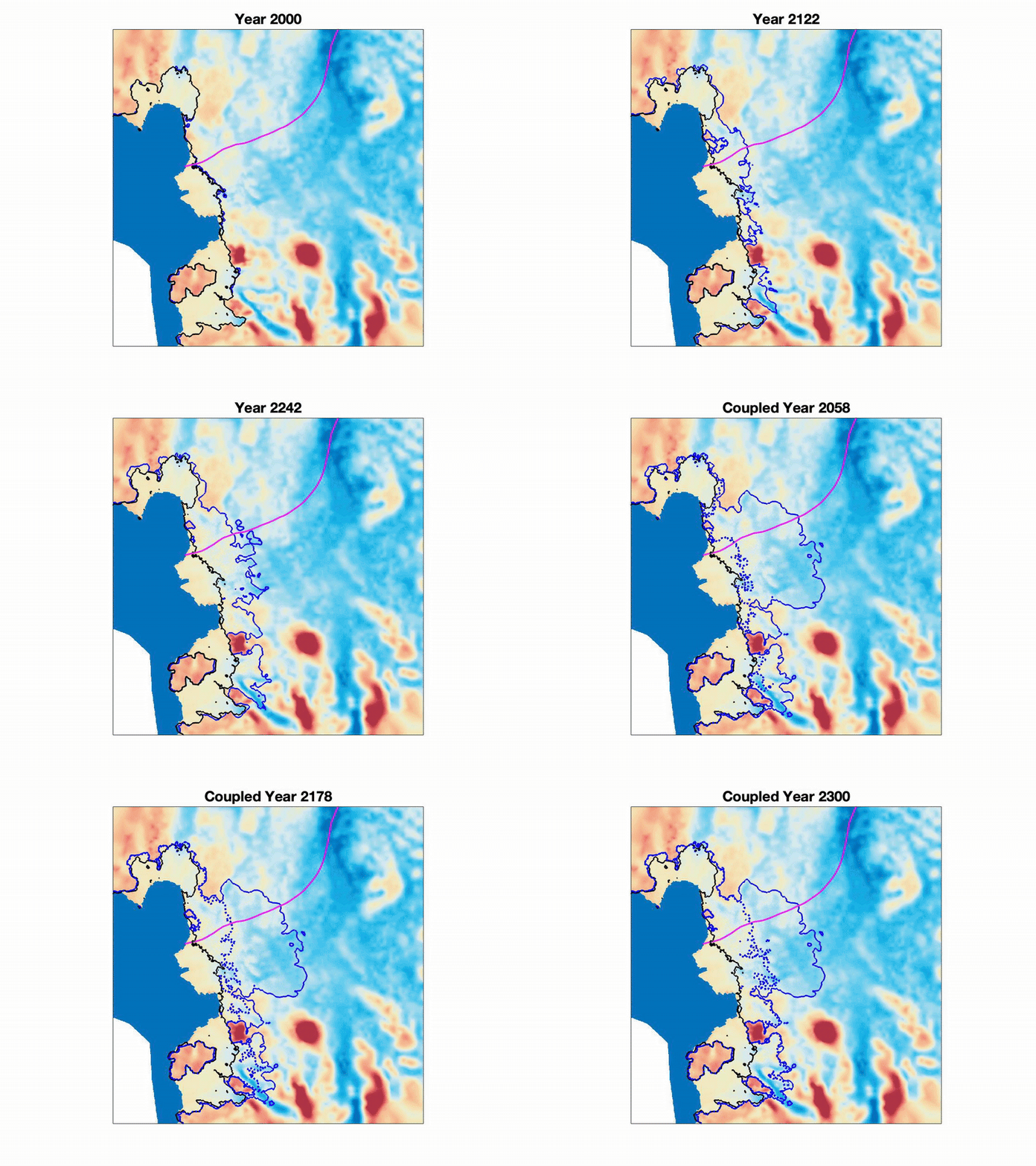 Figure 2: Simulated evolution of Thwaites Glacier in our study. The black line marks the initial grounding line position. The solid blue line marks the grounding line position in the absence of bedrock rebound (uncoupled ice and bedrock). The dotted blue line marks the grounding line position in the presence of bedrock rebound (coupled ice and bedrock). The solid blue surface represents the sea free of ice. The background (red, orange, and blue) shows the topography of the bedrock.
This coupled system of ice and bedrock, which has evolved in an intertwined manner, has only recently begun to be taken into account in sea level projections. Hence, our study provides a basis for guiding the implementation of future coupled simulations. By integrating vast amounts of ground and satellite data into scientific models, such simulations further our understanding of future sea level and help us prepare our coastal populations and cities.
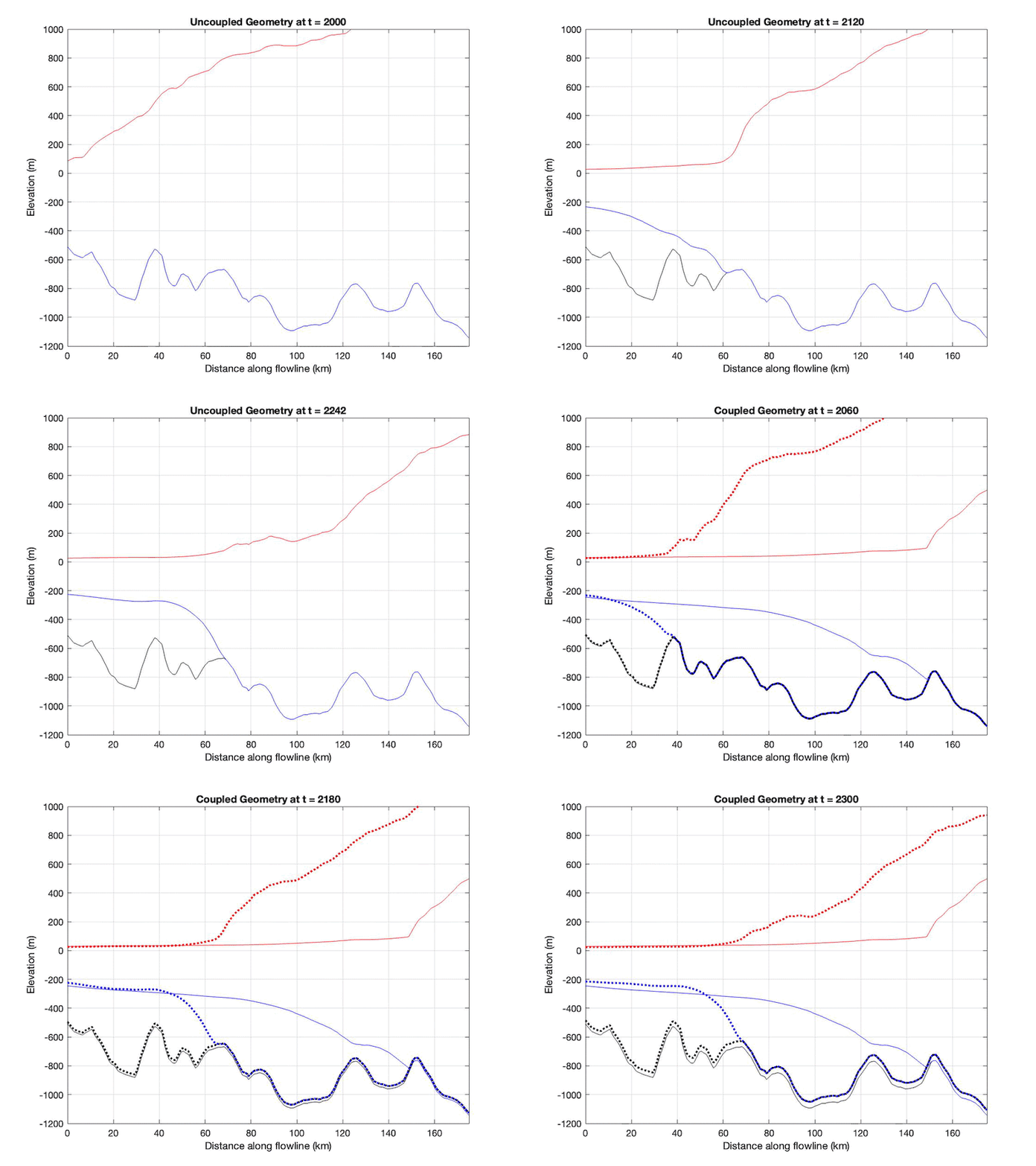 Figure 3: Simulated evolution of Thwaites Glacier in our study along the magenta flowline in Figure 2. The Glacier is delimited by its surface (red line) and base (blue line). The bedrock topography is shown in black. We represent the evolution of the glacier with (solid lines) and without (dotted lines) bedrock rebound.
However, as Earth science funding faces significant reductions, environmental data and scientific expertise are under duress. The next decades will be a ‘make or break’ period of time for climate adaptation and mitigation. Society currently faces the risk of walking into these blindfolded if scientists are deprived of tools and support to anticipate the movements of our rapidly changing environment.
This phenomenon and others are discussed in detail in a recent paper: https://egusphere.copernicus.org/preprints/2025/egusphere-2024-4136/egusphere-2024-4136.pdf
This article is a part of the Stanford Data Science legacy publication. Read more about the HAI and Stanford Data Science merger.
Related News

Biomni can analyze mountains of medical data, spot patterns humans might miss, and even design experiments—helping researchers make discoveries faster in the race to cure disease.

Biomni can analyze mountains of medical data, spot patterns humans might miss, and even design experiments—helping researchers make discoveries faster in the race to cure disease.

New AI tools generate hypotheses, design experiments, and find patterns in data—transforming how scientists make discoveries across every field.

New AI tools generate hypotheses, design experiments, and find patterns in data—transforming how scientists make discoveries across every field.
PsychAdapter lets researchers dial in on personality traits, age, and mental health characteristics to generate text that sounds like real individuals, opening the door to training simulations and personalized content.
PsychAdapter lets researchers dial in on personality traits, age, and mental health characteristics to generate text that sounds like real individuals, opening the door to training simulations and personalized content.