Stanford Merges AI and Data Science Efforts Under Single Institute
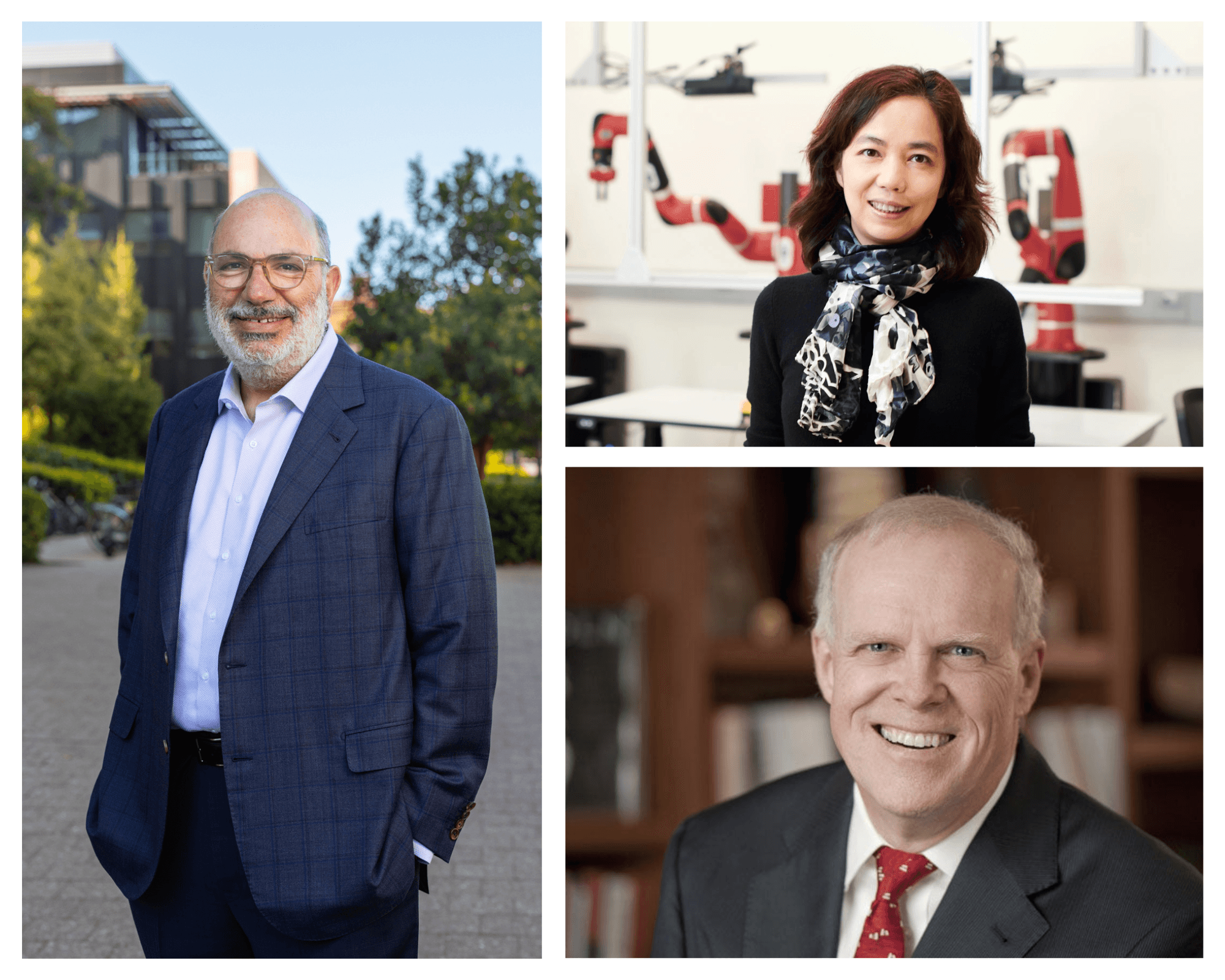
From left, clockwise: James Landay will lead the Stanford Institute for Human-Centered AI, while Fei-Fei Li and John Hennessy will serve as co-chairs of the advisory council. | Andrew Brodhead, Linda A. Cicero, Drew Kelly
The combined institute will retain the Stanford HAI name and be helmed by computer scientist James Landay. Co-founder Fei-Fei Li takes on a new university-wide role as Special Advisor on AI and joins John Hennessy as co-chair of the advisory council.
As AI opens up new opportunities for research and education at Stanford, the university is organizing to meet the moment.
Stanford University is merging its two flagship AI and data science organizations into a single institute, to be led by computer scientist James Landay.
The Stanford Institute for Human-Centered AI and the Stanford Data Science initiative will combine under the Stanford HAI name, with Landay continuing as Denning Director. University leaders believe the human-centered focus is critical to the future of technology. It is reflected in the broad sweep of faculty involved – from engineering to medicine to the humanities and more.
Former Stanford president John Hennessy and HAI founding director Fei-Fei Li will serve as co-chairs of the institute’s advisory council. Li will also take on a new university-wide role as Special Advisor on AI to President Jonathan Levin. (Read our Q&A with the new leadership to learn more.)
The merger combines HAI’s network of more than 400 scholars, extensive industry affiliates program, and $60 million in cumulative grant funding with Stanford Data Science’s high-performance Marlowe computing cluster and early scholar fellowship program. Levin describes the new Stanford HAI as “the front door for AI at Stanford.”
Much of that capacity has been built through donor investment – endowed professorships, the Data Science Scholars program and the HAI Graduate Fellowship program that train early-career researchers, and seed and scale-up research grants funding projects across the university.
“The merged organization creates a community of scholars whose research touches powerfully on every aspect of AI, its applications, and implications,” Levin said, “and the human-centered focus provides a north star for the institute.”
Landay has spent three decades working in what’s now called human-centered computing. His 1990s design software SILK foreshadowed tools like Figma and Canva; his UbiFit project in the early 2000s anticipated the Fitbit and Apple Watch. In 2024, he received the ACM SIGCHI Lifetime Research Award.
“This technology is changing everything,” said Landay, who is also the Anand Rajaraman and Venky Harinarayan Professor in the School of Engineering. “To have real impact in this moment, we need to adapt. This is about shaping how AI affects people, communities, and society – with that human-centered perspective at the core of everything we do.”
Opportunities Unlocked
AI is beginning to open up research frontiers across the campus. Stanford astronomers use machine learning to spot new exoplanets and model early-universe physics. Neuroscientists build models that predict brain activity. Historians run natural language processing over archival collections to surface patterns in how societies communicate. And education researchers test tutoring systems that adapt to individual learners and support teachers in classrooms.
“Data science and AI share the same mathematical foundations and computational infrastructure, each pushing the boundaries of what’s possible with data,” said David Studdert, vice provost and dean of research. “Bringing them together under one roof will accelerate research and unlock opportunities that neither of the two organizations could have accessed alone.”
Two Programs, One Roof
HAI, founded in 2019 by Li, former Stanford provost John Etchemendy, computer scientist Chris Manning, and Landay, has grown into a multidisciplinary hub spanning research, education, and policy. It was founded on the principle that Stanford could play a leading role in developing AI technology and applications, and also in leading discussions on what it means to be fully human in an age of machine intelligence. HAI runs the Congressional Boot Camp on AI for policymakers and centers studying foundation models, the digital economy, the science of intelligence, and ambient intelligence for aging in place. It launched fellowship programs for early career scholars, hired junior and senior faculty, developed executive and policy education programs, and produces the annual AI Index.
Stanford Data Science, launched and led by Emmanuel Candès, the Barnum-Simons Chair in Mathematics and Statistics in the School of Humanities and Sciences, built out research centers in sustainability, astrophysics, causal science, neuroscience, and other fields; created interdisciplinary graduate student fellowships; recruited faculty members in partnership with collaborating departments; and spearheaded the establishment of the Marlowe cluster. Guido Imbens, the Applied Econometrics Professor and professor of economics at Stanford Graduate School of Business, served as faculty director for the past year and led the transition team with Landay and Li before returning earlier this year to focus on his teaching and research.
Candès will become an associate director of Stanford HAI, focused on computational resources. Etchemendy will continue as a senior fellow and advisor.
Built On Openness
Stanford HAI will organize its work around three pillars: advancing AI and data science for discovery across fields, transforming education from K-12 through lifelong learners, and examining and shaping AI’s societal impact through evidence-based research.
This comprehensive approach ensures the university can influence AI development across foundational algorithms, real-world applications, economic analysis, and governance frameworks. The institute will also partner with global organizations to extend its human-centered approach beyond Stanford.
Landay says Stanford HAI’s defining commitment will be openness: open science, open-source code, open datasets, and open education.
Openness has shaped the field before. ImageNet, the labeled image database Li helped create, is widely credited with catalyzing modern deep learning. Open-source code and libraries like FlashAttention democratized AI development. And open science publication subjects results to scrutiny that closed industry work often lacks.
“What makes Stanford’s approach impactful is our commitment to operating as an open community,” said Landay. “We publish in open forums, we champion open research, we make knowledge accessible. That’s what differentiates universities from the frontier AI companies dominating artificial intelligence today.”
Landay is now working to define what “human-centered AI” means in practice – pressing researchers to design for and weigh impact on users, communities, and society from a project’s inception through to its development, deployment, and maintenance phases.
New Co-chairs and Role
Hennessy, who co-founded the Knight-Hennessy Scholars program, will also serve as a Stanford HAI special advisor, in addition to his role on the advisory council.
“This is the most important effort for Stanford, and I am happy to help it succeed,” Hennessy said. “AI will evolve in ways we can’t predict, but the principles guiding our work – openness, excellence, human-centeredness – will be enduring.”
Li’s co-chair role is separate from her new university-wide appointment advising President Levin, which will span research, partnerships, education, and student careers across all seven Stanford schools. She will retain her title as Stanford HAI’s founding director and senior fellow.
“AI is transforming not only technology, but also the way we pursue scientific discovery, learn and educate, and serve society,” Li said. “It is a historical opportunity and responsibility of Stanford to rise to the occasion.”
The new institute will harness team science – spanning Stanford’s seven schools and partners across sectors – to tackle AI’s toughest challenges while preserving what universities do best: pursue fundamental questions, train the next generation, and serve the public good.
“This is not just a stronger institute,” Landay said. “It is a new model for how a university organizes AI and data science to have real impact in the world.”
Related News

How managers introduce and support AI determines whether workers engage with or resist the technology.

How managers introduce and support AI determines whether workers engage with or resist the technology.
Director of the Stanford Digital Economy Lab and Senior Fellow at Stanford HAI Erik Brynjolfsson discusses the fallacy of thinking "the only way that you get productivity from A.I. is by removing labor costs,” arguing that business can return larger gains through AI use for employees' productivity, rather than replacing workers.
Director of the Stanford Digital Economy Lab and Senior Fellow at Stanford HAI Erik Brynjolfsson discusses the fallacy of thinking "the only way that you get productivity from A.I. is by removing labor costs,” arguing that business can return larger gains through AI use for employees' productivity, rather than replacing workers.

As artificial intelligence transforms society, Stanford HAI’s James Landay, Fei-Fei Li, and John Hennessy explain why they’re merging HAI with the Stanford Data Science initiative, mobilizing “team science at scale,” and betting that academic openness will shape AI’s future.
As artificial intelligence transforms society, Stanford HAI’s James Landay, Fei-Fei Li, and John Hennessy explain why they’re merging HAI with the Stanford Data Science initiative, mobilizing “team science at scale,” and betting that academic openness will shape AI’s future.