New Stanford Grants Tackle AI's Impact on Global Security and Geopolitics
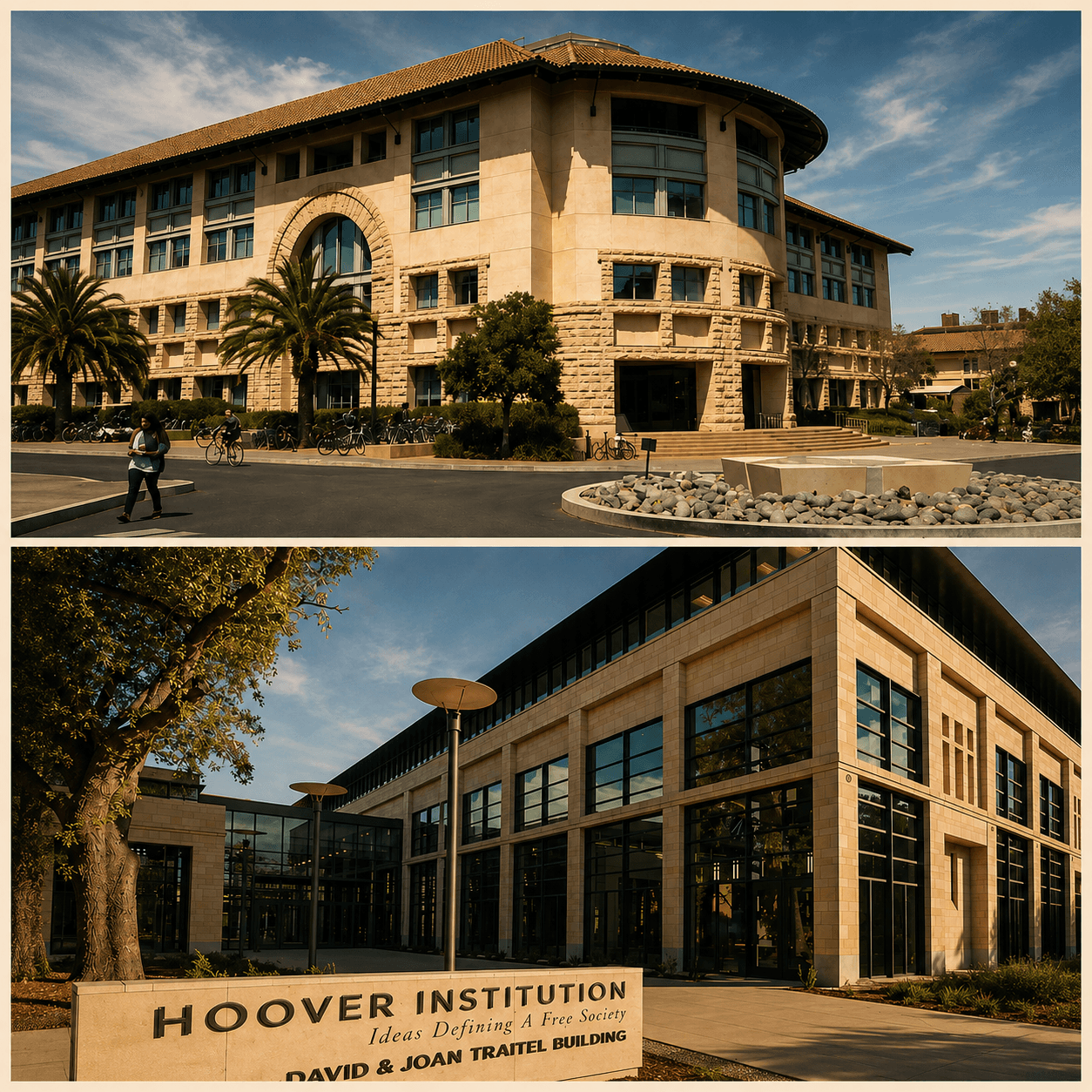
Stanford HAI and the Hoover Institution’s Technology Policy Accelerator back projects examining AI's role in detecting nuclear proliferation, U.S.-China competition, and political influence.
Global AI competition is central to today’s geopolitical debates. As this technology creates seismic shifts in economies, national security, and defense, leaders need to understand both the opportunities and risks to international stability and governance.
In April 2026, Stanford HAI and the Hoover Institution’s Technology Policy Accelerator invited scholars to pitch ambitious ideas for a new grant program examining the possibilities that foundation models, agents, and AI systems present for global policy experts. To ensure multidisciplinary approaches to these large challenges, the teams needed to be led by one technical and one social science or humanities scholar.
“AI is rapidly reshaping the geopolitical landscape. This program aims to catalyze original research that helps policymakers understand where the greatest risks and opportunities lie,” said Amy Zegart, the Morris Arnold and Nona Jean Cox Senior Fellow at the Hoover Institution and a senior fellow at Stanford HAI. “We're excited that these projects will bring technical and policy experts together across campus to examine urgent questions about nuclear security, public opinion, and the use of AI in political decision-making.”
“We need research that translates technical AI advances into strategic insights for policymakers,” said Chris Manning, senior fellow at Stanford HAI and professor of linguistics and computer science at Stanford. “These projects will help leaders anticipate and respond to AI's geopolitical impact.”
Three projects were selected to receive policy research grants of $100,000 each to conduct their research over the next year. These teams are addressing nuclear proliferation, U.S.-China competition, and political influence in foundation models.
Learn more about the winners:
Human-Centered AI for Proliferation Monitoring
Existing research has proven that AI-assisted workflows can identify nuclear proliferation in large-scale satellite imagery dataset, a volume of data that would be prohibitively time consuming to analyze by hand. Now we have the opportunity to leverage multimodal data including multilingual text, online media, and satellite imagery, to design AI protocols to help analysts detect illicit procurement of nuclear proliferation and undeclared nuclear infrastructure. A multidisciplinary team of computer scientists, imagery analysts, and open-source nonproliferation researchers will explore how foundation models and AI agents could help close the detection gap.
Led by Associate Professor of Aeronautics and Astronautics and HAI Senior Fellow Mykel Kochenderfer and Zegart, the researchers will design AI agents that could work like digital detectives, following specific steps to comb through documents in multiple languages, still images or videos, and satellite photos to see changes that indicate potential nuclear development in violation of international law. The researchers also plan to create a standardized benchmark to prove the system works reliably.
Comparing Public Opinion in the United States and China
The future of AI will depend not only on technological advances, but also on public opinion. Public attitudes will shape how governments regulate AI, how firms invest, and how quickly new tools spread through workplaces. It is, therefore, essential to understand what the public thinks about AI, and why.
Principal investigators Michael Tomz, professor of political science, and Diyi Yang, assistant professor of computer science, will build CrossInterviewer, a bilingual AI-powered interviewing tool, and use it to compare public opinion in the United States and China.
CrossInterviewer will conduct interviews in both Chinese and English. It will also adapt survey questions based on each individual’s responses, allowing scholars to conduct nuanced, in-depth interviews — previously only possible with human interviewers — at the scale and efficiency of traditional online surveys.
Tomz and Yang will study three themes:
General attitudes toward AI. Surveys consistently find that enthusiasm for AI is far higher in China than in the United States, but we know little about why this difference exists. By probing each respondent’s reasoning in their own words, CrossInterviewer will surface the beliefs, hopes, and worries that produce this gap.
Willingness to adopt AI at work. Yang recently co-authored a study mapping where U.S. workers across 104 occupations welcome or resist AI systems. This project will extend the analysis to China, producing the first systematic comparison of how workers in the two countries view AI in their own jobs.
Open versus closed models. Some AI developers release their models’ weights publicly, letting anyone download, inspect, and modify them; others keep weights private. Experts continue to debate the tradeoffs, but almost nothing is known about public preferences. The PIs will investigate which approach people favor, and what considerations drive their views.
By analyzing public opinion on these important issues, the project will provide a firmer basis for government policy, corporate investments, and forecasts about the future of AI.
Studying Agent-Mediated Political Action
AI agents today are increasingly involved in many aspects of policymaking. For example, interest groups may use AI agents to generate public comments at scale, and the government agencies receiving them may use agents to summarize large volumes of submissions before a human makes a policy decision. These tools rarely operate as a single model in isolation, instead running in multi-step pipelines where agents read and build on each other's outputs.
But agents are built on models that are developed in different countries and thus have different built-in biases. For instance, single-model audits have documented that models developed under different national regulatory regimes handle politically sensitive content differently; an agent based on a U.S.-developed model might respond differently from a Chinese-developed model. And the provenance of foundation models could shape the type of information and conclusions that decision-makers get from their AI agents. This issue is particularly pressing because those who want to deploy agents at scale and avoid platform monitoring are increasingly deploying agents based on open-weight Chinese models that make their parameters available for the public to see and modify.
Using closed U.S.-China trade dockets as a test case, Jennifer Pan, professor of communication, and Sanmi Koyejo, associate professor of computer science, will examine how model provenance affects what agent teams produce and what survives that summarization step. They will also release a public dataset of political-task agents with their underlying models identified, offering a first look at which foundation models are actually being deployed in this space. The findings will speak to debates over sovereign AI, open-weight governance, and whether provenance disclosure should be required in government and political applications.
Learn more about the Policy Research Grants program.
Related News

In a new series called Prompt Response, Stanford’s Surya Ganguli, Diyi Yang and Rob Reich examined emergent agent behavior, recursive self-improvement, independent evaluation and whether a kill switch can make advanced AI safer.

In a new series called Prompt Response, Stanford’s Surya Ganguli, Diyi Yang and Rob Reich examined emergent agent behavior, recursive self-improvement, independent evaluation and whether a kill switch can make advanced AI safer.
HAI Denning Director James Landay responds to the latest round of AI doomerism and how policymakers should respond to it.
HAI Denning Director James Landay responds to the latest round of AI doomerism and how policymakers should respond to it.
As The World Debates The Risks Of AI, China Closes The Technology Gap With The US
Associated Press cites Stanford HAI's AI Index on China's emergence as an AI counterweight to the U.S.
Associated Press cites Stanford HAI's AI Index on China's emergence as an AI counterweight to the U.S.