Today's AI Talks Like “Nobody.” New Research Gives It Real Personality.
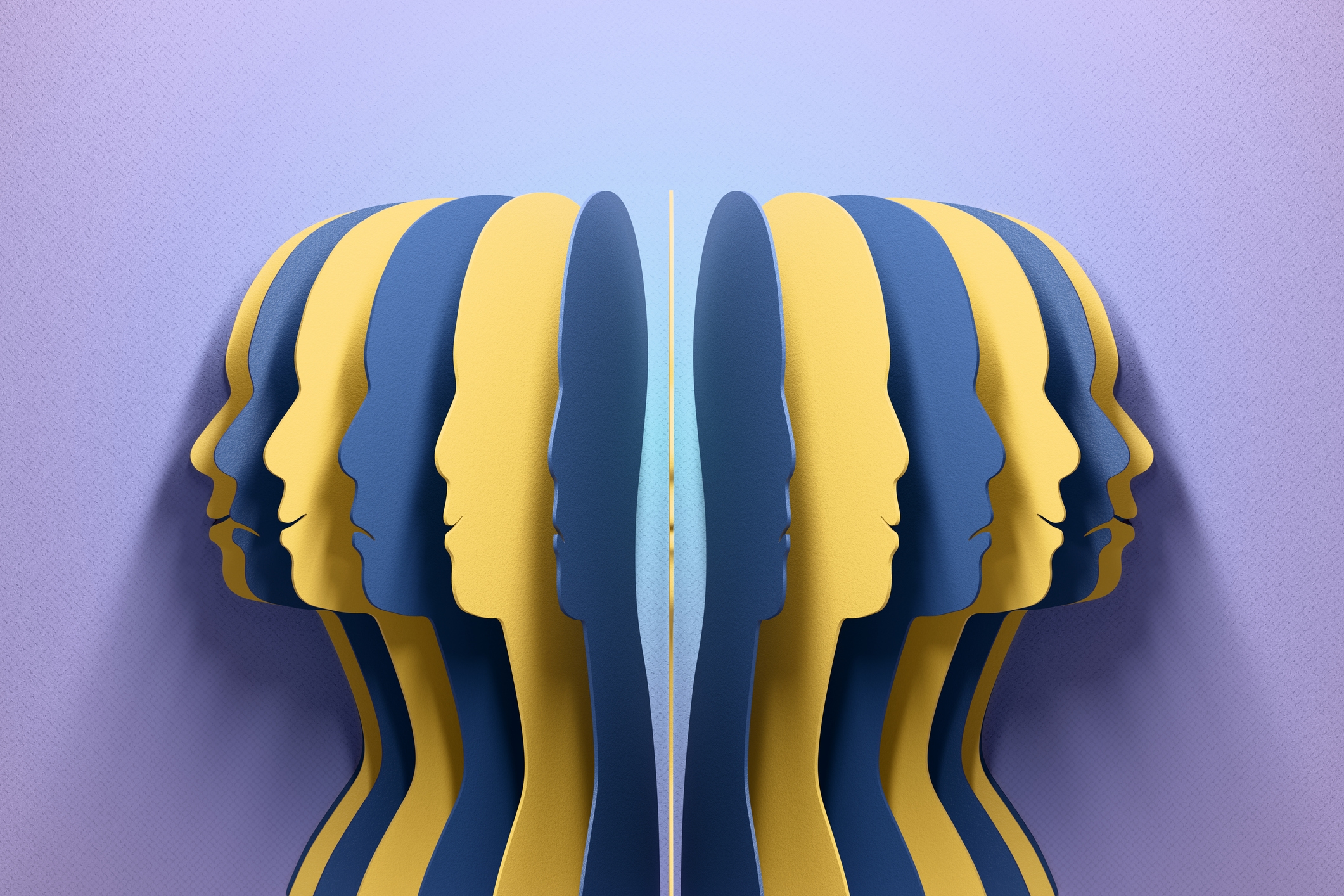
PsychAdapter lets researchers dial in on personality traits, age, and mental health characteristics to generate text that sounds like real individuals, opening the door to training simulations and personalized content.
Today's large language models are trained on the aggregate writing of millions of authors. But that also means that LLMs like ChatGPT converge on a narrow, agreeable, mildly positive voice that flattens the variation between one human writer and another. Users experience this as homogeneous output — “language from nobody.”
Now, a group of psychologists and computer scientists has found a way to put such traits back into the large language models and have fine-grained control over “who” is generating the language. The breakthrough will enable AI patients for training therapists, personalized educational materials, and more.
A study published in npj Artificial Intelligence introduces PsychAdapter, a small modification to standard language models. PsychAdapter takes a list of continuous psychological scores — e.g., gender, age, Big Five personality, depression, life satisfaction — as direct inputs to the model and generates text that reflects any point along all those dimensions. Expert raters confirmed the language fits with 87% accuracy for personality and 97% for mental health.
In this way, PsychAdapter can reintroduce human differences into AI-generated text. Set extraversion to +1.7, depression to +3, and age to young, and the model produces language that reflects that profile — not a categorical “type of person” like "extravert" that could be elicited with a prompt, but a continuous personality profile spanning many dimensions. This precise freedom is not easily achievable by prompting. And the produced language is grounded in real human language data, not in an LLM's guess at what an extravert sounds like.
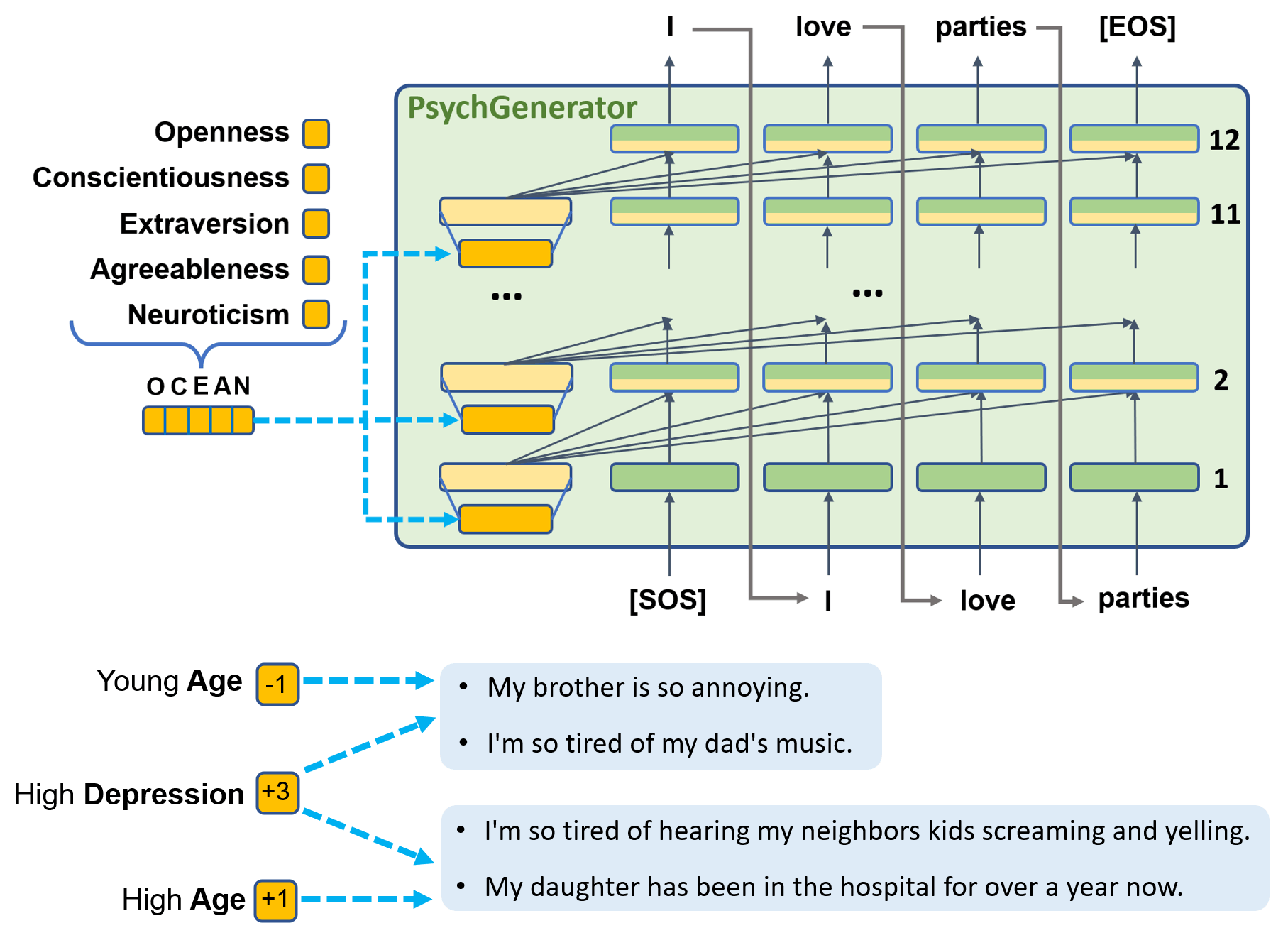
Top: Traits and personality modify generation at every layer of the neural network. Bottom: Example language produced for depression at different ages.
"This is the next step in a tradition that runs from the earliest psychologists to the age of big data. For the last half century, psychology has built the tools to analyze language to understand personality — now we can generate language for personality as well," said Johannes C. Eichstaedt, co-senior author and a faculty fellow at the Stanford Institute for Human-Centered AI.
This gives psychology AI applications something that’s been missing. With these more realistic personalities, AI can be used to simulate patients calibrated to specific symptom profiles to train crisis-line workers and clinicians without involving real patients. Clinical and educational materials can be tailored to the reader's age and reading level. Social scientists can create digital cohorts — groups of simulated people with a variety of personality and demographic profiles — to test ideas or programs before trying them on real people.
“Language models are now ubiquitous behind programs like ChatGPT and Claude, but they fundamentally, statistically, miss the idea that each person talks differently. PsychAdapter addresses this, helping to generate language across the many psychological dimensions that distinguish people,” said H. Andrew Schwartz, co-senior author and associate professor of computer science and psychology at Vanderbilt University's College of Connected Computing.
Different prompts can make the personality differences stand out more; for example, "I like to ..." reveals a lot about the activated personality profile. High extraverts mention parties and friends; introverts mention reading or gaming.
"Having this simultaneous control also meant we could model more complex psychological traits. For example, we could model dominant people who are socially dominant by combining high extraversion with low agreeableness,” said Huy Vu, the lead author, formally at Stony Brook University.
How It Works
PsychAdapter was trained on roughly 500,000 tweets and 700,000 publicly shared blog posts. Each post was scored for traits — extraversion, depression, age — using existing machine-learning models that were built by determining users' traits from surveys and analyzing their language. This step is important — the trait language patterns do not rely on the large language model itself but are derived from separate training data collected via surveys. The outcome is a training set in which language is paired with a psychological profile. As a result, these machine- learning models learn what depressed language looks like versus language from those who are satisfied or what an introvert's writing looks like versus an extravert's.
The team then changed the architecture of the large language models — any open-weight model can be used for this, such as Google’s Gemma3, Meta’s Llama3, or OpenAI’s GPT2. The team embedded psychological scores directly into the model's processing layers, accepting trait scores as numeric inputs and shaping language output at every point in the neural network, which enforces the desired personality. Feed the model extraversion = +3, neuroticism = -2, age = +1, and the output reflects that combination.
Of course, increasing the psychological abilities of AI models in this way also has ethical implications. "It's absolutely critical that any content generated for specific audiences or psychological profiles be clearly marked as AI-generated," Eichstaedt said. "The same tool that could help train crisis counselors or personalize education can also be used for micro-targeting and influence operations."
The authors released the source code and trained models for research use on GitHub.
PsychAdapter was developed by a team across computer science and psychology. First author Huy Vu and co-author Huy Anh Nguyen are at the Computer Science Department at Stony Brook University. Co-senior author Johannes C. Eichstaedt is an assistant professor of psychology at Stanford School of Humanities and Sciences, a Shriram faculty fellow at the Stanford Institute for Human-Centered AI, and a visiting assistant professor of decision sciences at INSEAD. Co-senior author H. Andrew Schwartz is at Vanderbilt University's College of Connected Computing, alongside Adithya V. Ganesan, Swanie Juhng, and Oscar N. E. Kjell. Other authors are Joao Sedoc (Stern School of Business, NYU), Margaret L. Kern (Centre for Wellbeing Science, University of Melbourne), Ryan L. Boyd (Department of Psychology, University of Texas at Dallas), and Lyle Ungar (Computer and Information Science, University of Pennsylvania).
Related News

Over three years, we’ve built progressively harder, more realistic benchmarks for medical AI. Here’s what we learned.

Over three years, we’ve built progressively harder, more realistic benchmarks for medical AI. Here’s what we learned.
Analyzing thousands of human-AI conversations, a new study shows that people are turning to chatbots for increasingly critical tasks – and that productive outcomes depend on how the collaboration unfolds.
Analyzing thousands of human-AI conversations, a new study shows that people are turning to chatbots for increasingly critical tasks – and that productive outcomes depend on how the collaboration unfolds.

How managers introduce and support AI determines whether workers engage with or resist the technology.

How managers introduce and support AI determines whether workers engage with or resist the technology.