What is a Reasoning Model? | Stanford HAI
Stanford
University
  • Stanford Home
  • Maps & Directions
  • Search Stanford
  • Emergency Info
  • Terms of Use
  • Privacy
  • Copyright
  • Trademarks
  • Non-Discrimination
  • Accessibility
© Stanford University.  Stanford, California 94305.
Skip to content
  • About

    • About
    • People
    • Get Involved with HAI
    • Support HAI
    • Subscribe to Email
  • Research

    • Research
    • Fellowship Programs
    • Grants
    • Student Affinity Groups
    • Centers & Labs
    • Research Publications
    • Research Partners
  • Education

    • Education
    • Executive and Professional Education
    • Government and Policymakers
    • K-12
    • Stanford Students
  • Policy

    • Policy
    • Policy Publications
    • Policymaker Education
    • Student Opportunities
  • AI Index

    • AI Index
    • AI Index Report
    • Global Vibrancy Tool
    • People
  • News
  • Events
  • Industry
  • Centers & Labs

What is a Reasoning Model?

A Reasoning Model is a type of AI system designed to solve complex problems by generating a logical, step-by-step sequence of thought. Unlike models that provide an immediate answer, these systems explicitly break down a problem into intermediate steps, mimicking a human-like process of deduction and analysis. This capability makes them more transparent and effective at tackling tasks that require multi-step logic, such as mathematical word problems, planning, and diagnosing complex issues. 

Navigate
  • About
  • Events
  • Careers
  • Search
Participate
  • Get Involved
  • Support HAI
  • Contact Us

Stay Up To Date

Get the latest news, advances in research, policy work, and education program updates from HAI in your inbox weekly.

Sign Up For Latest News


Reasoning Models mentioned at Stanford HAI

Explore Similar Terms:

AGI (Artificial General Intelligence) | Agentic AI | Explainable AI (XAI)

See Full List of Terms & Definitions

Enroll in a Human-Centered AI Course

This AI program covers technical fundamentals, business implications, and societal considerations.
MedArena: Comparing LLMs for Medicine in the Wild
Eric Wu, Kevin Wu, James Zou
Apr 24
news

Stanford scholars leverage physicians to evaluate 11 large language models in real-world settings.

MedArena: Comparing LLMs for Medicine in the Wild

Eric Wu, Kevin Wu, James Zou
Apr 24

Stanford scholars leverage physicians to evaluate 11 large language models in real-world settings.

Healthcare
Natural Language Processing
Generative AI
news
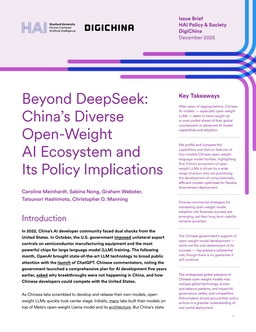
Beyond DeepSeek: China's Diverse Open-Weight AI Ecosystem and Its Policy Implications
Caroline Meinhardt, Sabina Nong, Graham Webster, Tatsunori Hashimoto, Christopher Manning
Deep DiveDec 16
issue brief

Almost one year after the “DeepSeek moment,” this brief analyzes China’s diverse open-model ecosystem and examines the policy implications of their widespread global diffusion.
Beyond DeepSeek: China's Diverse Open-Weight AI Ecosystem and Its Policy Implications

Caroline Meinhardt, Sabina Nong, Graham Webster, Tatsunori Hashimoto, Christopher Manning
Deep DiveDec 16

Almost one year after the “DeepSeek moment,” this brief analyzes China’s diverse open-model ecosystem and examines the policy implications of their widespread global diffusion.

Foundation Models
International Affairs, International Security, International Development
issue brief