Foundation Models
Foundation models serve as a backbone for diverse AI applications. How are they changing fields like natural language processing, vision, and robotics?
AI100 | AI Goes Mainstream: The Scaling Era and the Rise of Generative AI
This talk will cover key insights from the third AI100 report, AI Goes Mainstream: The Scaling Era and the Rise of Generative AI, set for release in October 2026. The report was commissioned by the AI100 standing committee and led by study panel chair Michael Wooldridge.
This talk will cover key insights from the third AI100 report, AI Goes Mainstream: The Scaling Era and the Rise of Generative AI, set for release in October 2026. The report was commissioned by the AI100 standing committee and led by study panel chair Michael Wooldridge.

Benchmarks — the standardized tests that rank AI models on safety, bias, and reasoning — drive markets and shape regulation. New Stanford research finds they often don't measure what they claim to.

Benchmarks — the standardized tests that rank AI models on safety, bias, and reasoning — drive markets and shape regulation. New Stanford research finds they often don't measure what they claim to.
Current societal trends reflect an increased mistrust in science and a lowered civic engagement that threaten to impair research that is foundational for ensuring public health and advancing health equity. One effective countermeasure to these trends lies in community-facing citizen science applications to increase public participation in scientific research, making this field an important target for artificial intelligence (AI) exploration. We highlight potentially promising citizen science AI applications that extend beyond individual use to the community level, including conversational large language models, text-to-image generative AI tools, descriptive analytics for analyzing integrated macro- and micro-level data, and predictive analytics. The novel adaptations of AI technologies for community-engaged participatory research also bring an array of potential risks. We highlight possible negative externalities and mitigations for some of the potential ethical and societal challenges in this field.
Current societal trends reflect an increased mistrust in science and a lowered civic engagement that threaten to impair research that is foundational for ensuring public health and advancing health equity. One effective countermeasure to these trends lies in community-facing citizen science applications to increase public participation in scientific research, making this field an important target for artificial intelligence (AI) exploration. We highlight potentially promising citizen science AI applications that extend beyond individual use to the community level, including conversational large language models, text-to-image generative AI tools, descriptive analytics for analyzing integrated macro- and micro-level data, and predictive analytics. The novel adaptations of AI technologies for community-engaged participatory research also bring an array of potential risks. We highlight possible negative externalities and mitigations for some of the potential ethical and societal challenges in this field.
Implementing the Transparency in Frontier AI Act Report for the California Department of Technology Multistakeholder Workshops
In this paper, HAI Associate Director and Senior Fellow Rob Reich and UC Berkeley School of Information Professor Deirdre K. Mulligan provide concrete recommendations to the California Department of Technology on the implementation of its frontier AI transparency requirements.
In this paper, HAI Associate Director and Senior Fellow Rob Reich and UC Berkeley School of Information Professor Deirdre K. Mulligan provide concrete recommendations to the California Department of Technology on the implementation of its frontier AI transparency requirements.
.png&w=256&q=80)
.png&w=1920&q=100)
HAI Co-Director Fei-Fei Li named one of America's top 250 greatest innovators, alongside fellow Stanford affiliates Rodney Brooks, Carolyn Bertozzi, Daphne Koller, and Andrew Ng.
HAI Co-Director Fei-Fei Li named one of America's top 250 greatest innovators, alongside fellow Stanford affiliates Rodney Brooks, Carolyn Bertozzi, Daphne Koller, and Andrew Ng.
All Work Published on Foundation Models

A Stanford HAI workshop brought together experts to develop new evaluation methods that assess AI's hidden capabilities, not just its test-taking performance.
A Stanford HAI workshop brought together experts to develop new evaluation methods that assess AI's hidden capabilities, not just its test-taking performance.

Model-based reinforcement learning (MBRL) is a promising route to sampleefficient policy optimization. However, a known vulnerability of reconstructionbased MBRL consists of scenarios in which detailed aspects of the world are highly predictable, but irrelevant to learning a good policy. Such scenarios can lead the model to exhaust its capacity on meaningless content, at the cost of neglecting important environment dynamics. While existing approaches attempt to solve this problem, we highlight its continuing impact on leading MBRL methods —including DreamerV3 and DreamerPro — with a novel environment where background distractions are intricate, predictable, and useless for planning future actions. To address this challenge we develop a method for focusing the capacity of the world model through synergy of a pretrained segmentation model, a task-aware reconstruction loss, and adversarial learning. Our method outperforms a variety of other approaches designed to reduce the impact of distractors, and is an advance towards robust model-based reinforcement learning.
Model-based reinforcement learning (MBRL) is a promising route to sampleefficient policy optimization. However, a known vulnerability of reconstructionbased MBRL consists of scenarios in which detailed aspects of the world are highly predictable, but irrelevant to learning a good policy. Such scenarios can lead the model to exhaust its capacity on meaningless content, at the cost of neglecting important environment dynamics. While existing approaches attempt to solve this problem, we highlight its continuing impact on leading MBRL methods —including DreamerV3 and DreamerPro — with a novel environment where background distractions are intricate, predictable, and useless for planning future actions. To address this challenge we develop a method for focusing the capacity of the world model through synergy of a pretrained segmentation model, a task-aware reconstruction loss, and adversarial learning. Our method outperforms a variety of other approaches designed to reduce the impact of distractors, and is an advance towards robust model-based reinforcement learning.
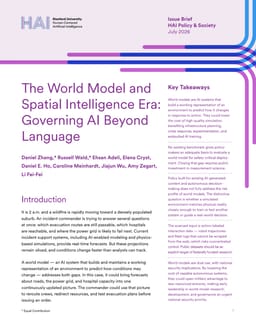
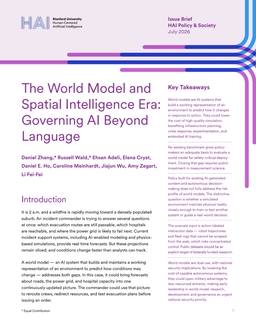
This brief highlights the emergence of world models and outlines a first-of-its-kind governance and policy agenda for the technology.
This brief highlights the emergence of world models and outlines a first-of-its-kind governance and policy agenda for the technology.
Why 'Zero-Shot' Clinical Predictions Are Risky

These models generate plausible timelines from historical patterns; without calibration and auditing, their “probabilities” may not reflect reality.
These models generate plausible timelines from historical patterns; without calibration and auditing, their “probabilities” may not reflect reality.

Vafa et al. (2024) introduced a transformer-based econometric model, CAREER, that predicts a worker’s next job as a function of career history (an “occupation model”). CAREER was initially estimated (“pre-trained”) using a large, unrepresentative resume dataset, which served as a “foundation model,” and parameter estimation was continued (“fine-tuned”) using data from a representative survey. CAREER had better predictive performance than benchmarks. This paper considers an alternative where the resume-based foundation model is replaced by a large language model (LLM). We convert tabular data from the survey into text files that resemble resumes and fine-tune the LLMs using these text files with the objective to predict the next token (word). The resulting fine-tuned LLM is used as an input to an occupation model. Its predictive performance surpasses all prior models. We demonstrate the value of fine-tuning and further show that by adding more career data from a different population, fine-tuning smaller LLMs surpasses the performance of fine-tuning larger models.
Vafa et al. (2024) introduced a transformer-based econometric model, CAREER, that predicts a worker’s next job as a function of career history (an “occupation model”). CAREER was initially estimated (“pre-trained”) using a large, unrepresentative resume dataset, which served as a “foundation model,” and parameter estimation was continued (“fine-tuned”) using data from a representative survey. CAREER had better predictive performance than benchmarks. This paper considers an alternative where the resume-based foundation model is replaced by a large language model (LLM). We convert tabular data from the survey into text files that resemble resumes and fine-tune the LLMs using these text files with the objective to predict the next token (word). The resulting fine-tuned LLM is used as an input to an occupation model. Its predictive performance surpasses all prior models. We demonstrate the value of fine-tuning and further show that by adding more career data from a different population, fine-tuning smaller LLMs surpasses the performance of fine-tuning larger models.
Data Privacy and Foundation Models: Can We Have Both?
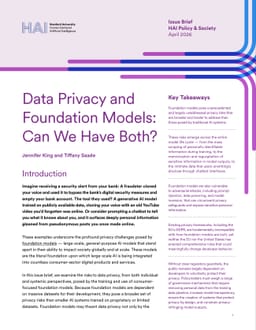
This brief examines the privacy risks foundation models pose to individuals and society, and governance mechanisms needed to address them.
This brief examines the privacy risks foundation models pose to individuals and society, and governance mechanisms needed to address them.