Stanford
University
  • Stanford Home
  • Maps & Directions
  • Search Stanford
  • Emergency Info
  • Terms of Use
  • Privacy
  • Copyright
  • Trademarks
  • Non-Discrimination
  • Accessibility
© Stanford University.  Stanford, California 94305.
Inside the 2026 AI Index Report | Stanford HAI | Stanford HAI
Navigate
  • About
  • Events
  • AI Glossary
  • Careers
  • Search
Participate
  • Get Involved
  • Support HAI
  • Contact Us
Skip to content
  • About

    • About
    • People
    • Get Involved with HAI
    • Support HAI
    • Subscribe to Email
  • Research

    • Research
    • Research Programs
    • Grants
    • Marlowe (opens in new tab)
    • Student Affinity Groups
    • Centers & Labs
    • Research Publications
    • Research Partners
  • Education

    • Education
    • Executive and Professional Education
    • Government and Policymakers
    • K-12
    • Stanford Students
  • Policy

    • Policy
    • Policy Publications
    • Policymaker Education
    • Student Opportunities
  • AI Index

    • AI Index
    • AI Index Report
    • Global Vibrancy Tool
    • People
  • News
  • Events
  • Industry
  • Centers & Labs

Stay Up To Date

Get the latest news, advances in research, policy work, and education program updates from HAI in your inbox weekly.

Sign Up For Latest News

Your browser does not support the video tag.
eventSeminar

Inside the 2026 AI Index Report | Stanford HAI

Status
Past
Date
Wednesday, May 20, 2026 12:00 PM - 1:15 PM PST/PDT
Location
353 Jane Stanford Way, Stanford, CA, 94305 | Room 119
Topics
Economy, Markets
Energy, Environment
Finance, Business
Regulation, Policy, Governance
Industry, Innovation
Sciences (Social, Health, Biological, Physical)
Robotics
Arts, Humanities
Automation
Foundation Models
Attend Virtually
Overview
Watch Recording
Overview
Watch Recording
Share
Link copied to clipboard!
Event Contact
Stanford HAI
stanford-hai@stanford.edu
Related
  • AI Index

    The mission of the AI Index is to provide unbiased, rigorously vetted, and globally sourced data for policymakers, researchers, journalists, executives, and the general public to develop a deeper understanding of the complex field of AI. To achieve this, we track, collate, distill, and visualize data relating to artificial intelligence.

Related Events

Rob Reich, Diyi Yang, Amy Zegart | Prompt Response: Should AI Slow Down?
WebinarSep 21, 202610:00 AM - 11:15 AM
September
21
2026

HAI faculty offer independent critique of the AI debates of the moment.

Webinar
Your browser does not support the video tag.

Rob Reich, Diyi Yang, Amy Zegart | Prompt Response: Should AI Slow Down?

Sep 21, 202610:00 AM - 11:15 AM

HAI faculty offer independent critique of the AI debates of the moment.

Alexandr Lenk & Arvind Karunakaran | Industry Conversation with Instacart
SeminarSep 23, 202612:00 PM - 1:15 PM
September
23
2026

This seminar pairs a case study of AI diffusion with an organizational approach to technological changes in the workplace.

Seminar
Your browser does not support the video tag.

Alexandr Lenk & Arvind Karunakaran | Industry Conversation with Instacart

Sep 23, 202612:00 PM - 1:15 PM

This seminar pairs a case study of AI diffusion with an organizational approach to technological changes in the workplace.

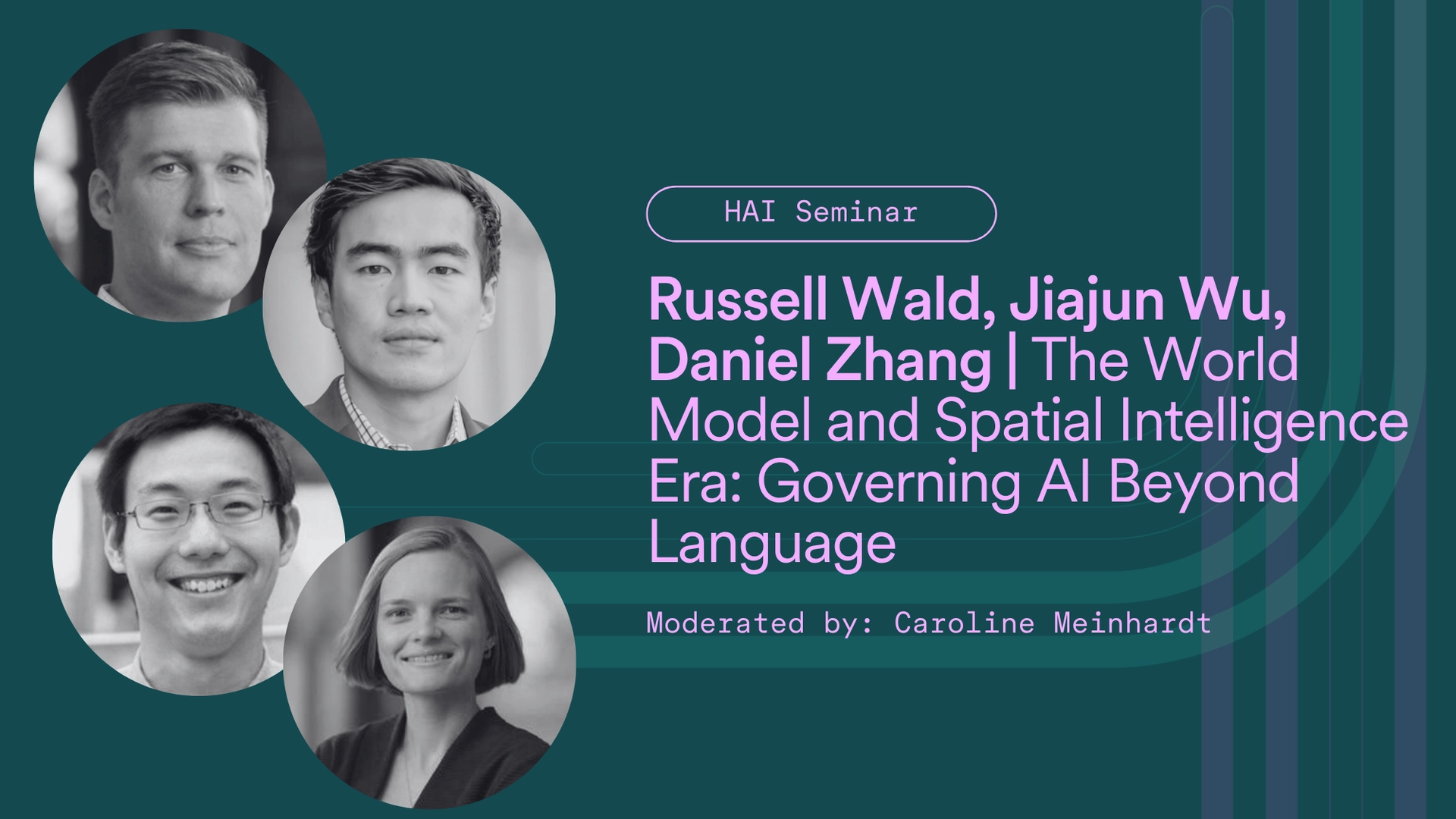
Daniel Zhang, Caroline Meinhardt, Jiajun Wu, and Russell Wald | The World Model and Spatial Intelligence Era: Governing AI Beyond Language
SeminarSep 30, 20263:00 PM - 4:15 PM
September
30
2026

As AI moves beyond language into systems that can perceive, understand, and act in the physical world, a new frontier is emerging: world models—AI systems that build and maintain working representations of real environments to predict how they change in response to action.
Seminar

Daniel Zhang, Caroline Meinhardt, Jiajun Wu, and Russell Wald | The World Model and Spatial Intelligence Era: Governing AI Beyond Language

Sep 30, 20263:00 PM - 4:15 PM

As AI moves beyond language into systems that can perceive, understand, and act in the physical world, a new frontier is emerging: world models—AI systems that build and maintain working representations of real environments to predict how they change in response to action.