An Ankle Exoskeleton Could Greatly Increase Our Walking Speed
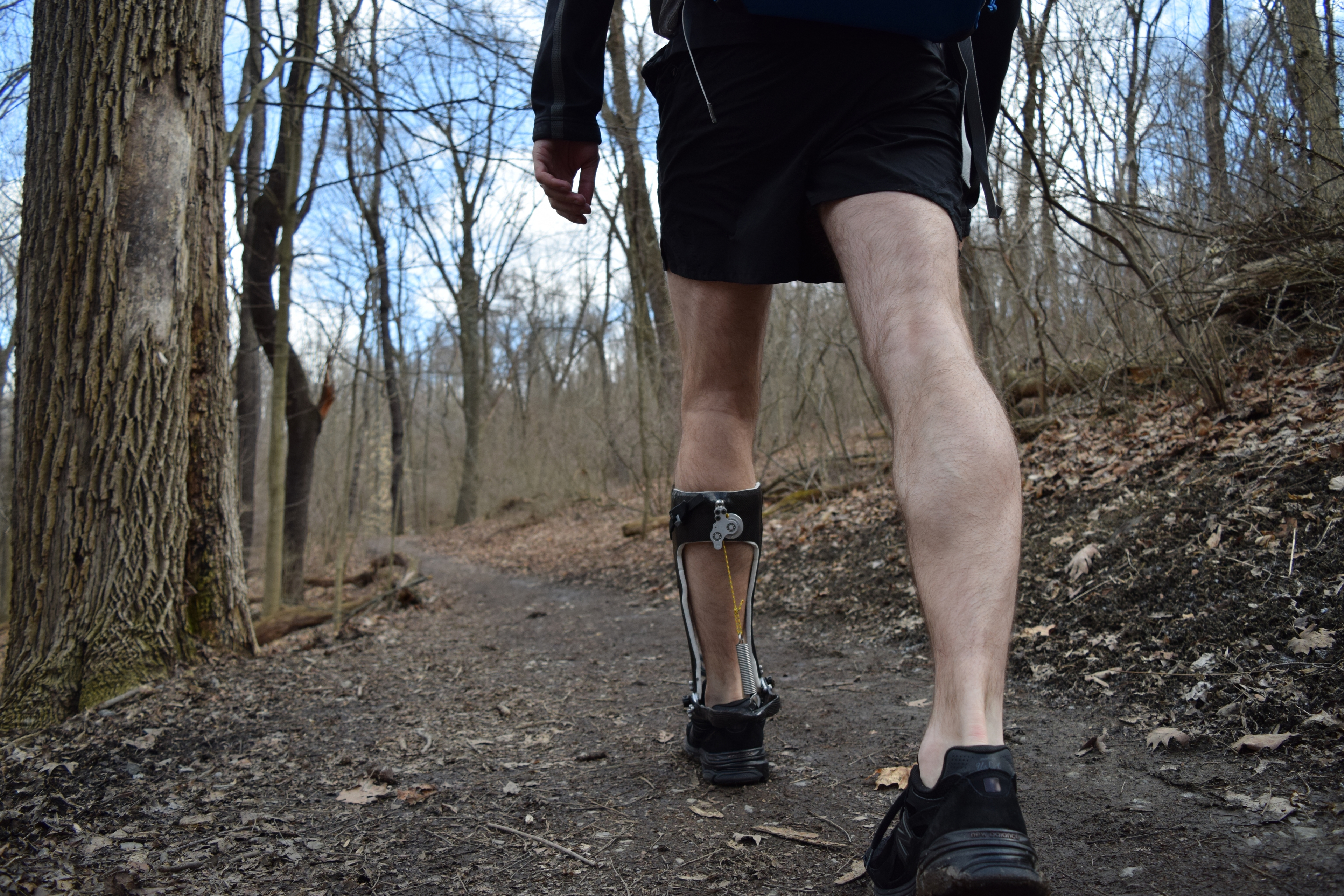
Stanford scholars found that an optimized exoskeleton system increased walking speed by about 40% in lab tests.
Being unable to walk quickly can be frustrating and problematic, but it is a common issue, especially as people age. Noting the pervasiveness of slower-than-desired walking, engineers at Stanford University have tested how well a prototype exoskeleton system they have developed – which attaches around the shin and into a running shoe – increased the self-selected walking speed of people in an experimental setting.
The exoskeleton is externally powered by motors and controlled by an algorithm. When the researchers optimized it for speed, participants walked, on average, 42 percent faster than when they were wearing normal shoes and no exoskeleton. The results of this study were published on April 20 in IEEE Transactions on Neural Systems and Rehabilitation Engineering.
“We were hoping that we could increase walking speed with exoskeleton assistance, but we were really surprised to find such a large improvement,” said Steve Collins, associate professor of mechanical engineering at Stanford and senior author of the paper. “Forty percent is huge.”
Read the full paper, "Optimizing Exoskeleton Assistance for Faster Self-Selected Walking"
For this initial set of experiments, the participants were young, healthy adults. Given their impressive results, the researchers plan to run future tests with older adults and to look at other ways the exoskeleton design can be improved. They also hope to eventually create an exoskeleton that can work outside the lab, though that goal is still a ways off.
“My research mission is to understand the science of biomechanics and motor control behind human locomotion and apply that to enhance the physical performance of humans in daily life,” said Seungmoon Song, a postdoctoral fellow in mechanical engineering and lead author of the paper. “I think exoskeletons are very promising tools that could achieve that enhancement in physical quality of life.”
Walking in the loop
The ankle exoskeleton system tested in this research is an experimental emulator that serves as a testbed for trying out different designs. It has a frame that fastens around the upper shin and into an integrated running shoe that the participant wears. It is attached to large motors that sit beside the walking surface and pull a tether that runs up the length of the back of the exoskeleton. Controlled by an algorithm, the tether tugs the wearer’s heel upward, helping them point their toe down as they push off the ground.
For this study, the researchers had 10 participants walk with five different modes of operation. They walked in normal shoes without the exoskeleton, with the exoskeleton turned off and with the exoskeleton turned on with three different modes: optimized for speed, optimized for energy use, and a placebo mode adjusted to make them walk more slowly. In all of the tests, participants walked on a treadmill that adapts to their speed.
The mode that was optimized for speed – which resulted in the 42 percent increase in walking pace – was created through a human-in-the-loop process. An algorithm repeatedly adjusted the exoskeleton settings while the user walked, with the goal of improving the user’s speed with each adjustment. Finding the speed-optimized mode of operation took about 150 rounds of adjustment and two hours per person.
In addition to greatly increasing walking speed, the speed-optimized mode also reduced energy use, by about 2 percent per meter traveled. However, that result varied widely from person to person, which is somewhat expected, given that it was not an intentional feature of that exoskeleton mode.
“The study was designed to specifically answer the scientific question about increasing walking speed,” Song said. “We didn’t care too much about the other performance measures, like comfort or energy. However, seven out of 10 participants not only walked faster but consumed less energy, which really shows how much potential exoskeletons have for helping people in an efficient way.”
The settings that were optimized specifically for energy use were borrowed from a previous experiment. In the current study, this mode decreased energy use more than the speed-optimized settings but did not increase speed as much. As intended, the placebo mode both slowed down participants and boosted their energy use.
Better, faster, stronger
Now that the researchers have attained such significant speed assistance, they plan to focus future versions of the ankle exoskeleton emulator on reducing energy use consistently across users, while also being more comfortable.
In considering older adults specifically, Collins and his lab wonder whether future designs could reduce pain caused by weight on joints or improve balance. They plan to conduct similar walking tests with older adults and hope those provide encouraging results as well.
“A 40 percent increase in speed is more than the difference between younger adults and older adults,” said Collins. “So, it’s possible that devices like this could not only restore but enhance self-selected walking speed for older individuals and that’s something that we’re excited to test next.”
This story was first published by Stanford News.
Stanford HAI's mission is to advance AI research, education, policy and practice to improve the human condition. Learn more.
Related News

Dashboards created by Stanford HAI’s Digital Economy Lab measure how AI adoption is altering employment trends and job growth, along with broader economic indicators.

Dashboards created by Stanford HAI’s Digital Economy Lab measure how AI adoption is altering employment trends and job growth, along with broader economic indicators.

Over three years, we’ve built progressively harder, more realistic benchmarks for medical AI. Here’s what we learned.

Over three years, we’ve built progressively harder, more realistic benchmarks for medical AI. Here’s what we learned.

It's one of AI policy's hardest unsolved problems. Expert Deb Raji joins Stanford HAI to find answers that move beyond principles and into practice.

It's one of AI policy's hardest unsolved problems. Expert Deb Raji joins Stanford HAI to find answers that move beyond principles and into practice.