BEHAVIOR Challenge Charts the Way Forward for Domestic Robotics
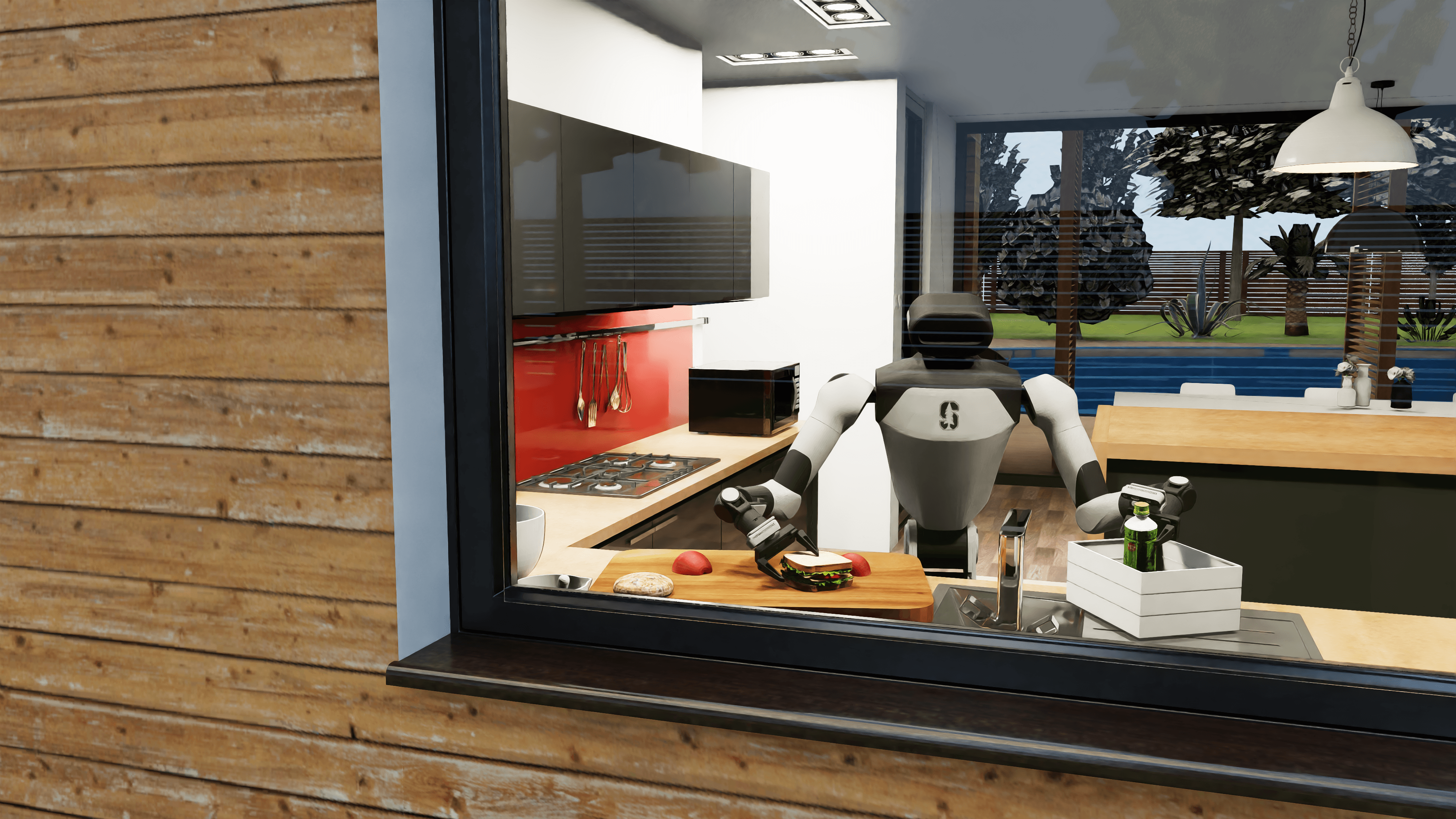
In the BEHAVIOR Challenge, robots will compete against each other on 50 everyday domestic tasks, from making toast to tidying a room.
With a first-of-its-kind competition for roboticists everywhere, researchers at Stanford are hoping to push domestic robotics into a new age of autonomy and capability.
Anyone who has ever made a pizza by hand knows that it is not easy to make a pizza. Now, consider the difficulty in training a robot to do the same, from making the pizza dough to setting the oven temperature, to slicing the mushrooms. Such was the challenge for a team of robotics engineers at Stanford over the last several years to not just simulate the making of a single pizza step by step but also 999 other domestic challenges that robots will be expected to complete—autonomously—for their human owners, from turning on the radio to cleaning a bathroom.
“Actually, making pizza is one of the easier tasks in our list,” says Ruohan Zhang with a smile. Zhang is a postdoctoral researcher in the Stanford Vision and Learning Lab run by renowned computer vision experts, Fei-Fei Li and Jiajun Wu, both professors of computer science.
Zhang co-led BEHAVIOR, a yearslong effort to benchmark 1,000 everyday domestic tasks in 50 richly simulated environments—houses, gardens, restaurants, offices, and more—stocked with over 10,000 interactive objects modeled with realistic physics. Li, Wu, and their Stanford Vision and Learning Lab colleagues hope BEHAVIOR will become something of a technical “North Star” that others in the field can use to guide the training of their robots.
"In BEHAVIOR, we see a bold vision of human-centered AI that connects academic research to everyday human life,” says Professor Li, who is the founding director of the Stanford Institute for Human-Centered AI. “This is not just a benchmark—it's a call to imagine and create intelligent agents that can truly assist people in their daily lives. Meanwhile, it represents a step forward in our quest to build generalist AI systems that understand, reason, and act in the complex world of humans."
“While any one of those tasks is already highly complex in its own right, the target is to create a single robot that can do all of these things,” Wu adds. “Creating these benchmarks now, before the field has evolved too far, will help to set up potential common goals for the community."
A Grand Challenge
Having completed the Herculean effort of simulating all 1,000 tasks, Zhang and colleagues announced the 2025 BEHAVIOR Challenge, a global competition for robotics engineers everywhere to demonstrate the capabilities of their robots to complete a hand-selected subset of 50 of BEHAVIOR’s tasks in one of the most comprehensive simulated households ever built, all before a worldwide audience of top academic researchers and robotics companies.
"By grounding robotics research in realistic human tasks, BEHAVIOR Challenge sets the stage for creating robots that people will actually want and need in their daily lives," says Yunfan Jiang, a doctoral student and BEHAVIOR core member.
Examples include making toast, tidying a room, or setting a table. Each task is defined by initial conditions, required objects, and a clear success criterion. Competitors are not judged on achieving individual tasks, but on a team’s success across all 50 tasks.
“BEHAVIOR stands out as a benchmark because it tackles real-world, long-horizon tasks that require mobile manipulation. I’m excited to see the community build on this foundation and push the boundaries of task success,” says team member Raven Huang, a postdoctoral researcher.
Submissions are welcome from academic labs, independent researchers, or industry teams. Entries are due November 15, 2025, with the winners to be announced at the NeurIPS 2025 Conference in December. The top prize is $1,000.
“This is about more than just a cash prize. The BEHAVIOR Challenge is really a chance to help shape the future of embodied AI,” Zhang says. “We actually don’t know if today’s robotic solutions—hardware or software—are ready to solve these real, everyday tasks. This competition is a chance to see where we stand as a field.”
"By open-sourcing everything—the simulator, demonstrations, and baselines—we're betting that collective progress will move faster than any single institution working in isolation,” says Hang Yin. "We're as excited as anyone to see what solutions emerge—may the best-behaved robot win!"
The Future of Robotics
The timing is not by chance. After great strides in recent years in perception and object manipulation, domestic robotics is at a crossroads where, despite some gains, it still struggles in complex real-world settings. For many roboticists, the competition is an opportunity to stress-test their algorithms in a fun environment with a mutually supportive community.
The BEHAVIOR Challenge is open to anyone worldwide. Teams can download the simulation environment, assets, and task definitions from the official challenge website. Full details are available on the BEHAVIOR Challenge website.
"It'll be encouraging to see robotics researchers strive to solve tasks that humans need. With such diverse scenes, challenging tasks, and high-fidelity simulation, it should indeed be a grand challenge,” says team member Sanjana Srivastava, who recently earned her PhD at Stanford.
Apply to the 2025 BEHAVIOR Challenge by November 15, 2025. Winners will be announced at the NeurIPS 2025 Conference in December.
Related News

Two models working together perform worse than one alone, exposing a critical gap in artificial intelligence capabilities.

Two models working together perform worse than one alone, exposing a critical gap in artificial intelligence capabilities.
AI Hiring Tools Can Yield Racial Bias and Systemic Rejection

The first large-scale study of hiring algorithms in the wild finds concerning patterns to how systems reject candidates.
The first large-scale study of hiring algorithms in the wild finds concerning patterns to how systems reject candidates.
From Benchmarks to Real-World Impact: Causal Science Conference Explores Modern Challenges in AI Evaluation

On April 24, 2026, the Stanford Causal Science Conference: Frontiers in AI Evaluation brought together leading researchers from academia and industry to examine how causal reasoning, evaluation, and measurement are reshaping the future of AI systems.
On April 24, 2026, the Stanford Causal Science Conference: Frontiers in AI Evaluation brought together leading researchers from academia and industry to examine how causal reasoning, evaluation, and measurement are reshaping the future of AI systems.