Stanford
University
  • Stanford Home
  • Maps & Directions
  • Search Stanford
  • Emergency Info
  • Terms of Use
  • Privacy
  • Copyright
  • Trademarks
  • Non-Discrimination
  • Accessibility
© Stanford University.  Stanford, California 94305.
Akshay Chaudhari | Stanford HAI

Stay Up To Date

Get the latest news, advances in research, policy work, and education program updates from HAI in your inbox weekly.

Sign Up For Latest News

Navigate
  • About
  • Events
  • Careers
  • Search
Participate
  • Get Involved
  • Support HAI
  • Contact Us
Skip to content
  • About

    • About
    • People
    • Get Involved with HAI
    • Support HAI
    • Subscribe to Email
  • Research

    • Research
    • Fellowship Programs
    • Grants
    • Student Affinity Groups
    • Centers & Labs
    • Research Publications
    • Research Partners
  • Education

    • Education
    • Executive and Professional Education
    • Government and Policymakers
    • K-12
    • Stanford Students
  • Policy

    • Policy
    • Policy Publications
    • Policymaker Education
    • Student Opportunities
  • AI Index

    • AI Index
    • AI Index Report
    • Global Vibrancy Tool
    • People
  • News
  • Events
  • Industry
  • Centers & Labs
peopleFaculty

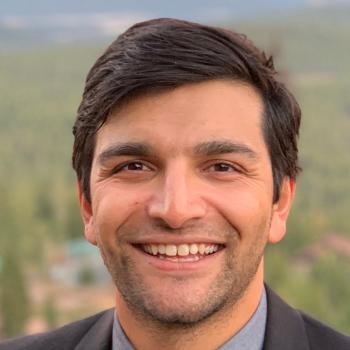
Akshay Chaudhari

Assistant Professor of Radiology (Integrative Biomedical Imaging Informatics) and, by courtesy, of Biomedical Data Science, Stanford University
External Bio

Dr. Chaudhari is an Assistant Professor in the Integrative Biomedical Imaging Informatics at Stanford (IBIIS) section in the Department of Radiology and is the Associate Director of Research and Education at the Stanford AIMI Center. He is interested in the application of artificial intelligence techniques to all aspects of medical imaging, including automated schedule and reading prioritization, image reconstruction, quantitative analysis, and prediction of patient outcomes. His interests range from developing novel data-efficient machine learning algorithms to clinical deployment and validation of patient outcomes, both for medical imaging acquisition and subsequent image analysis. Dr. Chaudhari has won many awards, including the W.S. Moore Young Investigator Award, the Junior Fellow Award, and an Outstanding Teacher Award from the International Society for Magnetic Resonance in Medicine, along with six young investigator awards from his work on MRI for osteoarthritis.
Share
Link copied to clipboard!

Latest Related to Akshay Chaudhari

Research
Your browser does not support the video tag.

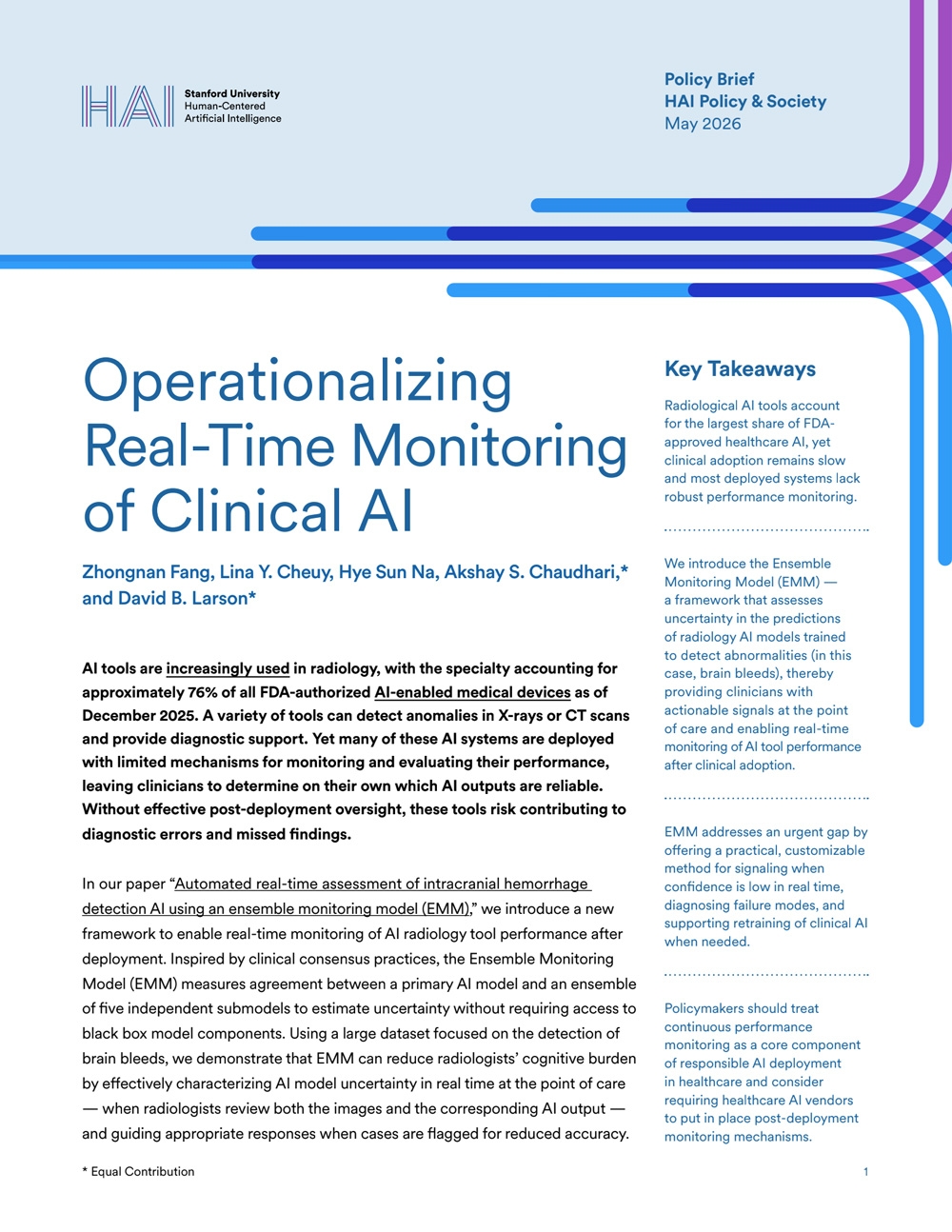
Automated real-time assessment of intracranial hemorrhage detection AI using an ensembled monitoring model (EMM)

Zhongnan Fang, Andrew Johnston, Lina Cheuy, Hye Sun Na, Magdalini Paschali, Camila Gonzalez, Bonnie Armstrong, Arogya Koirala, Derrick Laurel, Andrew Walker Campion, Michael Iv, Akshay Chaudhari, David B. Larson
HealthcareRegulation, Policy, GovernanceDeep DiveOct 13

Artificial intelligence (AI) tools for radiology are commonly unmonitored once deployed. The lack of real-time case-by-case assessments of AI prediction confidence requires users to independently distinguish between trustworthy and unreliable AI predictions, which increases cognitive burden, reduces productivity, and potentially leads to misdiagnoses. To address these challenges, we introduce Ensembled Monitoring Model (EMM), a framework inspired by clinical consensus practices using multiple expert reviews. Designed specifically for black-box commercial AI products, EMM operates independently without requiring access to internal AI components or intermediate outputs, while still providing robust confidence measurements. Using intracranial hemorrhage detection as our test case on a large, diverse dataset of 2919 studies, we demonstrate that EMM can successfully categorize confidence in the AI-generated prediction, suggest appropriate actions, and help physicians recognize low confidence scenarios, ultimately reducing cognitive burden. Importantly, we provide key technical considerations and best practices for successfully translating EMM into clinical settings.

Research
Your browser does not support the video tag.

Applications of Artificial Intelligence for Pediatric Cancer Imaging

Akshay Chaudhari, Shashi B. Singh, Amir H. Sarrami, Sergios Gatidis, Zahra S. Varniab, Heike E. Daldrup-Link
HealthcareMay 29

Artificial intelligence (AI) is transforming the medical imaging of adult patients. However, its utilization in pediatric oncology imaging remains constrained, in part due to the inherent scarcity of data associated with childhood cancers. Pediatric cancers are rare, and imaging technologies are evolving rapidly, leading to insufficient data of a particular type to effectively train these algorithms. The small market size of pediatric patients compared with adult patients could also contribute to this challenge, as market size is a driver of commercialization. This review provides an overview of the current state of AI applications for pediatric cancer imaging, including applications for medical image acquisition, processing, reconstruction, segmentation, diagnosis, staging, and treatment response monitoring. Although current developments are promising, impediments due to the diverse anatomies of growing children and nonstandardized imaging protocols have led to limited clinical translation thus far. Opportunities include leveraging reconstruction algorithms to achieve accelerated low-dose imaging and automating the generation of metric-based staging and treatment monitoring scores. Transfer learning of adult-based AI models to pediatric cancers, multiinstitutional data sharing, and ethical data privacy practices for pediatric patients with rare cancers will be keys to unlocking the full potential of AI for clinical translation and improving outcomes for these young patients.