Stanford
University
  • Stanford Home
  • Maps & Directions
  • Search Stanford
  • Emergency Info
  • Terms of Use
  • Privacy
  • Copyright
  • Trademarks
  • Non-Discrimination
  • Accessibility
© Stanford University.  Stanford, California 94305.
Christopher Piech | Stanford HAI

Stay Up To Date

Get the latest news, advances in research, policy work, and education program updates from HAI in your inbox weekly.

Sign Up For Latest News

Navigate
  • About
  • Events
  • Careers
  • Search
Participate
  • Get Involved
  • Support HAI
  • Contact Us
Skip to content
  • About

    • About
    • People
    • Get Involved with HAI
    • Support HAI
    • Subscribe to Email
  • Research

    • Research
    • Fellowship Programs
    • Grants
    • Student Affinity Groups
    • Centers & Labs
    • Research Publications
    • Research Partners
  • Education

    • Education
    • Executive and Professional Education
    • Government and Policymakers
    • K-12
    • Stanford Students
  • Policy

    • Policy
    • Policy Publications
    • Policymaker Education
    • Student Opportunities
  • AI Index

    • AI Index
    • AI Index Report
    • Global Vibrancy Tool
    • People
  • News
  • Events
  • Industry
  • Centers & Labs
peopleFaculty

Christopher Piech

Assistant Professor of Computer Science, Stanford University; Faculty Affiliate, Stanford HAI

Chris headshot
External Bio
Latest Work
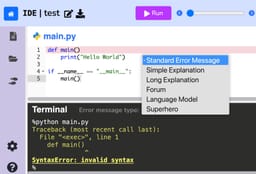
A Large Scale RCT on Effective Error Messages in CS1
Sierra Wang, John Mitchell, Christopher Piech
Mar 07
Research

In this paper, we evaluate the most effective error message types through a large-scale randomized controlled trial conducted in an open-access, online introductory computer science course with 8,762 students from 146 countries. We assess existing error message enhancement strategies, as well as two novel approaches of our own: (1) generating error messages using OpenAI's GPT in real time and (2) constructing error messages that incorporate the course discussion forum. By examining students' direct responses to error messages, and their behavior throughout the course, we quantitatively evaluate the immediate and longer term efficacy of different error message types. We find that students using GPT generated error messages repeat an error 23.1% less often in the subsequent attempt, and resolve an error in 34.8% fewer additional attempts, compared to students using standard error messages. We also perform an analysis across various demographics to understand any disparities in the impact of different error message types. Our results find no significant difference in the effectiveness of GPT generated error messages for students from varying socioeconomic and demographic backgrounds. Our findings underscore GPT generated error messages as the most helpful error message type, especially as a universally effective intervention across demographics.

The AI Teacher Test: Measuring the Pedagogical Ability of Blender and GPT-3 in Educational Dialogues
Anaïs Tack, Christopher Piech
Sep 09
Research
Your browser does not support the video tag.

The AI Teacher Test: Measuring the Pedagogical Ability of Blender and GPT-3 in Educational Dialogues

Generative Grading: Near Human-level Accuracy for Automated Feedback on Richly Structured Problems
Ali Malik, Mike Wu, Vrinda Vasavada, Jinpeng Song, Madison Coots, John Mitchell, Noah Goodman, Christopher Piech
Dec 20
Research
Your browser does not support the video tag.

Generative Grading: Near Human-level Accuracy for Automated Feedback on Richly Structured Problems

Share
Link copied to clipboard!

All Related

Play to Grade: Testing Coding Games as Classifying Markov Decision Process
Allen Nie, Emma Brunskill, Christopher Piech
Dec 06, 2021
Research
Your browser does not support the video tag.

Play to Grade: Testing Coding Games as Classifying Markov Decision Process

Play to Grade: Testing Coding Games as Classifying Markov Decision Process

Allen Nie, Emma Brunskill, Christopher Piech
Dec 06, 2021

Play to Grade: Testing Coding Games as Classifying Markov Decision Process

Your browser does not support the video tag.
Research