A Large Scale RCT on Effective Error Messages in CS1
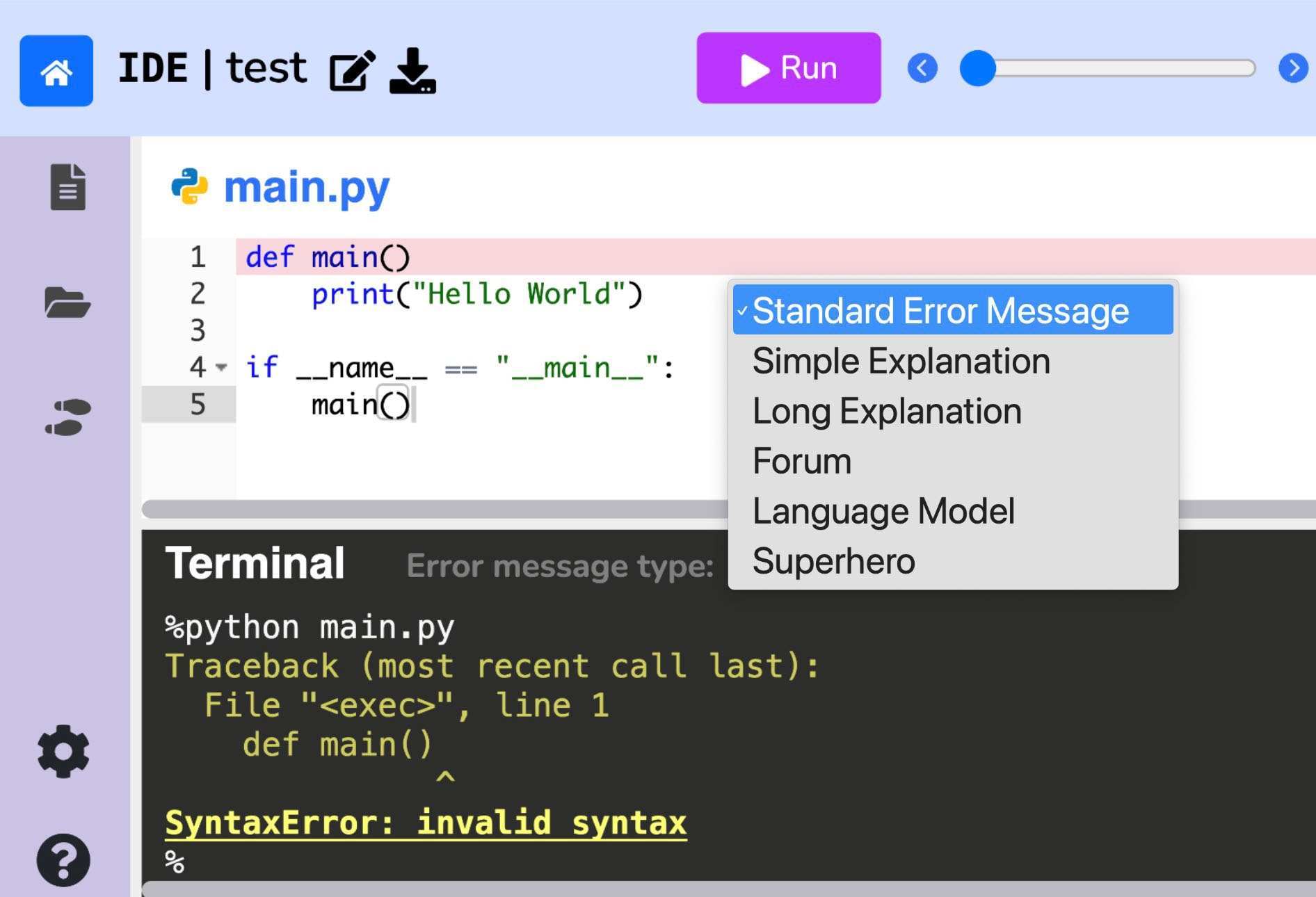
In this paper, we evaluate the most effective error message types through a large-scale randomized controlled trial conducted in an open-access, online introductory computer science course with 8,762 students from 146 countries. We assess existing error message enhancement strategies, as well as two novel approaches of our own: (1) generating error messages using OpenAI's GPT in real time and (2) constructing error messages that incorporate the course discussion forum. By examining students' direct responses to error messages, and their behavior throughout the course, we quantitatively evaluate the immediate and longer term efficacy of different error message types. We find that students using GPT generated error messages repeat an error 23.1% less often in the subsequent attempt, and resolve an error in 34.8% fewer additional attempts, compared to students using standard error messages. We also perform an analysis across various demographics to understand any disparities in the impact of different error message types. Our results find no significant difference in the effectiveness of GPT generated error messages for students from varying socioeconomic and demographic backgrounds. Our findings underscore GPT generated error messages as the most helpful error message type, especially as a universally effective intervention across demographics.
Related Publications

We invited 11 sci-fi filmmakers and AI researchers to Stanford for Stories for the Future, a day-and-a-half experiment in fostering new narratives about AI. Researchers shared perspectives on AI and filmmakers reflected on the challenges of writing AI narratives. Together researcher-writer pairs transformed a research paper into a written scene. The challenge? Each scene had to include an AI manifestation, but could not be about the personhood of AI or AI as a threat. Read the results of this project.

We invited 11 sci-fi filmmakers and AI researchers to Stanford for Stories for the Future, a day-and-a-half experiment in fostering new narratives about AI. Researchers shared perspectives on AI and filmmakers reflected on the challenges of writing AI narratives. Together researcher-writer pairs transformed a research paper into a written scene. The challenge? Each scene had to include an AI manifestation, but could not be about the personhood of AI or AI as a threat. Read the results of this project.
Current societal trends reflect an increased mistrust in science and a lowered civic engagement that threaten to impair research that is foundational for ensuring public health and advancing health equity. One effective countermeasure to these trends lies in community-facing citizen science applications to increase public participation in scientific research, making this field an important target for artificial intelligence (AI) exploration. We highlight potentially promising citizen science AI applications that extend beyond individual use to the community level, including conversational large language models, text-to-image generative AI tools, descriptive analytics for analyzing integrated macro- and micro-level data, and predictive analytics. The novel adaptations of AI technologies for community-engaged participatory research also bring an array of potential risks. We highlight possible negative externalities and mitigations for some of the potential ethical and societal challenges in this field.
Current societal trends reflect an increased mistrust in science and a lowered civic engagement that threaten to impair research that is foundational for ensuring public health and advancing health equity. One effective countermeasure to these trends lies in community-facing citizen science applications to increase public participation in scientific research, making this field an important target for artificial intelligence (AI) exploration. We highlight potentially promising citizen science AI applications that extend beyond individual use to the community level, including conversational large language models, text-to-image generative AI tools, descriptive analytics for analyzing integrated macro- and micro-level data, and predictive analytics. The novel adaptations of AI technologies for community-engaged participatory research also bring an array of potential risks. We highlight possible negative externalities and mitigations for some of the potential ethical and societal challenges in this field.
Model-based reinforcement learning (MBRL) is a promising route to sampleefficient policy optimization. However, a known vulnerability of reconstructionbased MBRL consists of scenarios in which detailed aspects of the world are highly predictable, but irrelevant to learning a good policy. Such scenarios can lead the model to exhaust its capacity on meaningless content, at the cost of neglecting important environment dynamics. While existing approaches attempt to solve this problem, we highlight its continuing impact on leading MBRL methods —including DreamerV3 and DreamerPro — with a novel environment where background distractions are intricate, predictable, and useless for planning future actions. To address this challenge we develop a method for focusing the capacity of the world model through synergy of a pretrained segmentation model, a task-aware reconstruction loss, and adversarial learning. Our method outperforms a variety of other approaches designed to reduce the impact of distractors, and is an advance towards robust model-based reinforcement learning.
Model-based reinforcement learning (MBRL) is a promising route to sampleefficient policy optimization. However, a known vulnerability of reconstructionbased MBRL consists of scenarios in which detailed aspects of the world are highly predictable, but irrelevant to learning a good policy. Such scenarios can lead the model to exhaust its capacity on meaningless content, at the cost of neglecting important environment dynamics. While existing approaches attempt to solve this problem, we highlight its continuing impact on leading MBRL methods —including DreamerV3 and DreamerPro — with a novel environment where background distractions are intricate, predictable, and useless for planning future actions. To address this challenge we develop a method for focusing the capacity of the world model through synergy of a pretrained segmentation model, a task-aware reconstruction loss, and adversarial learning. Our method outperforms a variety of other approaches designed to reduce the impact of distractors, and is an advance towards robust model-based reinforcement learning.
Vafa et al. (2024) introduced a transformer-based econometric model, CAREER, that predicts a worker’s next job as a function of career history (an “occupation model”). CAREER was initially estimated (“pre-trained”) using a large, unrepresentative resume dataset, which served as a “foundation model,” and parameter estimation was continued (“fine-tuned”) using data from a representative survey. CAREER had better predictive performance than benchmarks. This paper considers an alternative where the resume-based foundation model is replaced by a large language model (LLM). We convert tabular data from the survey into text files that resemble resumes and fine-tune the LLMs using these text files with the objective to predict the next token (word). The resulting fine-tuned LLM is used as an input to an occupation model. Its predictive performance surpasses all prior models. We demonstrate the value of fine-tuning and further show that by adding more career data from a different population, fine-tuning smaller LLMs surpasses the performance of fine-tuning larger models.
Vafa et al. (2024) introduced a transformer-based econometric model, CAREER, that predicts a worker’s next job as a function of career history (an “occupation model”). CAREER was initially estimated (“pre-trained”) using a large, unrepresentative resume dataset, which served as a “foundation model,” and parameter estimation was continued (“fine-tuned”) using data from a representative survey. CAREER had better predictive performance than benchmarks. This paper considers an alternative where the resume-based foundation model is replaced by a large language model (LLM). We convert tabular data from the survey into text files that resemble resumes and fine-tune the LLMs using these text files with the objective to predict the next token (word). The resulting fine-tuned LLM is used as an input to an occupation model. Its predictive performance surpasses all prior models. We demonstrate the value of fine-tuning and further show that by adding more career data from a different population, fine-tuning smaller LLMs surpasses the performance of fine-tuning larger models.