Jen King's Testimony Before the U.S. House Committee on Energy and Commerce Oversight and Investigations Subcommittee
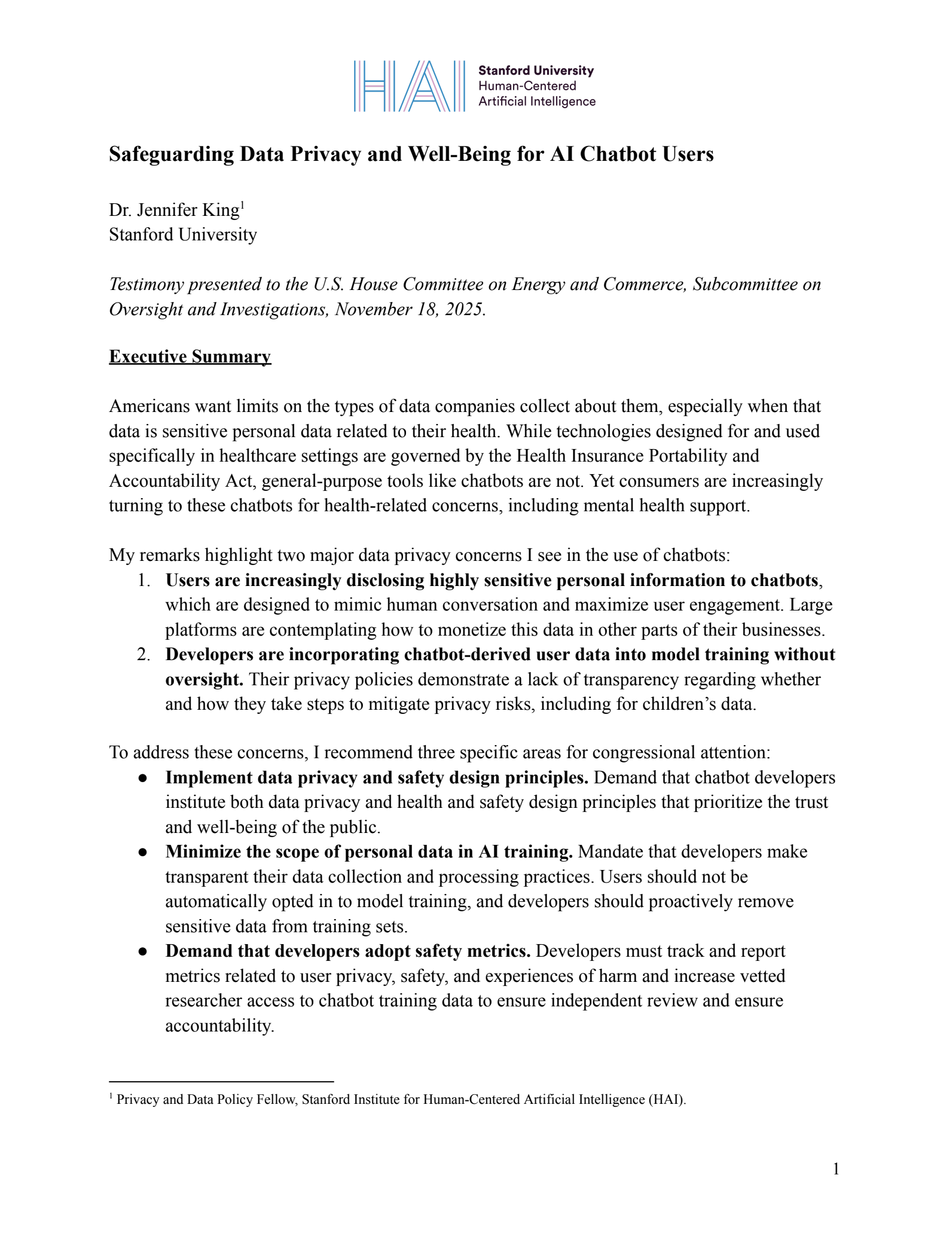
In this testimony presented to the U.S. House Committee on Energy and Commerce’s Subcommittee on Oversights and Investigations hearing titled “Innovation with Integrity: Examining the Risks and Benefits of AI Chatbots,” Jen King shares insights on data privacy concerns connected with the use of chatbots. She highlights opportunities for congressional action to protect chatbot users from related harms.
Executive Summary
Americans want limits on the types of data companies collect about them, especially when that data is sensitive personal data related to their health. While technologies designed for and used specifically in healthcare settings are governed by the Health Insurance Portability and Accountability Act, general-purpose tools like chatbots are not. Yet consumers are increasingly turning to these chatbots for health-related concerns, including mental health support.
My remarks highlight two major data privacy concerns I see in the use of chatbots:
Users are increasingly disclosing highly sensitive personal information to chatbots, which are designed to mimic human conversation and maximize user engagement. Large platforms are contemplating how to monetize this data in other parts of their businesses.
Developers are incorporating chatbot-derived user data into model training without oversight. Their privacy policies demonstrate a lack of transparency regarding whether and how they take steps to mitigate privacy risks, including for children’s data.
To address these concerns, I recommend three specific areas for congressional attention:
Implement data privacy and safety design principles. Demand that chatbot developers institute both data privacy and health and safety design principles that prioritize the trust and well-being of the public.
Minimize the scope of personal data in AI training. Mandate that developers make transparent their data collection and processing practices. Users should not be automatically opted in to model training, and developers should proactively remove sensitive data from training sets.
Demand that developers adopt safety metrics. Developers must track and report metrics related to user privacy, safety, and experiences of harm and increase vetted researcher access to chatbot training data to ensure independent review and ensure accountability.
Related Publications
Implementing the Transparency in Frontier AI Act Report for the California Department of Technology Multistakeholder Workshops
In this paper, HAI Associate Director and Senior Fellow Rob Reich and UC Berkeley School of Information Professor Deirdre K. Mulligan provide concrete recommendations to the California Department of Technology on the implementation of its frontier AI transparency requirements.
In this paper, HAI Associate Director and Senior Fellow Rob Reich and UC Berkeley School of Information Professor Deirdre K. Mulligan provide concrete recommendations to the California Department of Technology on the implementation of its frontier AI transparency requirements.
Designing Loyalty: AI Agents and Conflicts of Interest
This brief examines the conflict-of-interest risks posed by AI agents and calls for imposing a duty of loyalty on developers and deployers.
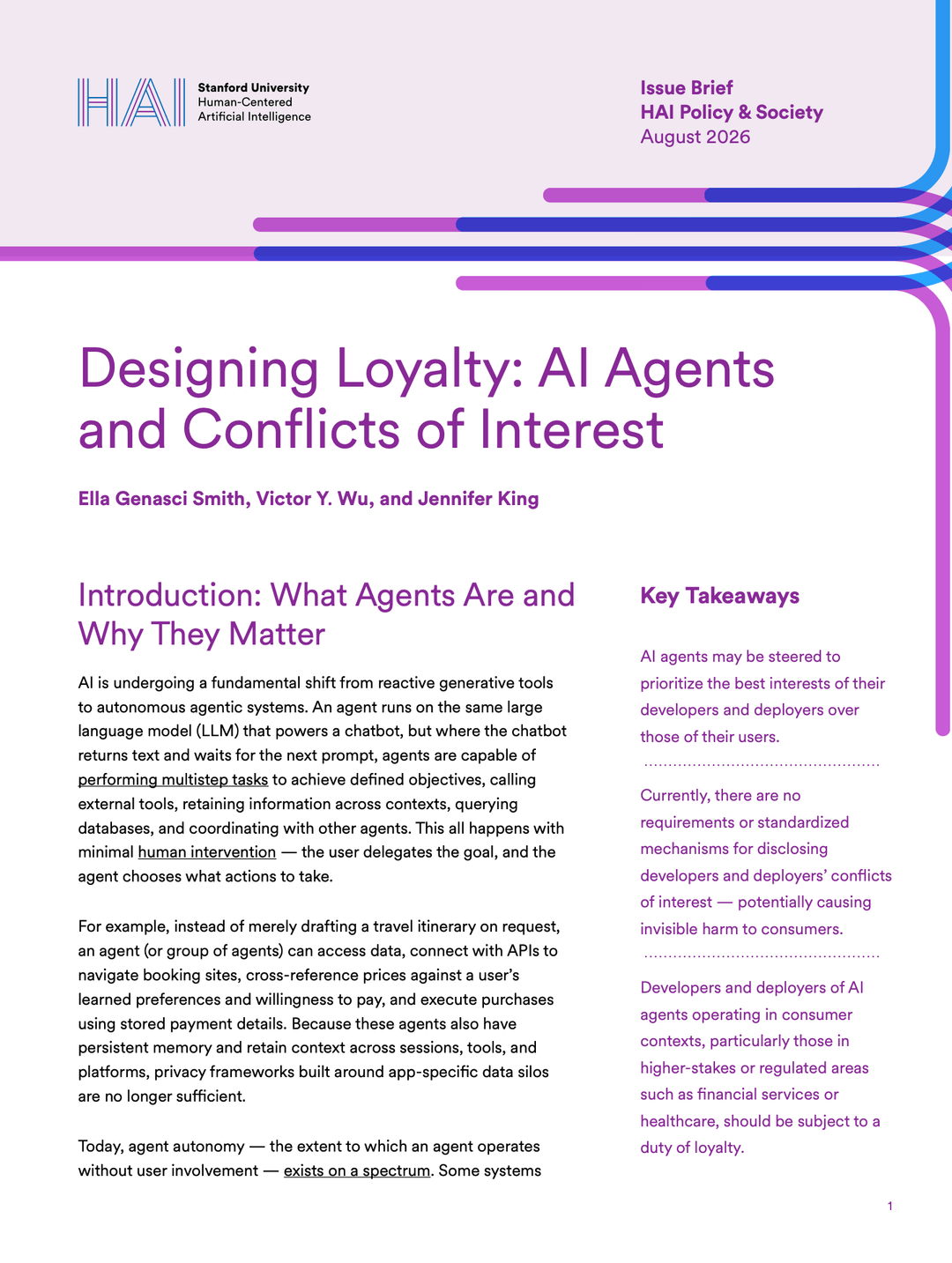
This brief examines the conflict-of-interest risks posed by AI agents and calls for imposing a duty of loyalty on developers and deployers.
Regulating Data Brokers in the Age of AI: A California Case Study
This brief assesses data broker compliance with California privacy laws and calls for more stringent consumer protections.
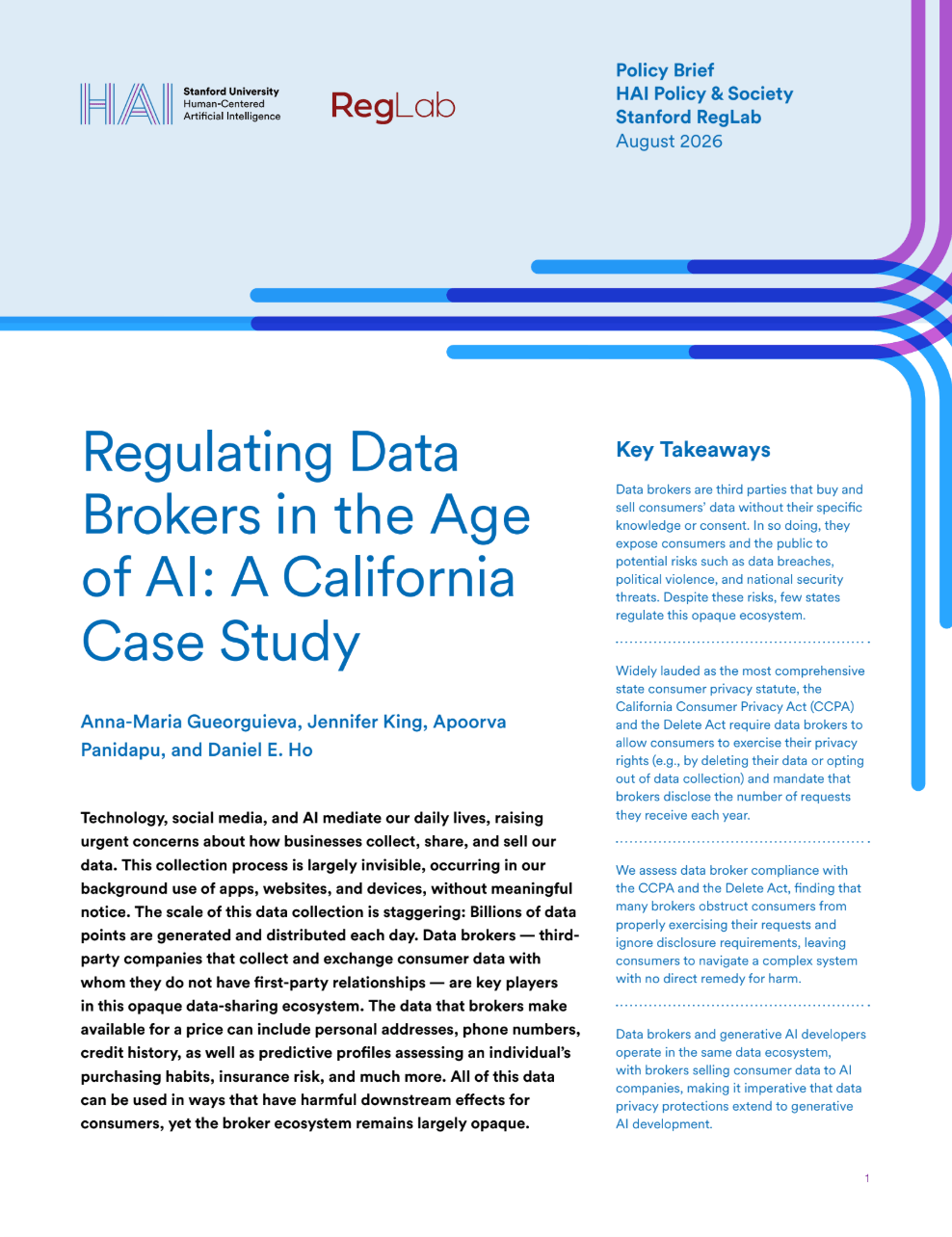
This brief assesses data broker compliance with California privacy laws and calls for more stringent consumer protections.
Data Privacy and Foundation Models: Can We Have Both?
This brief examines the privacy risks foundation models pose to individuals and society, and governance mechanisms needed to address them.
This brief examines the privacy risks foundation models pose to individuals and society, and governance mechanisms needed to address them.