Stanford
University
  • Stanford Home
  • Maps & Directions
  • Search Stanford
  • Emergency Info
  • Terms of Use
  • Privacy
  • Copyright
  • Trademarks
  • Non-Discrimination
  • Accessibility
© Stanford University.  Stanford, California 94305.
Skip to content
  • About

    • About
    • People
    • Get Involved with HAI
    • Support HAI
    • Subscribe to Email
  • Research

    • Research
    • Fellowship Programs
    • Grants
    • Student Affinity Groups
    • Centers & Labs
    • Research Publications
    • Research Partners
  • Education

    • Education
    • Executive and Professional Education
    • Government and Policymakers
    • K-12
    • Stanford Students
  • Policy

    • Policy
    • Policy Publications
    • Policymaker Education
    • Student Opportunities
  • AI Index

    • AI Index
    • AI Index Report
    • Global Vibrancy Tool
    • People
  • News
  • Events
  • Industry
  • Centers & Labs

What is AI Safety?

AI Safety is the field focused on ensuring AI systems behave reliably and don’t cause harm, even when they’re powerful, widely deployed, or operating in unexpected situations. It covers issues like preventing accidents (errors, brittleness), misuse (fraud, cyberattacks), and loss of human control (systems pursuing goals in unsafe ways). The aim is to build AI that is robust, secure, and aligned with human intentions and societal values.

Navigate
  • About
  • Events
  • Careers
  • Search
Participate
  • Get Involved
  • Support HAI
  • Contact Us

Stay Up To Date

Get the latest news, advances in research, policy work, and education program updates from HAI in your inbox weekly.

Sign Up For Latest News


AI Safety mentioned at Stanford HAI

Explore Similar Terms

AI Alignment | Responsible AI | Ethical AI

See Full List of Terms & Definitions

Exploring the Dangers of AI in Mental Health Care
Sarah Wells
Jun 11
news
Young woman holds up phone to her face

A new Stanford study reveals that AI therapy chatbots may not only lack effectiveness compared to human therapists but could also contribute to harmful stigma and dangerous responses.

Exploring the Dangers of AI in Mental Health Care

Sarah Wells
Jun 11

A new Stanford study reveals that AI therapy chatbots may not only lack effectiveness compared to human therapists but could also contribute to harmful stigma and dangerous responses.

Healthcare
Generative AI
Young woman holds up phone to her face
news
AI Action Summit in Paris Highlights A Shifting Policy Landscape
Shana Lynch
Feb 27
news

Stanford HAI joined global leaders to discuss the balance between AI innovation and safety and explore future policy paths.

AI Action Summit in Paris Highlights A Shifting Policy Landscape

Shana Lynch
Feb 27

Stanford HAI joined global leaders to discuss the balance between AI innovation and safety and explore future policy paths.

Democracy
Regulation, Policy, Governance
Privacy, Safety, Security
news
The Evolution of Safety: Stanford’s Mykel Kochenderfer Explores Responsible AI in High-Stakes Environments
Scott Hadly
May 09
news

As AI technologies rapidly evolve, Professor Kochenderfer leads the charge in developing effective validation mechanisms to ensure safety in autonomous systems like vehicles and drones.
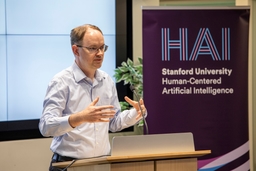
The Evolution of Safety: Stanford’s Mykel Kochenderfer Explores Responsible AI in High-Stakes Environments

Scott Hadly
May 09

As AI technologies rapidly evolve, Professor Kochenderfer leads the charge in developing effective validation mechanisms to ensure safety in autonomous systems like vehicles and drones.

Privacy, Safety, Security
news

Enroll in a Human-Centered AI Course

This HAI program covers technical fundamentals, business implications, and societal considerations.