Stanford Medicine and Stanford HAI Announce RAISE-Health, a Responsible AI Initiative


As part of Stanford's emphasis on advancing responsible AI, Stanford HAI and the Stanford Artificial Intelligence Lab (SAIL) are teaming up to build on their existing legacies on the foundations, development, applications, and study of AI technologies.
As part of Stanford's emphasis on advancing responsible AI, Stanford HAI and the Stanford Artificial Intelligence Lab (SAIL) are teaming up to build on their existing legacies on the foundations, development, applications, and study of AI technologies.
The Evolution of Safety: Stanford’s Mykel Kochenderfer Explores Responsible AI in High-Stakes Environments

As AI technologies rapidly evolve, Professor Kochenderfer leads the charge in developing effective validation mechanisms to ensure safety in autonomous systems like vehicles and drones.
As AI technologies rapidly evolve, Professor Kochenderfer leads the charge in developing effective validation mechanisms to ensure safety in autonomous systems like vehicles and drones.
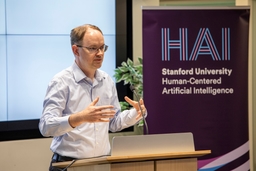

Five projects received a RAISE Health seed grant to support research and educational initiatives that advance responsible AI in biomedicine.
Five projects received a RAISE Health seed grant to support research and educational initiatives that advance responsible AI in biomedicine.


New Stanford tracker analyzes the 150 requirements of the White House Executive Order on AI and offers new insights into government priorities.
New Stanford tracker analyzes the 150 requirements of the White House Executive Order on AI and offers new insights into government priorities.


From patents to private funding, Stanford’s Global Vibrancy Tool aggregates 42 indicators to reveal which countries lead in AI – and why the U.S. holds a significant edge over other nations.
From patents to private funding, Stanford’s Global Vibrancy Tool aggregates 42 indicators to reveal which countries lead in AI – and why the U.S. holds a significant edge over other nations.


The new report covers major AI trends in technical advances, regulation, education, economics, and global politics.
The new report covers major AI trends in technical advances, regulation, education, economics, and global politics.
