
What is Machine Learning (ML)? | Stanford HAI
Stanford
University
  • Stanford Home
  • Maps & Directions
  • Search Stanford
  • Emergency Info
  • Terms of Use
  • Privacy
  • Copyright
  • Trademarks
  • Non-Discrimination
  • Accessibility
© Stanford University.  Stanford, California 94305.
Skip to content
  • About

    • About
    • People
    • Get Involved with HAI
    • Support HAI
    • Subscribe to Email
  • Research

    • Research
    • Fellowship Programs
    • Grants
    • Student Affinity Groups
    • Centers & Labs
    • Research Publications
    • Research Partners
  • Education

    • Education
    • Executive and Professional Education
    • Government and Policymakers
    • K-12
    • Stanford Students
  • Policy

    • Policy
    • Policy Publications
    • Policymaker Education
    • Student Opportunities
  • AI Index

    • AI Index
    • AI Index Report
    • Global Vibrancy Tool
    • People
  • News
  • Events
  • Industry
  • Centers & Labs

What is Machine Learning (ML)?

Machine Learning is a branch of artificial intelligence that enables computers to learn patterns and make decisions from data without being explicitly programmed with rules. Instead of following step-by-step instructions, ML algorithms analyze examples to identify patterns and improve their performance over time through experience. Common applications include email spam filters, recommendation systems, image recognition, voice assistants, and fraud detection.

Navigate
  • About
  • Events
  • Careers
  • Search
Participate
  • Get Involved
  • Support HAI
  • Contact Us

Stay Up To Date

Get the latest news, advances in research, policy work, and education program updates from HAI in your inbox weekly.

Sign Up For Latest News


Machine Learning mentioned at Stanford HAI

Explore Similar Terms:

Deep Learning | Artificial Intelligence (AI) | Supervised Learning

See Full List of Terms & Definitions

Enroll in a Human-Centered AI Course

This AI program covers technical fundamentals, business implications, and societal considerations.
Using Machine Learning To Help Refugees Succeed
Dylan Walsh
Nov 13
news

A new set of machine learning tools is helping countries place refugees where they’re most likely to find employment.


Using Machine Learning To Help Refugees Succeed

Dylan Walsh
Nov 13

A new set of machine learning tools is helping countries place refugees where they’re most likely to find employment.

Machine Learning
news
Using Machine Learning to Predict Rare Diseases
Prabha Kannan
Feb 02
news

The POPDx model eliminates the need for large patient datasets, giving it the potential to help patients with uncommon diseases.

Using Machine Learning to Predict Rare Diseases

Prabha Kannan
Feb 02

The POPDx model eliminates the need for large patient datasets, giving it the potential to help patients with uncommon diseases.

Healthcare
news
Battery Research Gets Machine Learning Boost
Glennda Chui
Mar 09
news

The latest advance from a research collaboration with industry could dramatically accelerate the development of sturdier batteries for fast-charging electric vehicles.

Battery Research Gets Machine Learning Boost

Glennda Chui
Mar 09

The latest advance from a research collaboration with industry could dramatically accelerate the development of sturdier batteries for fast-charging electric vehicles.

Machine Learning
news
A New Direction for Machine Learning in Criminal Law
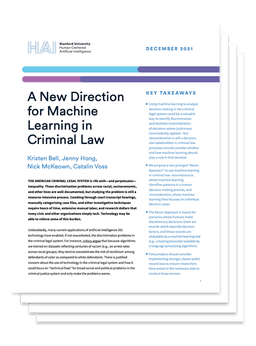
Kristen Bell, Jenny Hong, Nick McKeown, Catalin Voss
Quick ReadDec 01
policy brief

This brief proposes a machine learning approach to studying decision-making in the criminal legal system as a way to identify and reduce systemic inequalities.
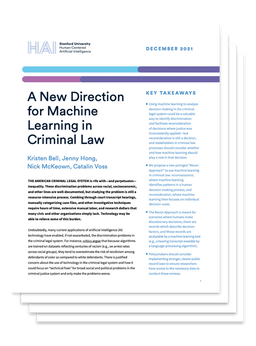
A New Direction for Machine Learning in Criminal Law

Kristen Bell, Jenny Hong, Nick McKeown, Catalin Voss
Quick ReadDec 01

This brief proposes a machine learning approach to studying decision-making in the criminal legal system as a way to identify and reduce systemic inequalities.

Law Enforcement and Justice
Machine Learning
policy brief
First-of-its-kind Stanford Machine Learning Tool Streamlines Student Feedback Process for Computer Science Professors
Isabel Swafford
Jul 27
media mention

Stanford professors develop and use an AI teaching tool that can provide feedback on students’ homework assignments in university-level coding courses; a previously laborious and time-consuming task.

First-of-its-kind Stanford Machine Learning Tool Streamlines Student Feedback Process for Computer Science Professors

Isabel Swafford
Jul 27

Stanford professors develop and use an AI teaching tool that can provide feedback on students’ homework assignments in university-level coding courses; a previously laborious and time-consuming task.

media mention
Beyond Algorithms: The Human Faces Driving Machine Learning Forward
Tech Times
Jul 25
media mention

HAI Co-Director Fei-Fei Li is recognized for her commitment to ethical AI and interdisciplinary research, continuing to shape the future of AI development and application.

Beyond Algorithms: The Human Faces Driving Machine Learning Forward

Tech Times
Jul 25

HAI Co-Director Fei-Fei Li is recognized for her commitment to ethical AI and interdisciplinary research, continuing to shape the future of AI development and application.

Ethics, Equity, Inclusion
Computer Vision
media mention
How a “Crazy Idea” Overturned the Conventional Rules of Machine Learning
Shana Lynch
Dec 08
news

Hogwild! challenged basic assumptions in early machine learning systems and helped develop a new field.

How a “Crazy Idea” Overturned the Conventional Rules of Machine Learning

Shana Lynch
Dec 08

Hogwild! challenged basic assumptions in early machine learning systems and helped develop a new field.

Machine Learning
news