A New Direction for Machine Learning in Criminal Law
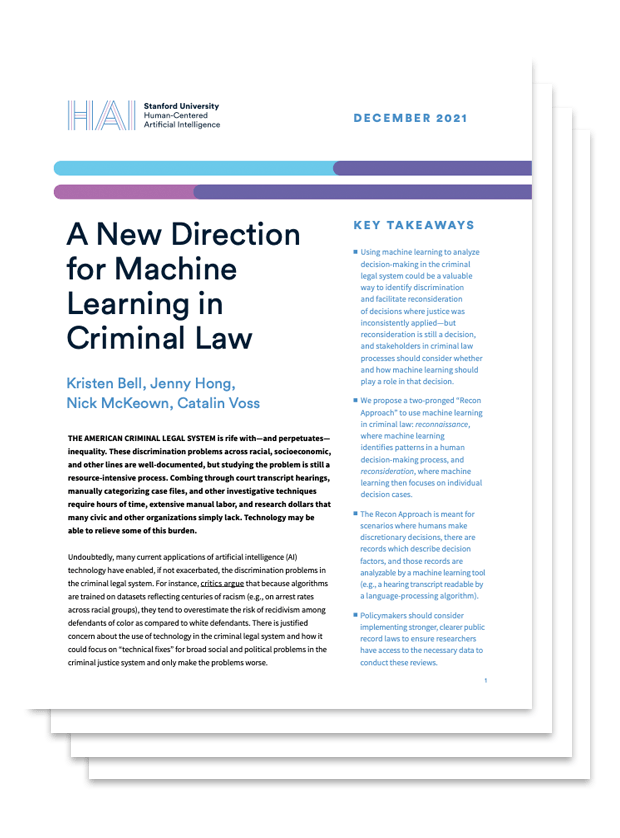
This brief proposes a machine learning approach to studying decision-making in the criminal legal system as a way to identify and reduce systemic inequalities.
Key Takeaways
Using machine learning to analyze decision-making in the criminal legal system could be a valuable way to identify discrimination and facilitate reconsideration of decisions where justice was inconsistently applied—but reconsideration is still a decision, and stakeholders in criminal law processes should consider whether and how machine learning should play a role in that decision.
We propose a two-pronged “Recon Approach” to use machine learning in criminal law: reconnaissance, where machine learning identifies patterns in a human decision-making process, and reconsideration, where machine learning then focuses on individual decision cases.
The Recon Approach is meant for scenarios where humans make discretionary decisions, there are records which describe decision factors, and those records are analyzable by a machine learning tool (e.g., a hearing transcript readable by a language-processing algorithm).
Policymakers should consider implementing stronger, clearer public record laws to ensure researchers have access to the necessary data to conduct these reviews.
Executive Summary
The American criminal legal system is rife with—and perpetuates— inequality. These discrimination problems across racial, socioeconomic, and other lines are well-documented, but studying the problem is still a resource-intensive process. Combing through court transcript hearings, manually categorizing case files, and other investigative techniques require hours of time, extensive manual labor, and research dollars that many civic and other organizations simply lack. Technology may be able to relieve some of this burden.
Undoubtedly, many current applications of artificial intelligence (AI) technology have enabled, if not exacerbated, the discrimination problems in the criminal legal system. For instance, critics argue that because algorithms are trained on datasets reflecting centuries of racism (e.g., on arrest rates across racial groups), they tend to overestimate the risk of recidivism among defendants of color as compared to white defendants. There is justified concern about the use of technology in the criminal legal system and how it could focus on “technical fixes” for broad social and political problems in the criminal justice system and only make the problems worse.
In our new paper, we propose using machine learning (ML) to analyze decision-making in the criminal legal system. Instead of using ML to assess those being put through the system, we argue for using ML to analyze decisions that people in power have already made— thereby bringing increased transparency to those decisions, identifying patterns, and shining a light to help people see potential injustices. The aim is not to predict human behavior or replace human decision-making, but to better understand the factors that led to past decisions in the hopes of facilitating increased fairness and consistency in how criminal law is applied. We call it the “Recon Approach.”
Related Publications
Improving Transparency in AI Language Models: A Holistic Evaluation

This brief introduces Holistic Evaluation of Language Models (HELM) as a framework to evaluate commercial application of AI use cases.
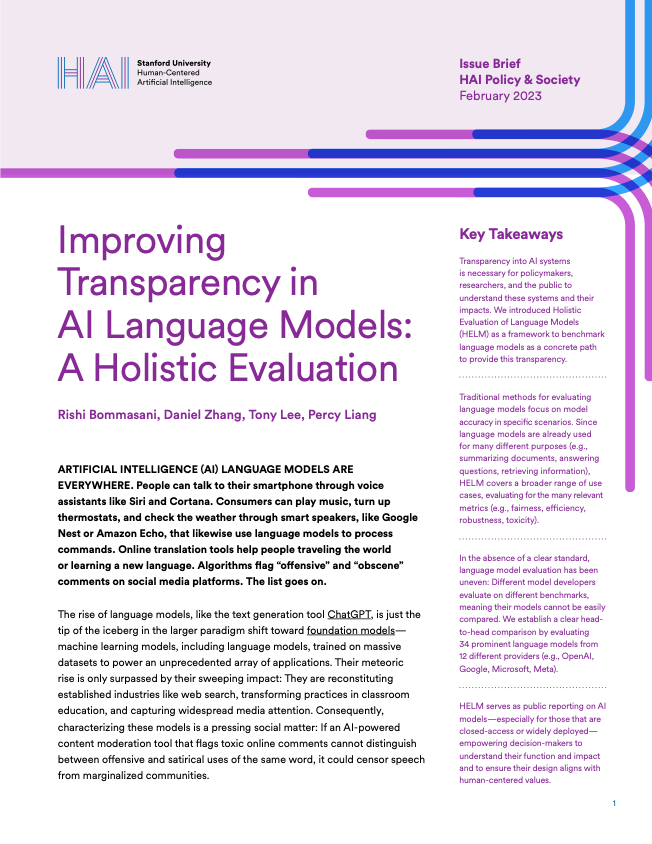
This brief introduces Holistic Evaluation of Language Models (HELM) as a framework to evaluate commercial application of AI use cases.
Promoting Algorithmic Fairness in Clinical Risk Prediction
-1.png&w=256&q=80)
This brief examines the debate on algorithmic fairness in clinical predictive algorithms and recommends paths to safer, more equitable healthcare AI.
-1.png&w=1080&q=100)
This brief examines the debate on algorithmic fairness in clinical predictive algorithms and recommends paths to safer, more equitable healthcare AI.
This explainer provides brief definitions for key terms associated with artificial intelligence, ranging from autonomous systems to deep learning and foundation models.
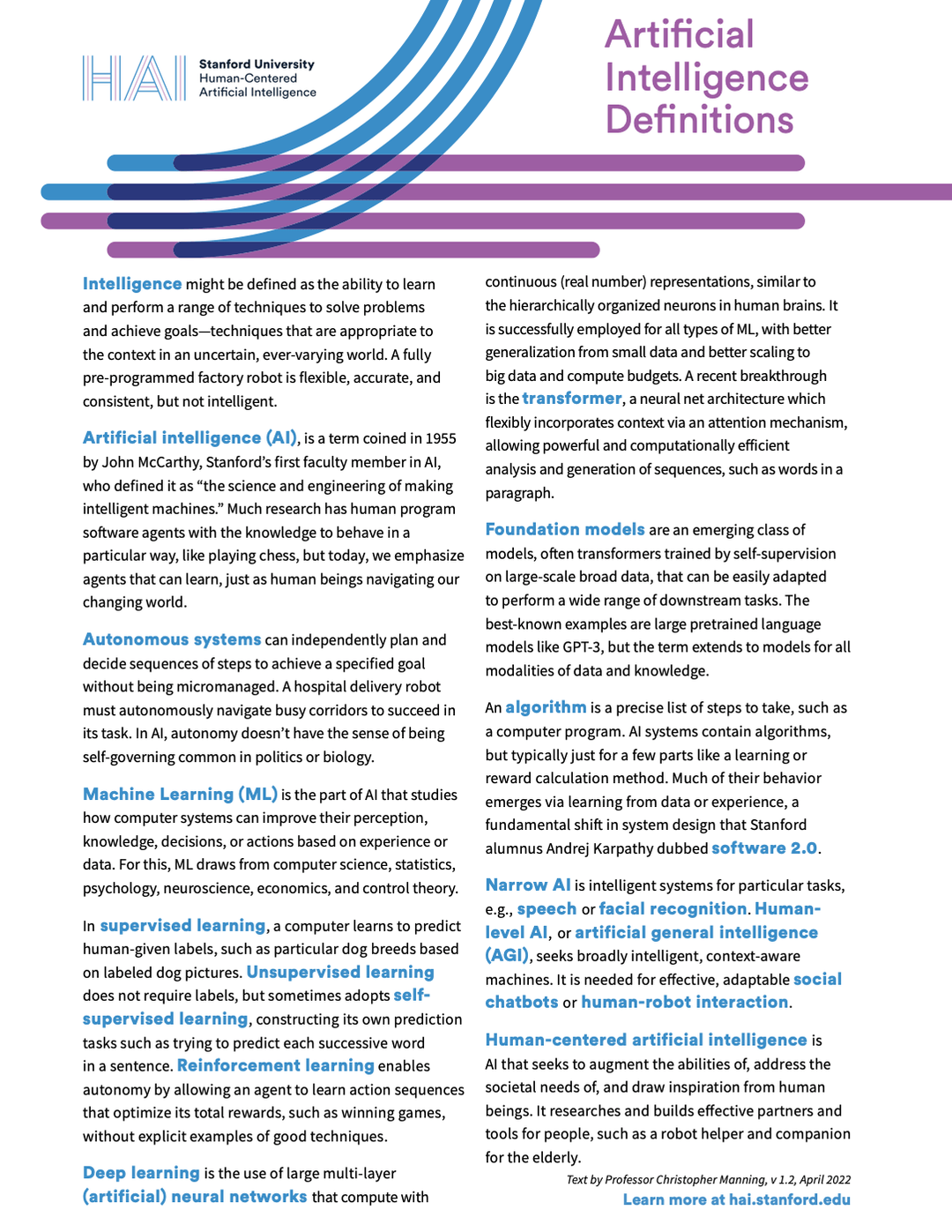
This explainer provides brief definitions for key terms associated with artificial intelligence, ranging from autonomous systems to deep learning and foundation models.
Response to FDA’s Request for Feedback on Considerations for the Regulation of GenAI-Enabled Medical Devices
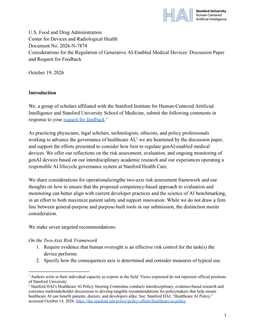
Stanford scholars respond to a federal request for feedback, offering policy recommendations for the regulation of generative AI-enabled medical devices.
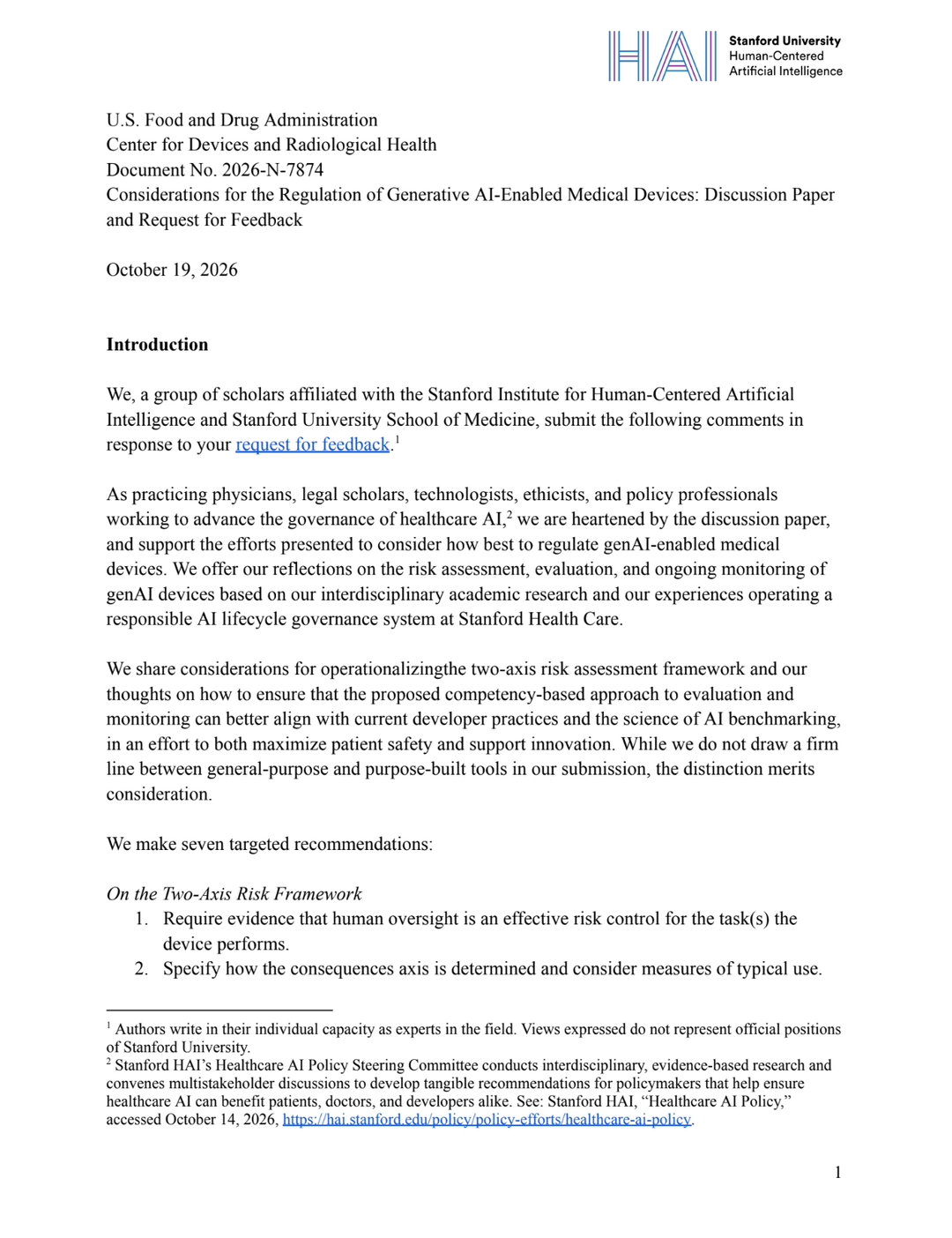
Stanford scholars respond to a federal request for feedback, offering policy recommendations for the regulation of generative AI-enabled medical devices.